Table of Contents
The SCOTUS Ruling
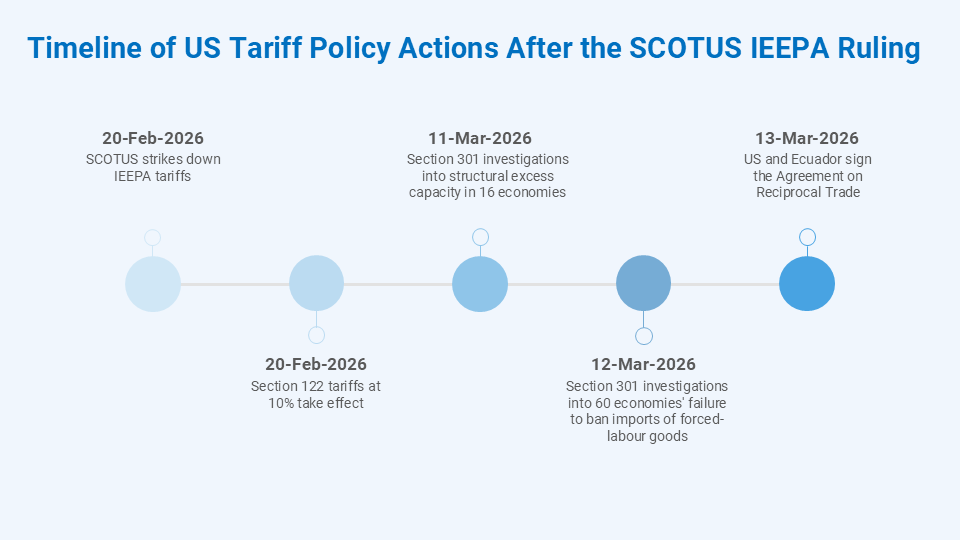
The Supreme Court’s ruling struck down the use of IEEPA as a basis for tariffs, triggering an immediate reconfiguration of the US tariff regime. This analysis sets out what the ruling means and quantifies the tariff impact.
Quantifies the tariff impact of the ruling. The trade-weighted average US tariff falls to 8.1%. Country- and product-level datasets are available for download.
Section 122: The Replacement Regime
These analyses explain what the Section 122 replacement regime looks like, which countries and sectors are most affected, and how the exemption structure compares with its IEEPA predecessor.
A side-by-side comparison of the two regimes: the flat surcharge replacing country-specific rates, the fate of bilateral deals, and the pivot to Sections 232 and 301.
Country- and product-level estimates of the Section 122 regime. Winners and losers identified by country and sector, with data for all economies available for download.
The product exemptions under Section 122 are nearly identical to those under IEEPA. Includes a downloadable comparison spreadsheet.
Only a small share of tariff carve-outs in bilateral deals were truly country-specific. With the move to Section 122, the product exemptions that disappear covered an estimated USD 8.6 billion in imports.
Section 232: The Backbone of Bilateral Deals
The bilateral concessions that mattered commercially were built on Section 232, not IEEPA. Negotiated rate reductions under Section 232 covered USD 213 billion in trade across four countries. Eight new investigations are underway and four implemented tariffs are expanding product coverage. These analyses explain why Section 232 was already central to US tariff policy before the ruling and where it is heading next.
Eight investigations are currently underway covering pharmaceuticals, critical minerals, commercial aircraft, drones, polysilicon, wind turbines, robotics, and medical devices. Four implemented tariffs are also expanding product coverage.
Section 232 rate modifications covered USD 213 billion in trade with the EU, Japan, Korea, and the UK. This is roughly 25 times the value of IEEPA product carve-outs.
A procedural overview of the two authorities: triggers, processes, scope, possible actions, and durability.
Section 301: The Next Front
Section 301 is already active on multiple fronts. Tariffs from the 2017 Chinese intellectual property investigation remain in force and several new investigations are underway. On 11 March 2026, investigations targeting excess capacity across 16 economies were launched. Further investigations into 60 economies' failure to ban imports of forced-labour goods have since been announced. These analyses explain who is exposed, what the pipeline looks like, and where Section 301 may be heading.
Examines the scope of the new Section 301 investigations launched on 11 March 2026 targeting structural excess capacity across manufacturing sectors in 16 economies.
Maps the USTR’s 2025 National Trade Estimate report against concern themes highlighted by Ambassador Greer. Indonesia is the most exposed jurisdiction, followed by China, Vietnam, the EU, India, and the Philippines.
The current state of Section 301 tariffs and the next round of actions. Six investigations have status either implemented, postponed, approved, or ongoing, with at least four additional investigations under active consideration.