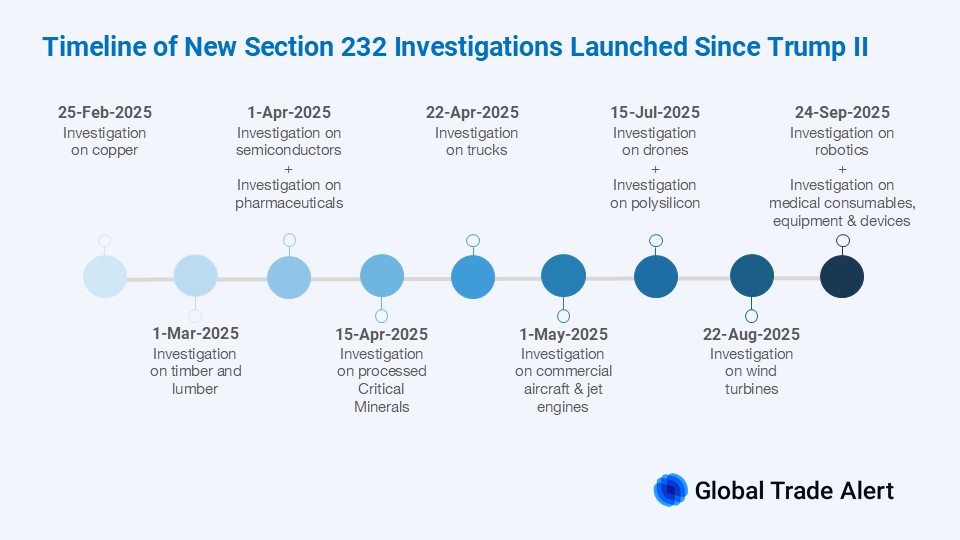
After the Supreme Court repealed IEEPA tariffs on 20 February 2026, USTR Jamieson Greer named the path forward: Sections 122, 301, and 232. For Section 232, his message was continuity: maintain existing tariffs and conclude ongoing investigations. But Section 232 had never stopped expanding. Since February 2025, the Trump administration issued 20 policy announcements launching, relaunching, or expanding Section 232 investigations. A rolling inclusions process is adding new products to the existing tariff scope. This explainer covers what is in force, expanding, and pending.
From Steel to Semiconductors: What Is Already in Force
The Trump administration inherited three active Section 232 investigations. Steel and aluminium tariffs, first imposed in 2018, were increased, reaching 50% for most jurisdictions in June 2025. The product scope of the aluminium and steel tariffs also expanded. The investigation on automobiles and parts, also initiated in 2018, concluded with 25% tariffs. Canada and Mexico received preferential treatment under USMCA.
Four investigations launched in 2025 have already produced tariffs. These cover copper (50% since August 2025), timber and lumber (10–25% since October 2025), trucks and buses (25%-10% since November 2025) and semiconductors (25% since January 2026). The semiconductor tariff excludes US data centres, R&D, and consumer applications.
An Ever-Expanding Perimeter
The product scope of existing Section 232 tariffs is not fixed. Several founding proclamations let the Secretary of Commerce add products to the tariff scope on a rolling basis. Investigations that currently include inclusion processes are steel and aluminium, automobile parts, copper, and timber and lumber.
The steel and aluminium inclusions process operates on a triannual cycle, opening in May, September, and January. The September 2025 round offers the clearest picture of the scale at stake. On 7 October 2025, BIS published 95 requests covering 695 HS codes. These products represented USD 287 billion in US imports in 2024. Of that, USD 114 billion covers products not previously subject to 232 tariffs. The affected products included aircraft engine parts, certain articles of plastic and food packaging, among others.
The automobile parts inclusion process runs quarterly, with windows in January, April, July, and October. The January 2026 round drew 11 applications covering 10 HS codes at the 10-digit level. The US import value of these goods in 2024 was USD 14 billion. Product categories range from hydraulic motors and compressor parts to thermostats and plastic fittings.
At the time of writing, no official rollout of the inclusions mechanism has been announced for the lumber and copper investigations. However, Proclamation 10962 (copper, July 2025) and Proclamation 10976 (timber and lumber, September 2025) authorise the Secretary to add derivative products.
The Pipeline
Section 232 is not done growing. Eight investigations launched in 2025 remain open, spanning 214 six-digit HS codes. The sectors under active investigation are:
According to US ITC data, the import value of these goods in 2024 was ca. USD 656 billion.
These investigations extend national security tariffs well beyond traditional industrial inputs. Commercial aircraft parts alone represented USD 52 billion in US imports in 2024, while robotics and industrial machinery accounted for USD 43 billion. When Commerce finds a national security threat, the President can impose tariffs by proclamation. Congress need not approve, and judicial review is limited.
What to watch
Section 232 enters the post-IEEPA period as an authority already in motion, not a hastily assembled substitute. Existing tariffs now cover steel and aluminium and their derivatives, autos and parts, trucks, copper, lumber, and semiconductors. Inclusions processes can expand the product scope of existing tariffs. Eight investigations remain unresolved. The question is not whether Section 232 will generate new trade restrictions in 2026; it is how many and across which sectors.