The US Supreme Court struck down IEEPA tariffs on 20 February 2026. Within hours, USTR Jamieson Greer identified Section 301 as one of three authorities to carry the Trump Administration's tariff agenda forward, committing to launch several new investigations under the instrument. Section 301 is well-suited to that role. It requires no national security finding and imposes no statutory cap on tariff rates. This explainer maps what Section 301 tariffs are already in place, how their scope can shift, and what the next round of measures looks like.
What Section 301 Is Already Doing
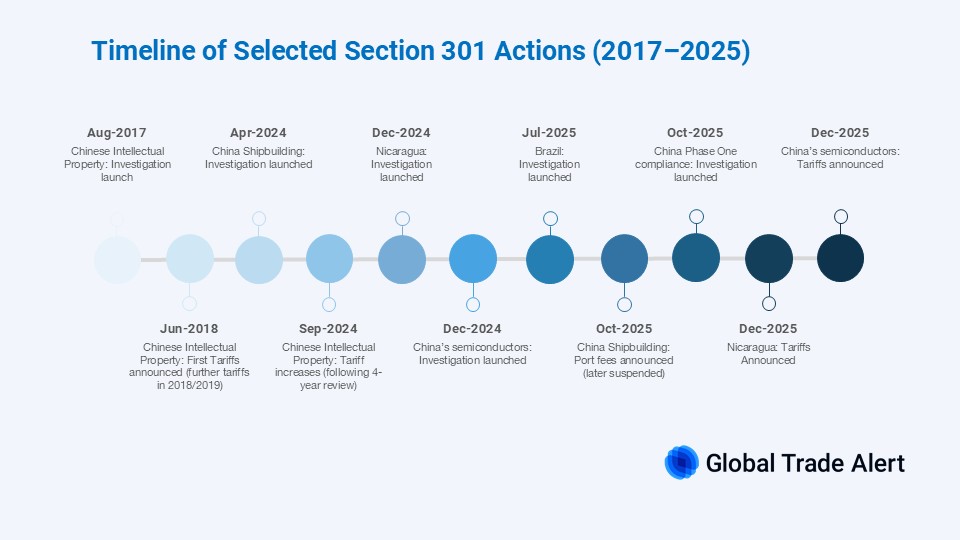
Tariffs linked to the Chinese Intellectual Property (IP) investigation launched in 2017 are still in force. These duties target Chinese policies on technology transfer, intellectual property, and innovation that the United States Trade Representative (USTR) determined harm US commerce. They have affected approximately USD 370 billion annually since 2019. The duties targeted different product lists and set tariffs originally ranging between 15% and 25%, depending on the product. The Phase One deal led to a tariff reduction to 7.5% for several products. The 2022 four-year statutory review extended all product lists and added targeted rate increases of up to 100% on strategic sectors, including solar cells, batteries, electric vehicles, steel and aluminium products, ship-to-shore cranes, and syringes.
The USTR concluded the investigation into China's maritime, logistics, and shipbuilding sectors. In October 2025, Customs and Border Protection (CBP) announced port fees on Chinese-built or Chinese-operated vessels. However, following the US-China trade deal announced on 1 November 2025, the USTR suspended the action for one year until 9 November 2026.
Two additional Section 301 actions are on the books but not yet in effect. The USTR adopted an action targeting China’s semiconductor industry practices, with duties scheduled to take effect in 2026. A separate action against Nicaragua targets labour practices and also carries a future implementation date.
Built to Be Modified
Section 301 actions are not static. The USTR can modify an existing action at any time by adding or removing products, adjusting tariff rates, or suspending duties. The process moves fast when the USTR wants it to. In November 2025, the USTR proposed suspending the maritime sector action and allowed approximately one day for public comment.*
The statutory four-year review under Section 307(c) provides the primary structured checkpoint. Every four years, the USTR must assess whether an existing Section 301 action should continue, based on its effectiveness and economic impact. The review process does not restrict USTR’s ability to introduce exclusions, suspensions, or other modifications at other times. The 2022 review of the China IP tariffs exemplifies this process.
Product exclusions provide another mechanism for adjusting scope. The USTR can grant temporary exemptions from additional duties, either in response to industry petitions or as part of broader diplomatic agreements. The active China IP investigation illustrates how this works in practice. During the COVID-19 pandemic, the Administration announced temporary exclusions on medical products.
The Pipeline
There are four active investigations under Section 301. For these investigations, the USTR is still gathering evidence, consulting stakeholders, and assessing whether a determination of unfair trade practice is warranted. The first investigation concerns trade practices by Brazil. This investigation covers a wide range of Brazil's trade-related acts, policies, and practices, including digital taxes, IP protection, weak anti-corruption enforcement and import barriers to US ethanol. The second investigation examines whether China has fulfilled its commitments under the Phase One trade agreement signed in January 2020. A finding of non-compliance could justify new or expanded tariff actions on top of the existing China IP measures. On 11 March 2026, USTR also launched an investigation related to structural excess capacity and production in manufacturing sectors. This investigation affects 16 jurisdictions. A day later, Washington launched another investigation to prohibit imports of goods produced with forced labour. This investigation focuses on 60 of the U.S. trading partners, which collectively accounted for more than 99% of U.S. imports in 2024.
Possible, Not Certain
Several potential Section 301 investigations are under active consideration. The White House has signalled interest in examining practices of major seafood-producing countries. The USTR has publicly flagged Chinese practices in the apparel sector as a possible target. A petition has been filed concerning Korea’s practices related to the e-commerce platform Coupang. The Administration also announced it would evaluate launching investigations into digital service taxes levied by foreign governments. Ambassador Greer, in his post-IEEPA-ruling speech, also referred to several other areas of concern. These included “industrial excess capacity, forced labour, pharmaceutical pricing practices, discrimination against U.S. technology companies and digital goods and services, digital services taxes, ocean pollution, and practices related to the trade in seafood, rice, and other products”.
The return of the Super 301 authority is another possibility. The original Super 301, enacted in 1988, required USTR to identify priority countries and mandatorily open Section 301 investigations if barriers persisted. Congress created the original mandate; President Clinton revived it three times via executive order. A similar mechanism already exists for intellectual property under the Special 301 process. The Trade Facilitation and Trade Enforcement Act (TFTEA) of 2015 required the USTR to develop action plans with benchmarks for persistent Priority Watch List countries. A new Super 301 could extend this mandatory escalation logic beyond intellectual property.
What to Watch
Section 301 is not pausing. Active investigations, suspended actions, and new White House signals point in one direction. The question is not whether Section 301 will generate new trade restrictions in 2026. It is how many, across which sectors and who will be targeted.