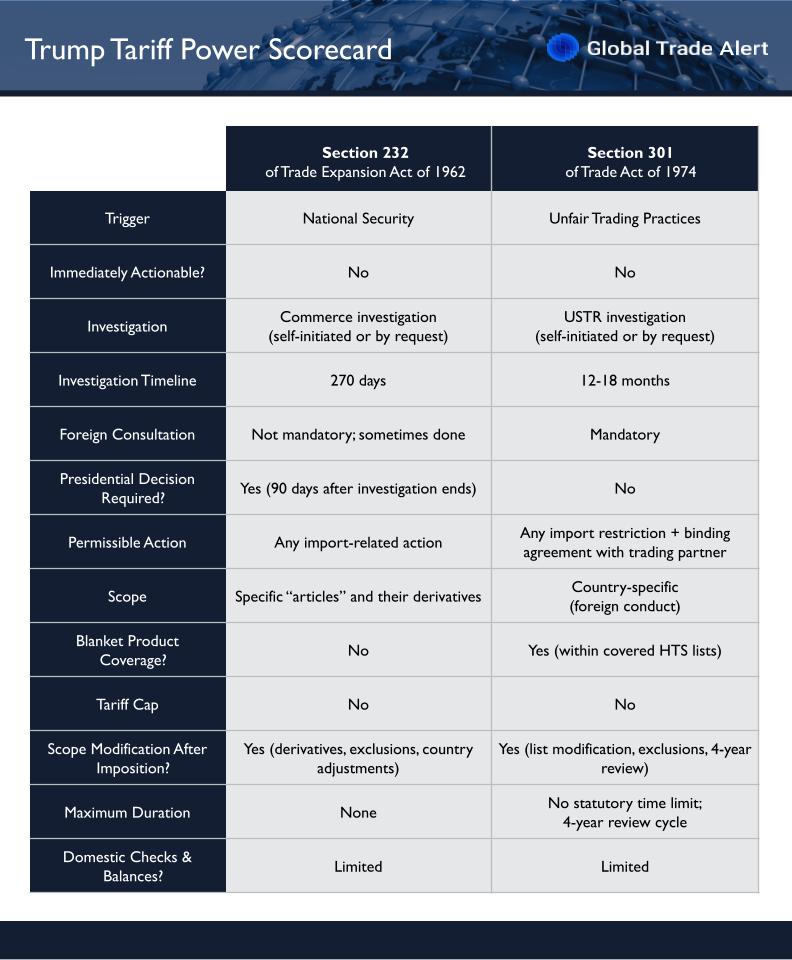
IEEPA reciprocal tariffs are gone. A Section 122 surcharge now fills the gap, but it expires in 150 days. The Trump administration has committed to rebuilding its tariff architecture on two more durable foundations: Sections 232 and 301. U.S. Trade Representative Jamieson Greer has described them as "very durable tools" that can stay in place for “as long as needed."
Greer has indicated that the administration intends to maintain existing 232 tariffs and conclude ongoing investigations. It also plans to initiate a broad wave of new 301 investigations covering most major trading partners. This explainer outlines the procedural mechanism of both authorities.
Section 232 Investigations - National Security
The trigger. Section 232 of the Trade Expansion Act of 1962 allows the President to “adjust imports” that threaten U.S. national security. The statute leaves "national security" undefined. The Bureau of Industry and Security (BIS) within the Department of Commerce conducts Section 232 investigations. Investigations may be initiated by application from an interested party, by request from the head of any department or agency, or by the Secretary of Commerce on their own initiative.
The process. BIS has 270 days to deliver a report to the President. Consultation with "appropriate officers” is mandatory. Public input should be allowed if "appropriate and after reasonable notice”. If Commerce determines that there is a threat to U.S. national security, the President then has 90 days to decide whether to act and an additional 15 days to implement any measure chosen.
The action. Section 232 authorises the President to "adjust imports" of an article and its derivatives once a national security threat has been identified. In practice, this has mostly meant tariffs and quota arrangements. The statute sets no numeric ceiling on tariff rates. Although investigations are product-based, measures need not apply uniformly across countries. The President may impose global tariffs, exempt specific countries, or substitute country-specific quota arrangements.
The scope. Section 232 measures apply to the article under investigation and its derivatives. Coverage is defined in the presidential proclamation and implemented through tariff classifications and related instruments. Measures may take the form of tariffs, quotas, or tariff-rate quotas (TRQs), and may be structured globally or with country-specific arrangements.
The scope modifications. The scope of Section 232 measures is not fixed at the time of imposition. Coverage may extend to additional derivative products, and recent proclamations have delegated authority to the Secretary of Commerce to add such products following established procedures. Separate exclusion procedures allow individual importers to seek relief, typically based on domestic unavailability or national security concerns. The President may also exempt specific countries, replace tariffs with country-specific quota arrangements or TRQs, or suspend duties under negotiated agreements.
The durability. Section 232 has no statutory time limit. Measures remain in force indefinitely unless the President acts to change them. The steel and aluminium tariffs imposed in 2018 confirm this. They remain substantially in force in 2026, having survived legal challenge and a change of administration.
The domestic checks and balances. Section 232 requires procedural reporting to Congress about actions taken. Courts have upheld the statute against constitutional challenge and have applied broad deference to presidential national security determinations. In its IEEPA ruling, the U.S. Supreme Court also confirmed that Section 232 contains “sweeping, discretion-conferring language that IEEPA does not contain”
Section 301 Investigations - Unfair Trade Practices
The trigger. Section 301 of the Trade Act of 1974 allows the Office of the United States Trade Representative (USTR) to investigate foreign government practices that burden US commerce. These include violations of trade agreements and conduct that is unjustifiable, unreasonable, or discriminatory. The statute also covers conduct even where no international legal rule has been violated. Any interested party can petition; USTR must decide within 45 days whether to proceed. USTR can also self-initiate.
The process. A Section 301 Committee administers the investigation under USTR's direction. Consultation with the targeted foreign government is mandatory from the outset. The investigation must conclude within 12 months for non-treaty cases and within 18 months for treaty-based ones. USTR then determines whether the foreign measure is actionable. In certain cases, action is mandatory under the statute; in others, USTR retains discretion as to whether and how to respond.
The action. Section 301 authorises USTR to impose tariffs or other import restrictions, suspend or withdraw trade agreement concessions, or enter into a binding agreement with the foreign government. Such an agreement may require the foreign government to cease the offending conduct or compensate the United States. Tariffs have been the principal instrument in practice. Where action is mandatory, the level of retaliation must be equivalent in value to the burden imposed on U.S. commerce. In discretionary cases, USTR retains discretion over both the form and level of the response.
The scope. Section 301 actions are country-specific by design. Determinations target the acts or policies of a named foreign government, and retaliatory measures apply only to imports from that country. However, the statute places no limitation on the subject matter of investigations. “Commerce” is defined broadly to include goods, services, and investment. USTR has used this authority to investigate digital trade practices, forced technology transfer, and industrial dominance, sometimes across multiple countries in parallel proceedings.
The scope modifications. Once imposed, coverage is defined through published tariff lists identifying specific HTSUS subheadings. USTR may modify these lists by adding or removing products or adjusting duty rates, typically following notice and comment. Exclusion procedures allow product-specific relief, generally time-limited and applicable to all importers of the covered product. Section 301 actions are also subject to a statutory four-year review, after which measures terminate unless continuation is requested. As a result, Section 301 measures may evolve through list modifications, negotiated arrangements, or statutory review.
The durability. Section 301 actions do not contain a general automatic sunset. However, four years after an action takes effect, it must terminate unless a domestic industry representative requests continuation. If such a request is filed, USTR conducts a statutory review, including public input, to determine whether continuation remains appropriate. USTR is also required to monitor foreign compliance and may modify or escalate measures if obligations are not met.
The domestic checks and balances. Section 301 requires post-action reporting to Congress for certain foreign export targeting measures. The precise procedural constraints applicable to Section 301 actions are the subject of ongoing litigation. Courts have generally upheld USTR’s authority under the statute. However, the Federal Circuit in September 2025 indicated that standard APA (Administrative Procedure Act) notice-and-comment requirements apply. USTR disputes this interpretation, and a petition for Supreme Court review was filed in February 2026.