The deal landscape
At least fifteen countries struck bilateral deals with the United States under IEEPA. Not all produced documents from which product-level concessions can be extracted. This analysis covers ten countries with written agreements listing product-specific exceptions: the EU, Switzerland, Indonesia, Malaysia, Chinese Taipei, El Salvador, Guatemala, Argentina, Cambodia, and Bangladesh. Of these, only the EU and Swiss deals were implemented in the US tariff schedule before the Supreme Court invalidated the IEEPA tariffs on 20 February 2026.
Three further countries engaged bilaterally without product-specific carve-outs. The United Kingdom signed a formal agreement focused on Section 232 steel and aluminium rate modifications. Japan and Korea produced joint statements with the same Section 232 focus. None of the three included product exception lists. Their deals operated through a different channel entirely, to which a subsequent analysis returns.
Several other countries produced joint statements too preliminary to assess: Ecuadro, India, North Macedonia, Thailand, and Viet Nam have yet to advance to formalised agreements.
The country-specific share
The central finding is how little of the bilateral trade covered by these deals was actually country-specific.
The EU's deal covered 1,580 product codes worth $248.5 billion in annual US imports. Under Section 122, Annex II exempts 1,209 of those codes. The remaining 371 codes represent $4.58 billion, or 1.8 per cent of the total. The EU negotiated a quarter-trillion dollars in bilateral trade coverage; nearly all was already available on a most-favoured-nation basis.
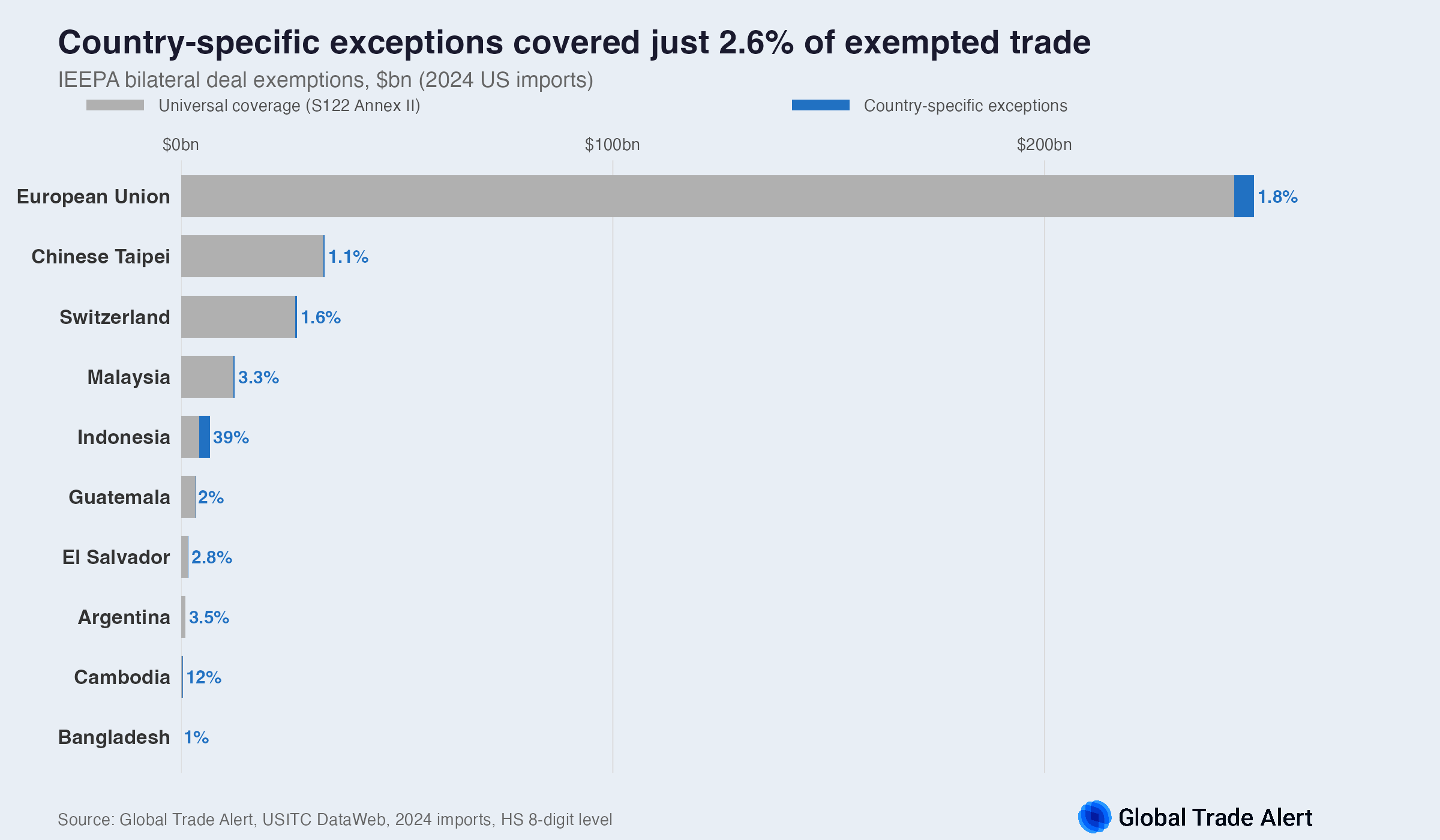
The same pattern holds across most deal partners. Switzerland's deal covered $26.9 billion; only $435 million (1.6 per cent) was country-specific. Chinese Taipei: $33.2 billion covered, $360 million specific (1.1 per cent). Malaysia: $12.5 billion covered, $410 million specific (3.3 per cent).
Indonesia stands apart. Its deal covered $6.7 billion, of which $2.63 billion (39 per cent) was country-specific. Indonesia's exception list targeted palm oil, rubber, and natural resource products that do not appear in S122's universal exemptions. Cambodia's deal covered approximately $410 million; 12 per cent ($49 million) was country-specific. For the Central American countries, Guatemala and El Salvador, the high total code counts (3,485 and 3,450 respectively) reflect the inclusion of 1,746 CAFTA-DR textile codes, of which 1,587 migrated to S122's CAFTA textile provision. Their deal-specific products were almost entirely agricultural: coffee, fruit, and plants.
Argentina ($35 million), El Salvador ($45 million), Guatemala ($71 million), and Bangladesh (negligible trade value) round out the pending deals with small country-specific exposures.
| Country |
Total US imports ($bn) |
Deal coverage |
Still exempt (S122) |
No longer exempt |
| Products (count) |
Value ($bn) |
Products (count) |
Value ($bn) |
Products (count) |
Value ($bn) |
| EU |
600.8 |
1,580 |
248.5 |
1,209 |
244.0 |
371 |
4.58 |
| Chinese Taipei |
115.3 |
1,741 |
33.2 |
1,294 |
32.9 |
447 |
0.36 |
| Switzerland |
63.3 |
1,681 |
26.9 |
1,218 |
26.4 |
463 |
0.43 |
| Malaysia |
51.7 |
1,711 |
12.5 |
1,278 |
12.0 |
433 |
0.41 |
| Indonesia |
28.0 |
1,819 |
6.7 |
1,342 |
4.1 |
477 |
2.63 |
| Guatemala |
5.0 |
3,485 |
3.5 |
2,885 |
3.4 |
600 |
0.07 |
| El Salvador |
2.3 |
3,450 |
1.6 |
2,863 |
1.6 |
587 |
0.05 |
| Argentina |
7.1 |
1,675 |
1.0 |
1,253 |
1.0 |
422 |
0.03 |
| Cambodia |
12.6 |
1,875 |
0.4 |
1,389 |
0.4 |
486 |
0.05 |
| Bangladesh |
8.3 |
1,633 |
0.0 |
1,218 |
0.0 |
415 |
0.00 |
| Total |
894.4 |
|
334.3 |
|
325.8 |
|
8.61 |
Source: GTA product-level tracking of US tariff regimes. Trade values: USITC DataWeb, 2024 US imports.
What these exceptions meant
Small aggregate numbers mask real impacts for individual industries. At the product level, these carve-outs shielded specific supply chains.
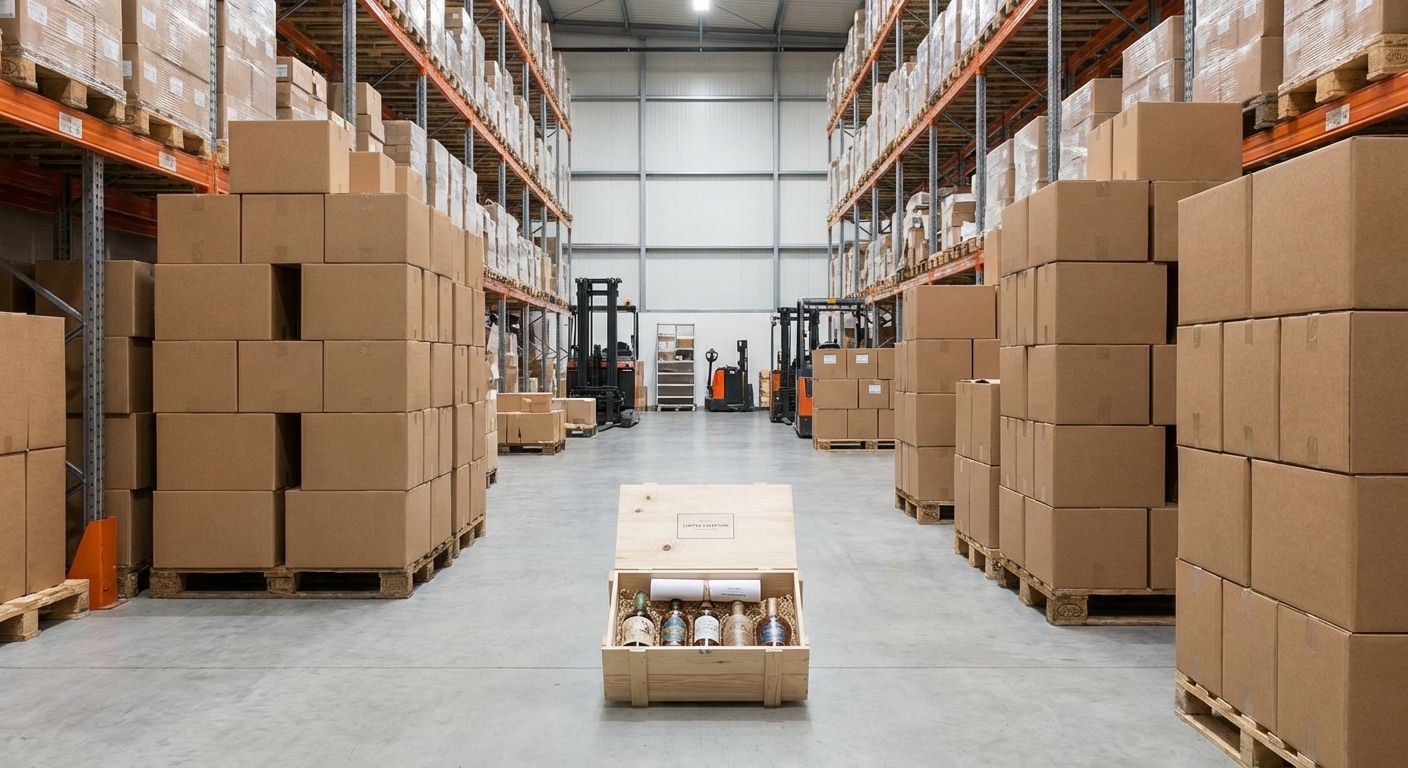
The EU's 37 non-pharmaceutical lost codes include products such as natural cork, certain prepared foods, and speciality chemicals. Natural cork is heavily used by American wine producers, for whom European suppliers are the primary source. For the industries behind each of these product codes, the loss of bilateral exemption is material.
Indonesia's case is different: $2.63 billion in palm oil, rubber, and resource products represents a significant bilateral stake, not a marginal carve-out. Had Indonesia's deal taken effect, the exemptions would have covered a meaningful share of its US export base.
But across all ten countries, country-specific exceptions totalled $8.6 billion of $334 billion in exempted trade, or 2.6 per cent. A caveat: this analysis treats S122's Annex II as a fixed baseline. The bilateral negotiating process itself may have shaped what ended up on the universal list. What is clear is that the product-level overlap between bilateral deals and S122 was extensive.
Generalising preferences in non-patented pharma and aircraft
The country-specific share appears small partly because the largest single category of 'deal' concessions was not bilateral for long. All ten tariff deals included long lists of pharmaceutical codes for non-patented (generic) medicines. Of these 334 codes are now absent from S122's Annex II. But their presence in every deal was uniform, suggesting the list of product negotiation mass released in September was the standard template. The aircraft exemptions, also part of several deals, were completely included in general exemptions eventually.
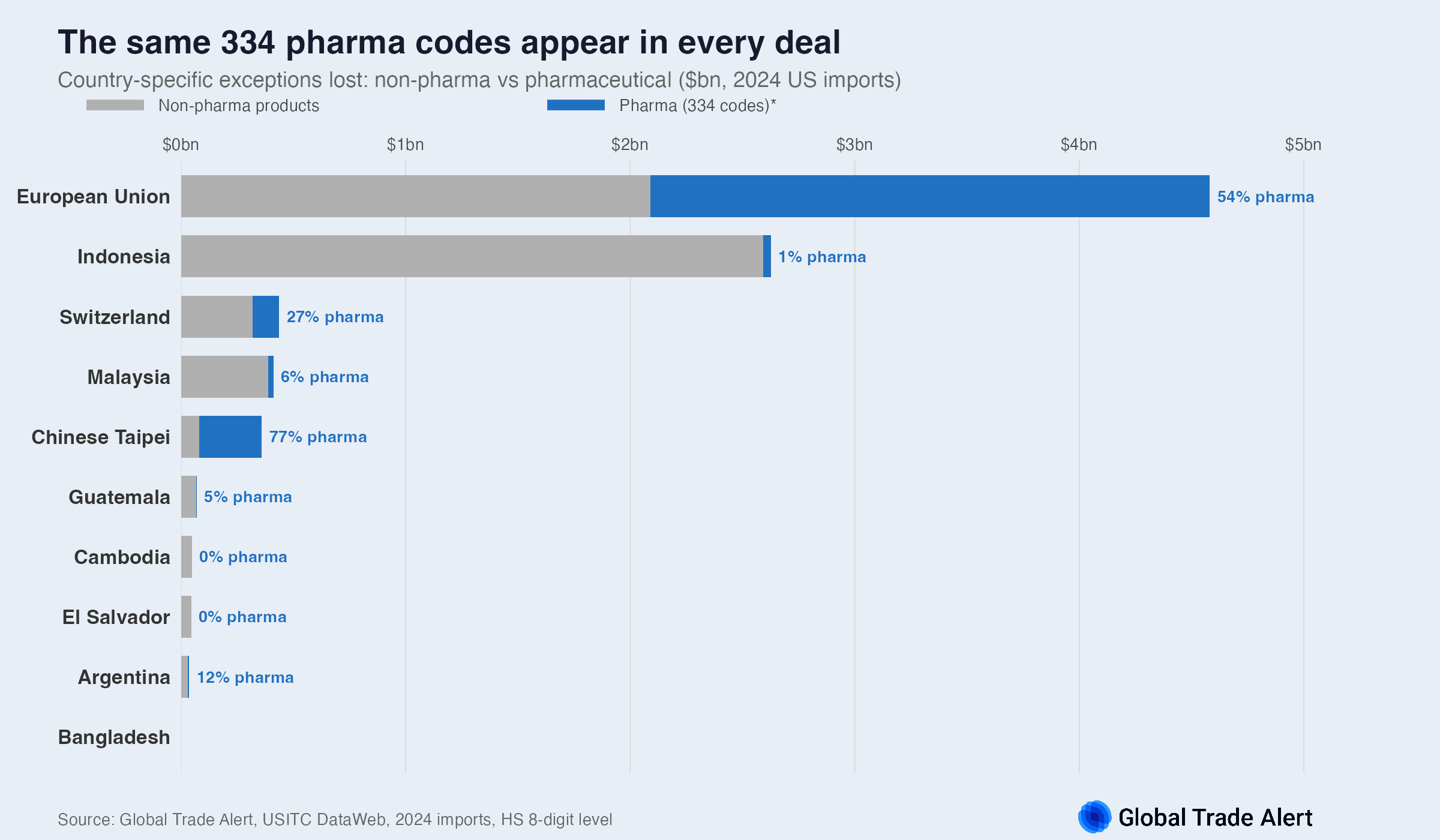
For the EU, the pharma codes account for $2.49 billion of the $4.58 billion in country-specific trade. However, this headline number does not reveal how much of the pharmaceutical exports in these product codes were actually subject to the exception. The exception for the pharma products only applied to the generic pharma exports. Branded products and their components were still subject to the IEEPA tariffs.
Where was the emphasis?
The UK, Japan, and Korea negotiated bilateral deals without product-specific exception lists. Their deals focused on Section 232 rate modifications for auto, steel and aluminium. The absence of product lists from these three advanced economies — all major US trading partners — is consistent with the pattern in the product-exception deals: the bilateral product-level content was narrow. Whether they focused on Section 232 because rate modifications offered greater economic value, or because universal exemptions already covered most product requests, this analysis cannot determine.