When the US Supreme Court struck down the IEEPA tariffs, Treasury Secretary Bessent immediately identified three statutes as replacements for the invalidated architecture: Section 122 as a temporary bridge, Section 232 for national security tariffs, and Section 301 for unjustified, unreasonable, or discriminatory foreign actions that burden US commerce. [1]
On the same day, US Trade Representative (USTR) Ambassador Greer provided a cue in announcing seven investigation themes. His office would address “industrial excess capacity, forced labor, pharmaceutical pricing practices, discrimination against U.S. technology companies and digital goods and services, digital services taxes, ocean pollution, and practices related to the trade in seafood, rice, and other products.” [2]
This piece tries to identify where the administration is likely to look, and at whom. The National Trade Estimate (NTE) Report on Foreign Trade Barriers is USTR's annual statutory record of foreign barriers to American exports and investment. [3] The findings map the 2025 NTE report to Greer's themes across 25 priority jurisdictions, including the G20, tariff deal partners and major import origins. The analysis focuses on "named measures" (i.e. specific regulations cited by statute or instrument name), because these are ready-to-use material for trade investigations. We have also included a section regarding "unknown measures", which covers practices the US has formally flagged as concerning.
What concerns are raised
Greer listed seven topics, but not all carry equal weight in the NTE.
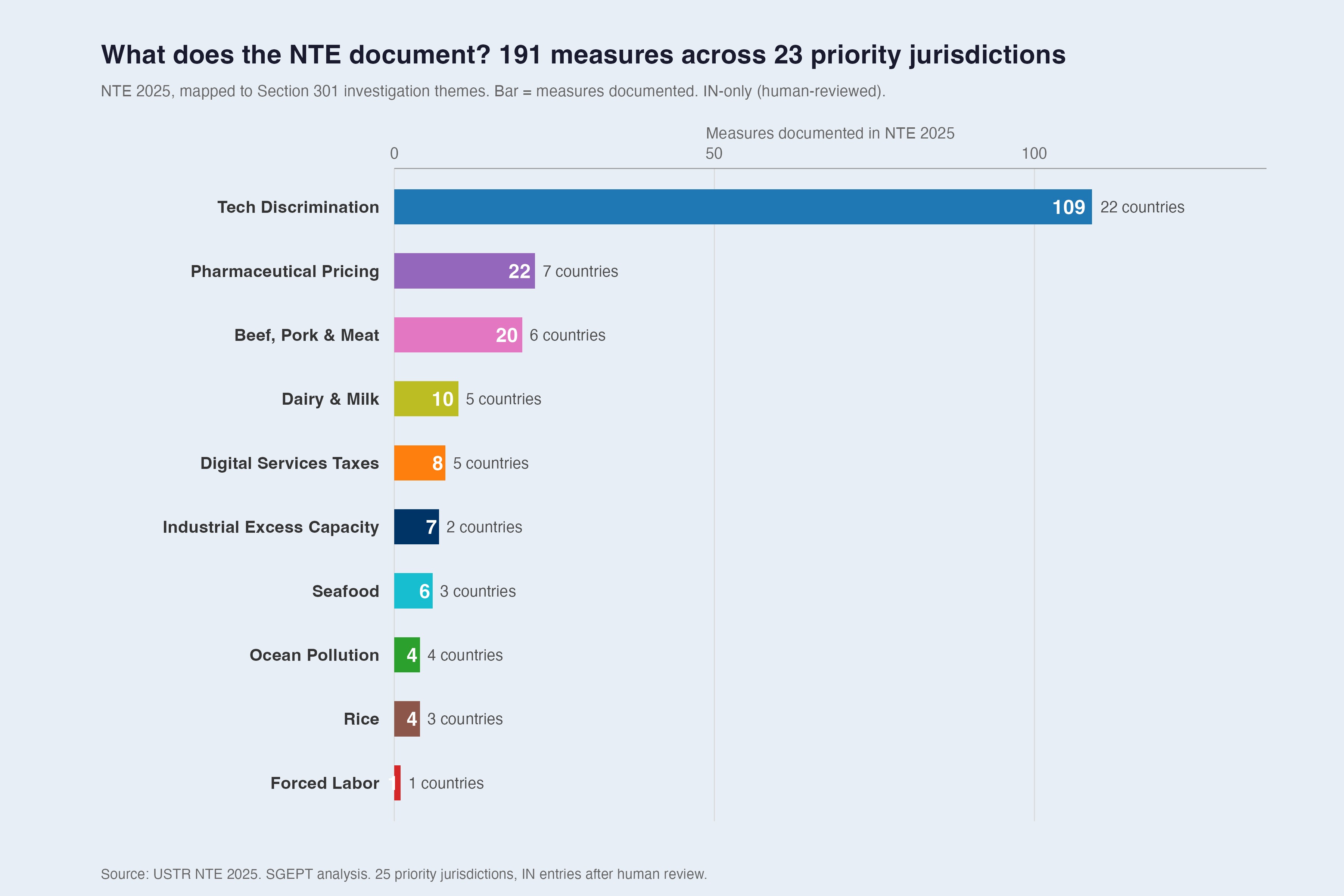
Technology discrimination dominates: 109 measures across 22 of the 25 priority jurisdictions. The NTE documents a layered regulatory architecture, referring from data-related concerns to actor-treatment differentiation. In China, it argues, six interlocking laws, including the Cybersecurity Law, Data Security Law, and Personal Information Protection Law impose local data storage requirements and “prohibit or severely restrict cross-border transfers of ‘important data.’” In India, the Communication Security Certification Scheme requires telecom equipment manufacturers to undergo costly in-country testing at government-designated laboratories and “share technical specifications and source code.” In Japan, USTR argues that "the Digital Platform Act and related regulations impose additional obligations and compliance costs that disproportionately target U.S. digital platform providers.”
Agricultural barriers form the second pillar, accounting for 36 measures across 9 jurisdictions. Beef, pork, and meat restrictions are the most widespread (20 measures, 6 countries), followed by dairy (10, 5), seafood (6, 3) and rice (4, 3). The measures are not interchangeable. They range from sanitary and phytosanitary requirements to tariffs and quotas. For instance, the report refers to how the Philippine DA Administrative Order No. 24 "maintains a discriminatory two-tiered system that imposes more burdensome handling requirements on frozen meat (which is mostly imported) than on freshly slaughtered domestic meat." For Russia, among others, it refers to Presidential Decree No. 807 and its ban on imports of U.S. beef, pork, poultry, and some sausages. For the United Kingdom, it refers to the Autonomous tariff quotas (ATQs) for fisheries products. The administration has already shown willingness to bundle disparate issues into a single Section 301 investigation. The July 2025 case against Brazil covers digital trade, electronic payments, tariffs, anti-corruption, intellectual property, ethanol, and deforestation under one umbrella, suggesting that agricultural product categories need not be separated into distinct proceedings.
Pharmaceutical pricing is the third-largest theme: 22 measures across 7 trading partners. The scope of pharma-related measures in the NTE extends well beyond pricing instruments. India suspended import license approvals for refurbished medical devices. In China, the Drug Administration Law "fails to adequately regulate the manufacture of active pharmaceutical ingredients (APIs) and enforce manufacturing standards." The USTR argues that the EU's implementation of its Medical Device Regulation suffers from a shortage of “notified bodies” for conformity assessment, making it “difficult for some companies, especially small and medium-sized enterprises, to obtain access to reviews.” Greer's announcement named 'pharmaceutical pricing practices'; the NTE documents a broader pharmaceutical regulatory landscape that Section 301 investigators can exploit.
Who the USTR worries about publicly
The previous sections showed what the US worries about and through which policy instruments. The next question is which trading partners face the broadest exposure across these themes.
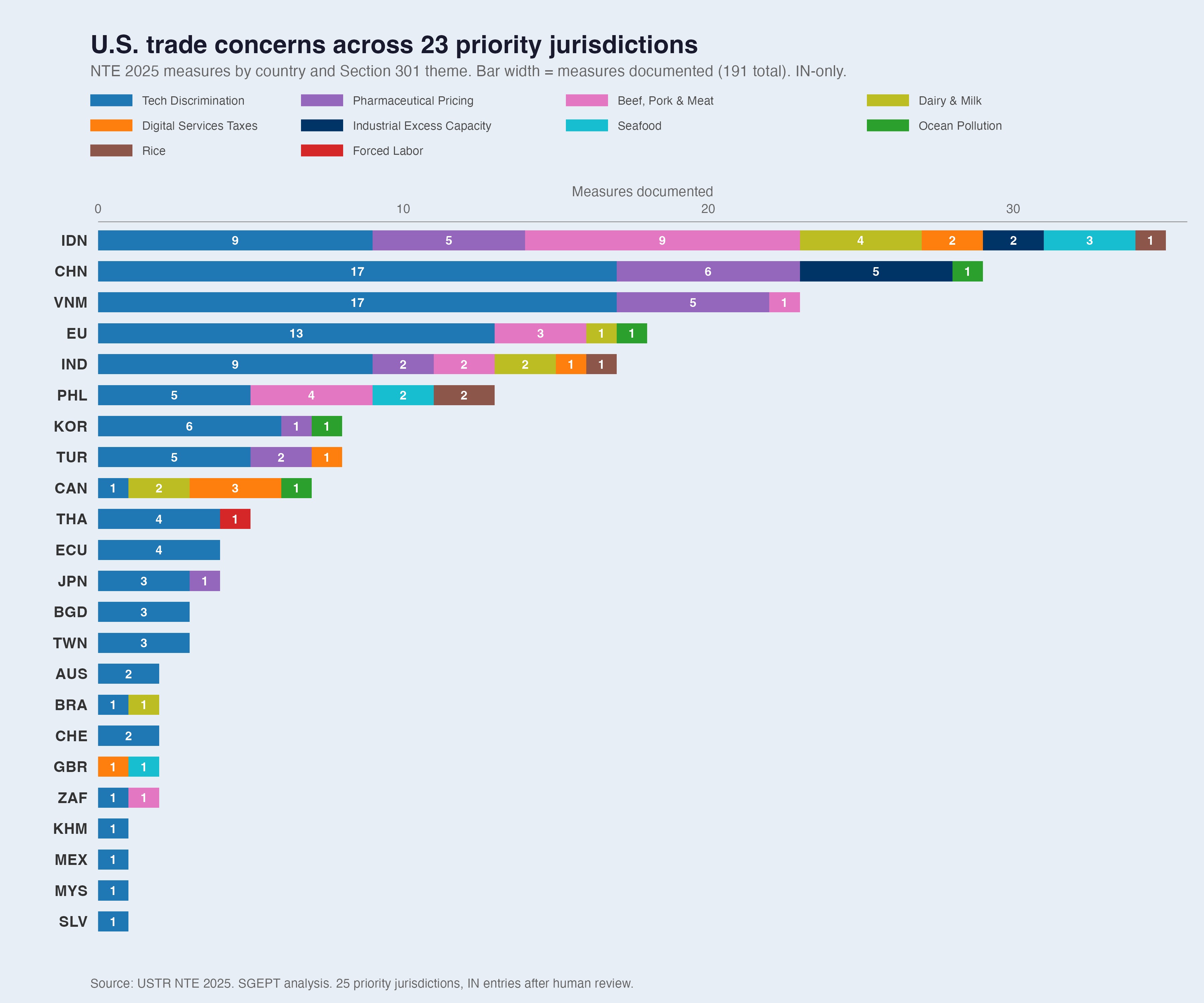
Six jurisdictions account for 70% of all documented measures. Indonesia is the most exposed jurisdiction with 35 named measures spanning 8 themes. China (29 measures, 4 themes), Vietnam (23, 3), the EU (18, 4), India (17, 6), and the Philippines follow (13, 4).
Indonesia stands out. It is the only jurisdiction implicated across eight of the ten themes. The agricultural-related theme alone generates 17 named measures. This country, together with China, is one of the only two jurisdictions mentioned in connection with the industrial excess capacity theme. The report refers to the export bans on certain mineral ores of the Mining Law of 2009 and the Mining Law of 2020 as contributors to "global overcapacity in the steel and aluminum sectors".
EU, China and India face six or more themes, but with a strong focus on technology discrimination. Technology discrimination measures represent 72%, 59% and 53% of all their entries, respectively. For the EU, policies like the General Data Protection Regulation (GDPR), the Data Act, and the Artificial Intelligence (AI) Act are highlighted in connection to data transfer and use concerns. For China, it argues, six interlocking laws, including the Cybersecurity Law, Data Security Law, and Personal Information Protection Law impose local data storage requirements and "prohibit or severely restrict cross-border transfers of 'important data.'" In the case of India, the NTE refers to Specific statutes like the IT Act and CERT-In directives.
Vietnam accumulates a high number of named measures under a few themes. Although almost three-quarters focus on technology discrimination, the pharmaceutical pricing category also stands out. The report highlights that four different regulations impose "burdensome requirements and backlogs in the pharmaceutical product registration process". This country has been a Section 301 target twice before under the First Trump Administration: a 2020 currency valuation investigation concluded with monitoring rather than tariffs, and a concurrent timber investigation was resolved through a bilateral agreement.
Named measures provide an overview of policies identified by the USTR that allegedly harm US trade. However, the NTE report lists multiple additional measures that expand the breadth of exposure to potential Section 301 investigations.
Analysing the known unknowns
This section addresses how "known unknowns" in the NTE report. In about half the passages, we documented that the USTR staff only refers to unspecified measures taken by government without naming the policy explicitly. This section summarises how these known unknowns distribute across themes and countries.
.png)
When including unspecified measures, measure counts and affected jurisdictions increase. Total measure counts more than double, going from 195 to 398. The number of priority countries mentioned in relation to the themes also increased from 21 to 23, to now include Argentina and Guatemala. For Argentina, the NTE themes identified are connected to beef, meat and pork, as well as pharmaceutical pricing. In the case of Guatemala, concerns referred to technology discrimination, pharmaceutical pricing and forced labour.
For 15 countries, unspecified measures represent more than half of the measures identified by the NTE report. These jurisdictions are the EU, India, Türkiye, Japan, Korea, Thailand, Taiwan, Malaysia, Australia, Brazil, South Africa, Mexico, Argentina, El Salvador and Guatemala.
In the expanded analytical scope, China leads. Measure counts jump from 29 to 50. Theme-wise, the scope expand to also refer to forced labour, seafood, rice, dairy and meat. China is already subject to four active Section 301 investigations: the 2017 forced technology transfer case remains in effect; a 2024 maritime and shipbuilding investigation produced action, though it is currently suspended due to tariff negotiations; a December 2024 semiconductor dominance case produced action in December 2025; and an October 2025 Phase One Agreement compliance investigation is ongoing.
Breadth of exposure, however, does not capture how thoroughly the NTE documents each jurisdiction. A country may appear across many themes yet receive only passing treatment, or feature in a few themes with extensive documentation.
Scaling the depth of the concern
Counting measures and themes shows breadth of concern, but not how thoroughly the NTE documents each one. A jurisdiction may appear in many themes yet receive only passing mention, or it may appear in a few themes with extensive documentation. The heatmap below shows how much detail the NTE devotes to each jurisdiction-theme combination.
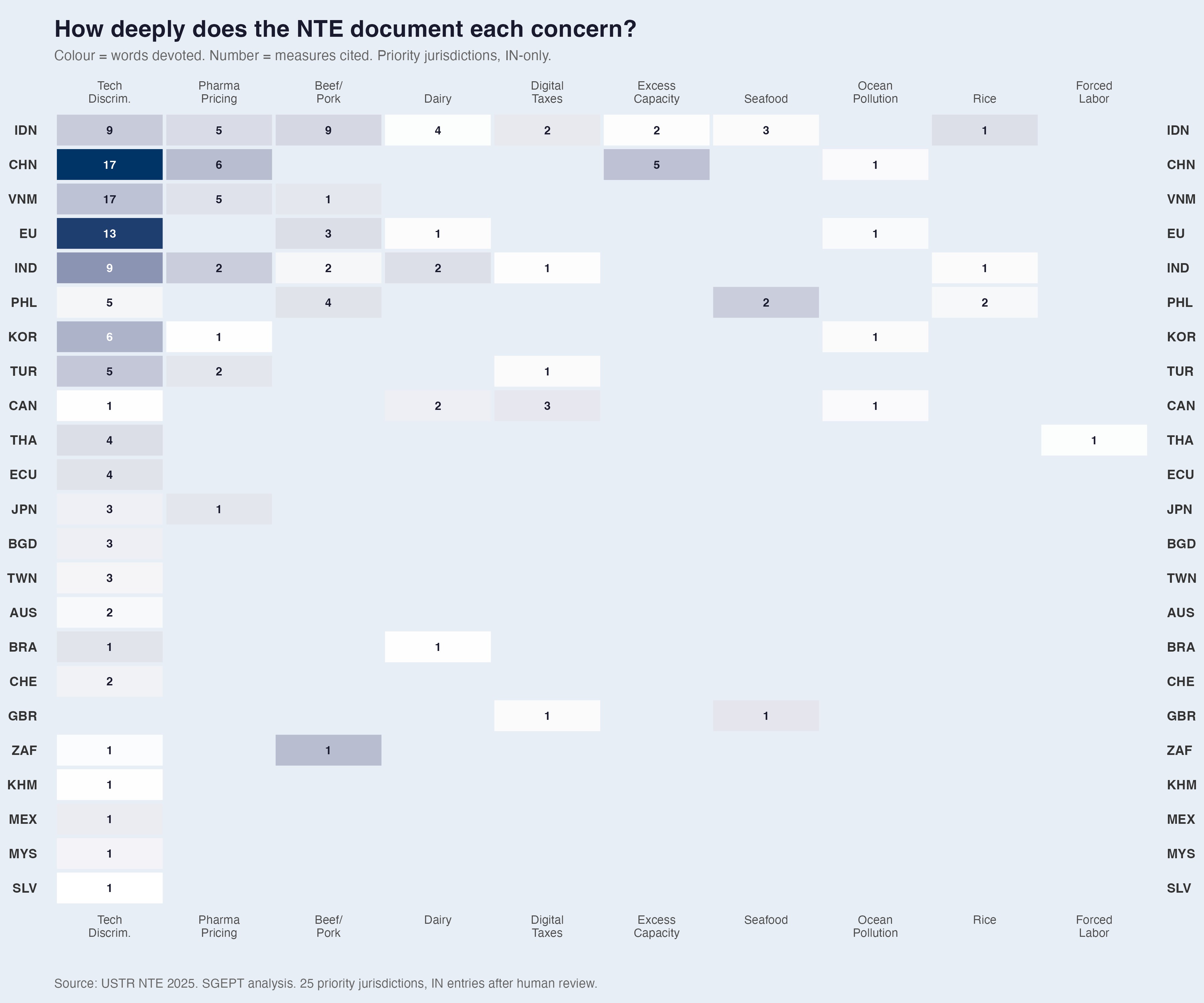
Documentation depth varies within jurisdictions, not just across them. China's technology discrimination entries run to 1,899 words citing 23 measures, 17 of them named instruments: the Cybersecurity Law, the Data Security Law, the Anti-Foreign Sanctions Law, and implementing regulations. The EU's technology discrimination entries cite 15 measures across 1,776 words, 13 named. India's technology entries cite 20 measures, but only 9 are named; the remainder describe unnamed administrative practices.
Turkish allegedly discriminatory practices are cited in 25 measures, but 17 describe administrative practices and other unknown regulations, leaving investigators to fill evidentiary gaps.
The EU illustrates within-country variation. Its technology discrimination entries name specific instruments: the Digital Services Act, the Digital Markets Act and Regulation (EU) 1025/2012 are examples. Its pharmaceutical pricing entries running 872 words describe diffuse practices without citing statutes, requiring further fact-gathering before legal arguments crystallise.
What the evidence contains
The NTE documents American government perceptions of foreign trade barriers at different degrees of specificity. In all documented entries, we do not take a position on the true discriminatory nature of the measure. The sole purpose of this piece is to analyse the USTR's vantage point.



.png)