
What the Section 301 overcapacity investigation covers, and what it does not
On 11 March, USTR opened Section 301 investigations into structural excess capacity in 16 economies.
Authors
Johannes Fritz
Date Published
12 Mar 2026
Related Topics:


On 11 March, USTR opened Section 301 investigations into structural excess capacity in 16 economies.
Johannes Fritz
12 Mar 2026

On 11 March 2026, USTR opened a Section 301 investigation into structural excess capacity in 16 economies. The announcement defines seven policy interventions as causes of overcapacity but, for ten of the 16 economies, cites only evidentiary indicators without identifying which causes apply. This analysis examines the scope of the investigation, compares it to the 2025 National Trade Estimate Report, and considers the legal framework within which it operates.
The definitional scope is measurable. In the 2025 National Trade Estimate Report, published a year earlier, USTR discussed overcapacity for two economies: China (steel, aluminium, solar, electric vehicles, batteries) and Indonesia (mineral ore export bans contributing to steel overcapacity). The Section 301 announcement applies ‘structural excess capacity’ to 16 economies.
USTR’s Background section defines two analytical layers: evidentiary indicators (trade surpluses, low capacity utilisation, sector overcapacity, unprofitable firms) and seven policy interventions said to cause them (production subsidies, wage suppression, state-owned enterprise activities, market access barriers, lax environmental or labour protection, subsidised lending, and currency manipulation).
Across all 16 economies, the announcement documents 33 evidentiary indicators but cites only seven specific policy interventions. For ten economies, it identifies symptoms but leaves the causes subject to investigation.
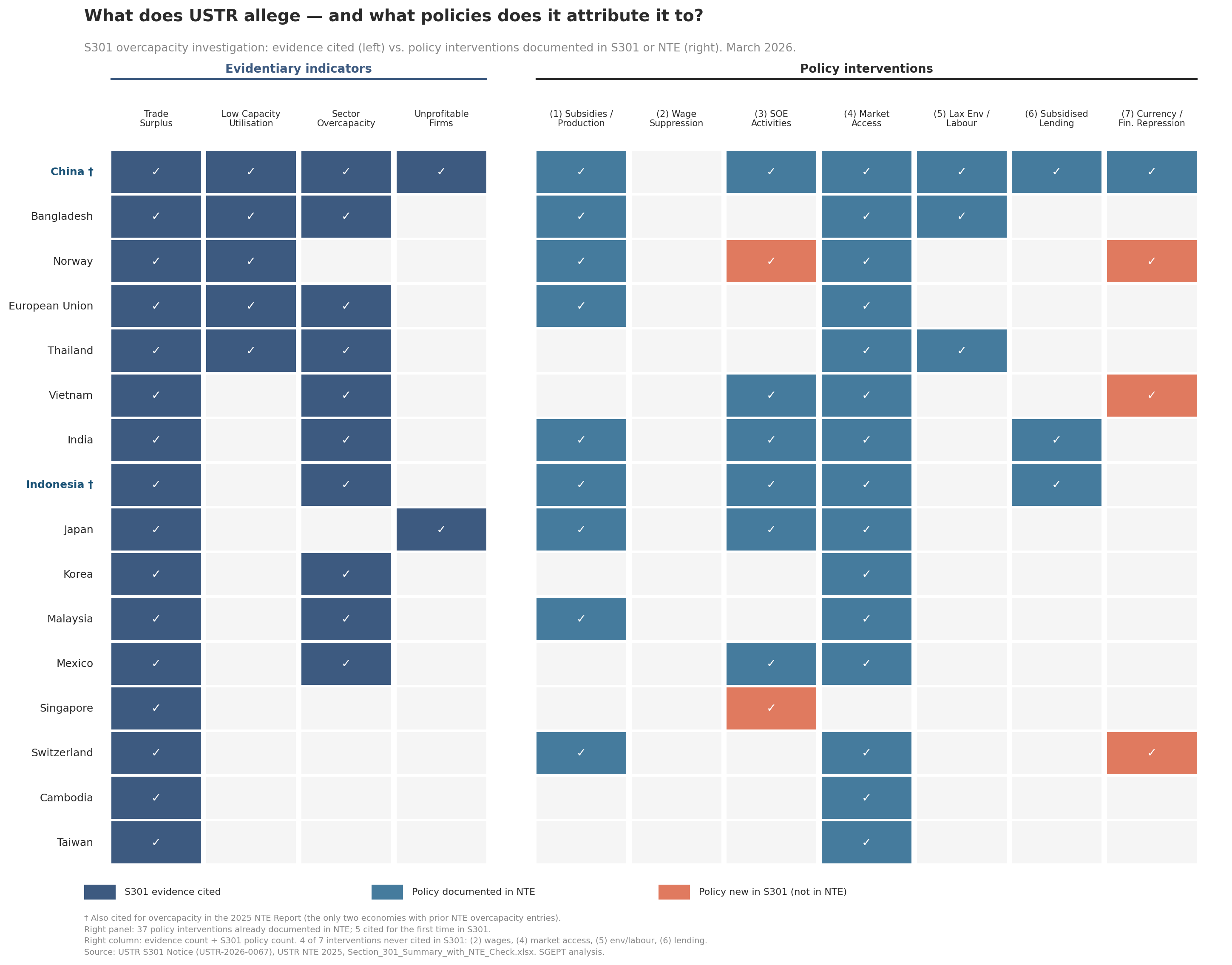
Three economies illustrate the breadth of the definition. Switzerland is cited for currency intervention and sterilisation of foreign exchange inflows, with no industrial overcapacity evidence and no policy interventions identified beyond currency practices. The NTE’s Switzerland chapter discusses tariffs, agricultural subsidies, sanitary measures, and data localisation; it contains no mention of overcapacity, currency manipulation, or trade surplus as a concern. Norway is cited for recycling oil revenues through its sovereign wealth fund rather than its domestic currency; its bilateral surplus with the United States is $1.9 billion. The NTE’s Norway chapter contains no reference to currency practices, sovereign wealth operations, or overcapacity. Japan runs a global goods trade deficit of roughly $36 billion but is included on the basis of its bilateral surplus and the share of unprofitable firms in its economy.
The S301 and the NTE diverge significantly. A systematic review of the 2025 NTE across all 16 targeted economy chapters finds that the S301’s core categories scarcely appear in the NTE’s analytical vocabulary. Neither currency intervention, undervaluation, nor zombie firms feature as concerns anywhere in the document. ‘Overcapacity’ is confined almost entirely to the China section and one brief Indonesia reference. The divergence extends to policy causes: the NTE documents instances of USTR’s own seven policy interventions far more extensively than the S301 does. Market access barriers, for instance, are documented in the NTE for 15 of the 16 targeted economies; the S301 does not cite market access barriers as a cause of overcapacity for any of them, though some country sections describe practices (such as Indonesia’s export restrictions) that could plausibly be characterised under that heading. The NTE is a document about the causes of trade distortion. The S301, at this stage, documents indicators and leaves most causes unspecified.
USTR grounds this investigation in statutory authority. The 1988 Omnibus Trade and Competitiveness Act instructed the US government to address large and persistent current account imbalances, and the S301 announcement cites this provision explicitly. The 1988 Act, however, addressed current account surpluses as a macroeconomic phenomenon requiring policy adjustment by surplus countries. The S301 recasts those surpluses as evidence of structural excess capacity in manufacturing, a framing that points towards unilateral trade action. The statutory basis is established; whether this application represents a routine extension or a substantive reconceptualisation of that authority is a question the comment process and, potentially, the courts will address.
The legal framework constrains some forms of review but not others. Section 301 has never been struck down by a US court, unlike IEEPA. The September 2025 Federal Circuit ruling requires S301 actions to comply with Administrative Procedure Act notice-and-comment requirements, and the March 11 announcement opens exactly that process (comments by 15 April, hearings 5 to 8 May). Courts will review whether USTR followed correct procedure. Whether Swiss currency intervention constitutes ‘structural excess capacity’ is a substantive determination on which US courts have historically deferred to the executive branch (see Clausen and Meyer,).
The S301 defines structural excess capacity through seven policy interventions but, for most economies, documents indicators of overcapacity without identifying which causes apply. The announcement is the opening of an investigation, not a finding; the comment and hearing process is designed to develop the evidentiary record further. Fourteen of the 16 targeted economies received no overcapacity analysis in USTR’s own NTE, published one year prior.
The comment period closing 15 April offers an opportunity to challenge the evidentiary basis for individual economies. Whether courts would scrutinise that basis remains an open question, but the historical pattern of judicial deference to executive trade determinations suggests a limited role for judicial review.