The United States Trade Representative's final action in its 60 forced-labour Section 301 investigations took effect at 12:01 a.m. eastern time on 24 July 2026 (Dockets USTR-2026-0265 and USTR-2026-0266). Additional duties of 10% or 12.5% now apply to all products of the 60 investigated economies, subject to exemptions set out in two annexes. Goods loaded onto a vessel and in transit on the final mode of transit before 24 July escape the additional duty if they are entered before 28 July.
This post explains how the 431-page Federal Register notice is organised, and provides it repackaged into one self-contained PDF per economy, so that traders and analysts can work with the provisions that concern them. Our estimate of what the action does to the US tariff wall follows in a separate post. For the investigations' background, see our June coverage of the determinations against the 60 economies.
Four rate treatments cover the 60 economies
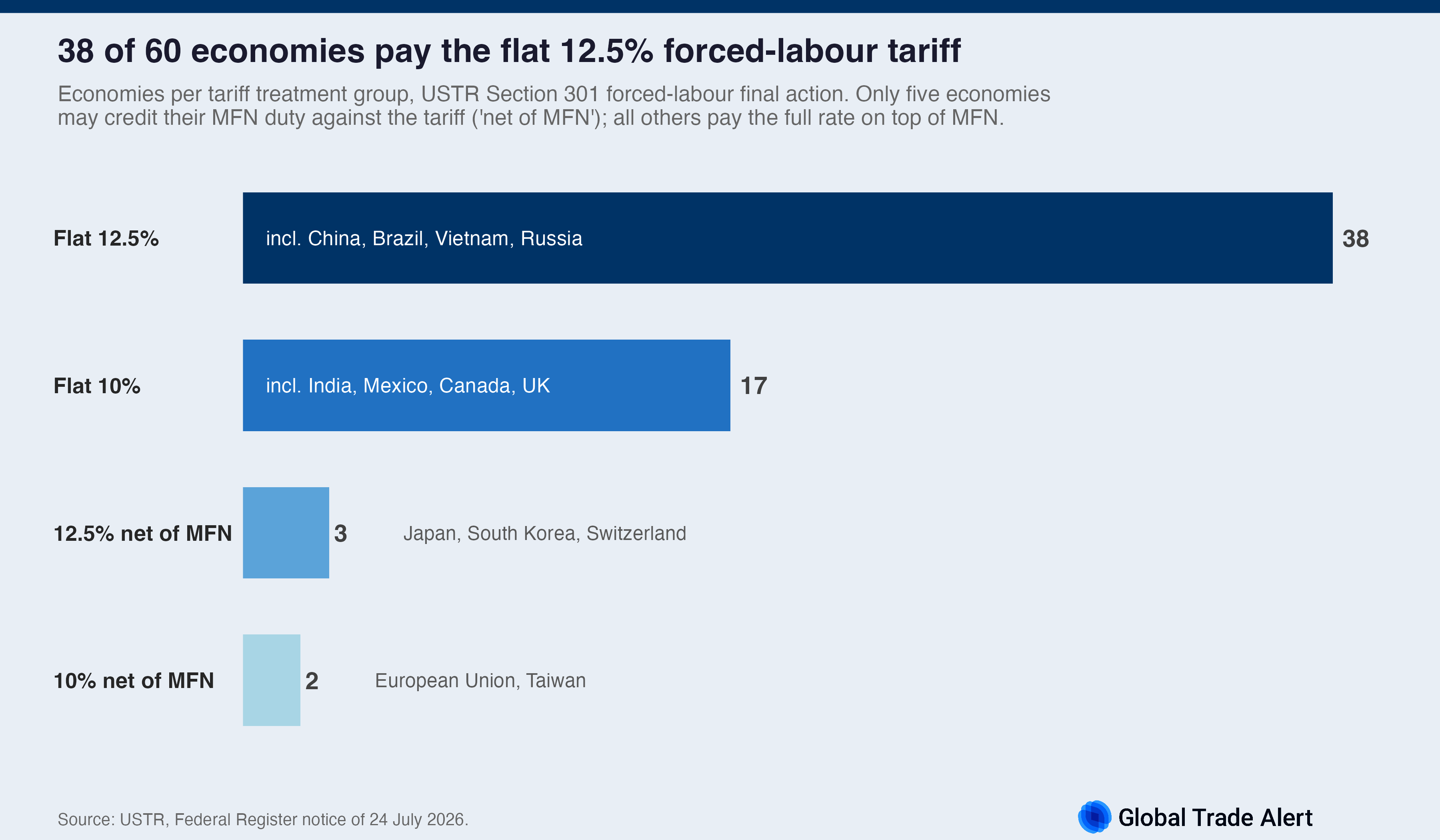
The rate an economy pays depends on its own forced-labour import regime. Economies that ban imports of forced-labour goods, that committed to such a ban in an Agreement on Reciprocal Trade, or that operate a partial regime pay 10%; every other economy pays 12.5%. Seventeen economies, among them the United Kingdom, India, Mexico and Canada, pay the flat 10% rate. The European Union and Taiwan also qualify for 10%, applied net of a product's most-favoured-nation duty. Japan, South Korea and Switzerland receive the same net-of-MFN treatment at 12.5%. The remaining 38 economies, including China, Brazil, Vietnam and Russia, pay the flat 12.5% rate. The new duty applies in addition to the existing Section 301 duties on imports from China and Brazil.
The determinations behind the rates fall into two groups. USTR found that 54 economies failed to impose and effectively enforce a prohibition on importing goods produced with forced labour, and that six economies, namely Canada, Ecuador, the European Union, Indonesia, Mexico and Pakistan, failed only to enforce one effectively. The notice also directs the establishment, when feasible, of tariff-rate quotas for Bangladesh, Cambodia, Indonesia and Malaysia, tied to each economy's importation of US cotton and textile inputs. The quotas would run for an initial three years and let a set volume of textiles and apparel enter free of the Section 301 duty; USTR will set the mechanism and its start date in a separate notice.
The 431-page notice has three layers
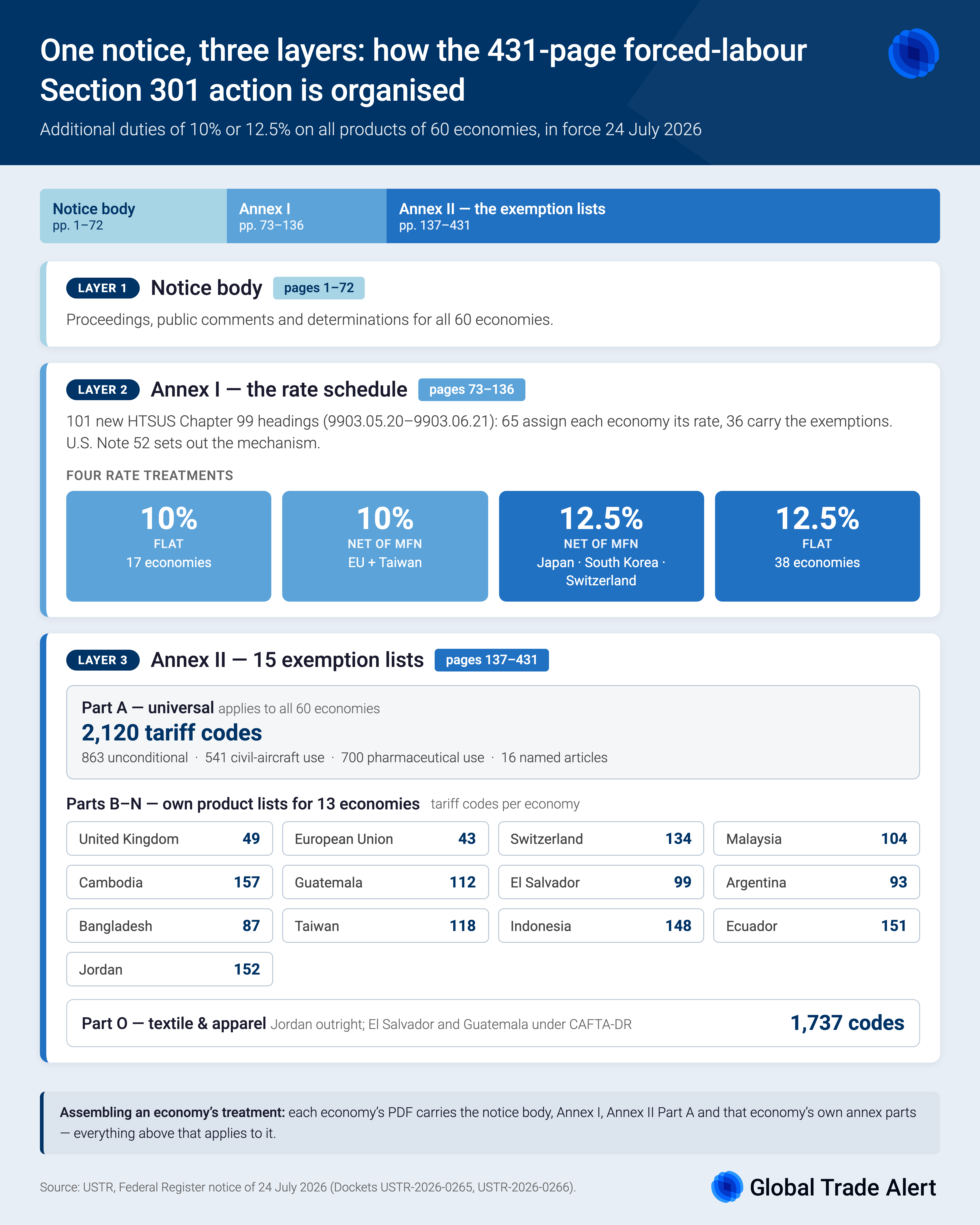
The notice reads as three self-contained blocks. Pages 1 to 72 carry the notice body: the proceedings, USTR's responses to public comments, and the determinations for all 60 economies. Pages 73 to 136 carry Annex I, which writes the action into the tariff schedule through 101 new Chapter 99 headings and U.S. Note 52, the legal mechanism for every exemption. Pages 137 to 431 carry Annex II, the fifteen exemption lists, Parts A to O. The infographic below sets out what each block contains.
Exemptions run through one universal list and fourteen targeted lists
Annex II, Part A covers 2,120 tariff codes for all 60 economies, but only 863 of them are exempt as entered. A further 541 apply only to goods entered for civil-aircraft use, 700 only to goods entered for pharmaceutical use, and 16 only to specifically named articles. The universal list grew by 465 codes from the June proposal's 1,655, with none removed.
Thirteen economies received their own additional lists, Parts B to N: the United Kingdom, the European Union, Switzerland, Malaysia, Cambodia, Guatemala, El Salvador, Argentina, Bangladesh, Taiwan, Indonesia, Ecuador and Jordan. Part O, a further 1,737 textile and apparel codes, covers Jordan outright, and El Salvador and Guatemala where goods are entered free of duty under CAFTA-DR.
Beyond the product lists, U.S. Note 52 exempts goods under enumerated Section 232 programmes, goods of Canada and Mexico entered free of duty under the USMCA, CAFTA-DR textiles, Chapter 98 entries other than the 9802 repair, alteration, processing and assembly provisions, which stay dutiable on the foreign value added, donations intended to relieve human suffering, and informational materials. A separate amendment inside Annex I adds patented pharmaceutical articles to the Section 232 exemption from 31 July 2026. Eligibility for a preference programme does not itself shield goods from the duty.
Download the notice, economy by economy
We have repackaged the notice into 60 self-contained PDFs, one per investigated economy. Each opens on a cover page giving that economy's rate, the dates in force and the annex parts that apply to it, and carries a navigation outline in the reader's sidebar, so a document of 243 to 367 pages can be jumped through rather than scrolled. Pages are reproduced verbatim and keep the notice's own page numbers; only the annex parts written for other economies are left out.
All 60 economies as one archive (75 MB): ZIP
Economies are listed by ISO three-letter code, alphabetically. Each code opens that economy's PDF.
The same notice split into its 16 modular parts, the notice body and each annex part as separate files, remains available as an archive.
Impact estimates follow
The Global Trade Alert will publish its estimate of how the final action changes the US tariff wall, economy by economy, in the coming days. Our June assessment of the proposed action's arithmetic is here; the final action's wider exemptions and net-of-MFN treatments change that arithmetic and warrant the fresh estimate.