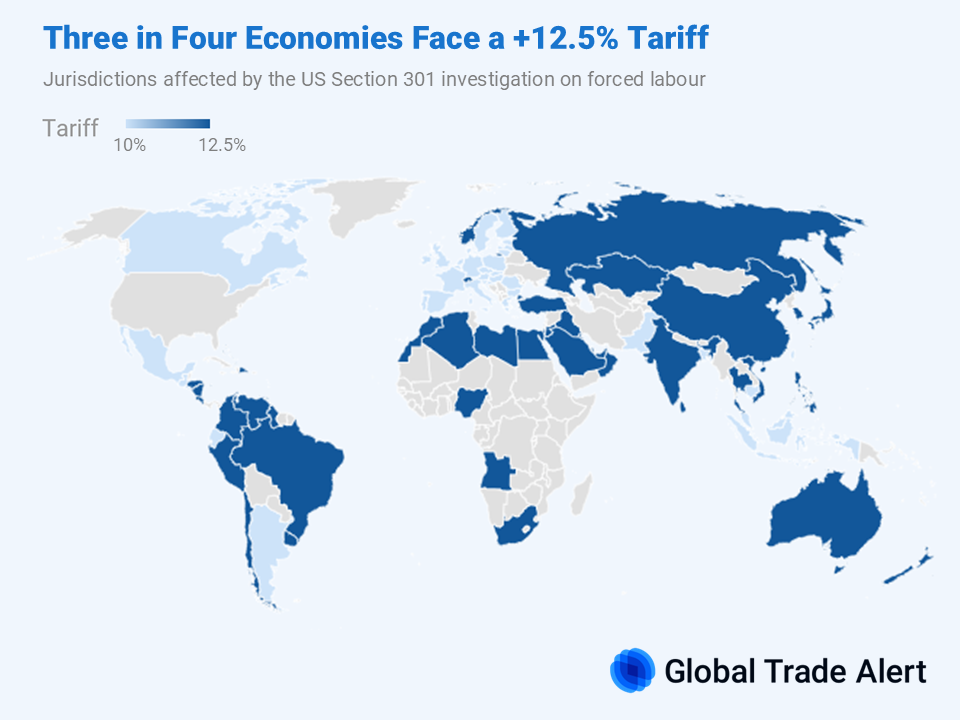
On 12 March 2026, the Office of the United States Trade Representative (USTR) launched an investigation into forced labour practices. It examined 60 economies. On 2 June, it issued its findings. Every economy under review had failed to meet US forced labour standards. Each one failed to ban imports of goods made with forced labour. USTR responded with a proposal: additional tariffs on all 60. The tariffs are not yet in force. Public comments close on 6 July. A hearing follows on 7 July. USTR will set the final action after that. This explainer covers the tariff tiers, the exemptions, the textile mechanism, and the timeline.
Two Tariff Tiers
USTR proposed two tariff tiers. The rate depends on each economy's forced labour rules. Stronger pledges earn the lower rate.
Tier 1 economies face a 10% tariff. They qualify in one of three ways. Some already ban imports of goods made with forced labour. This group includes Canada, the EU, Mexico, Ecuador, Indonesia, and Pakistan. Others pledged a ban through an Agreement on Reciprocal Trade. That group includes Argentina, Bangladesh, Cambodia, El Salvador, Guatemala, Malaysia, and Taiwan. The United Kingdom qualifies through a partial regime.
Tier 2 economies face a 12.5% tariff. They have neither a ban nor a pledge. The group spans every major region and includes some of the largest US trading partners. China, India, Japan, South Korea, Australia, Brazil, Vietnam, Switzerland, Norway, and Saudi Arabia all sit here. The full Tier 2 group covers 46 economies.*
Annex A: What Escapes the Tariff
Annex A sets out two layers of exemptions. The first applies to all 60 economies. The second adds country-specific carve-outs on top.
The first layer reflects four considerations that guided USTR's exclusion decisions :
- Necessary raw materials whose tariffing could cause domestic scarcity
- Products whose tariffing would disrupt supply or the wider economy
- Products where tariffs would not stop the targeted practices
- Products the US cannot make in sufficient quantities or source elsewhere
Applying these criteria produces a familiar product list. It covers energy products, rare earths, and certain critical minerals. It also covers pharmaceuticals, certain organic chemicals, aircraft, and aircraft parts. Beef, coffee, and selected fruits and vegetables are included too. The focus lands on similar categories as in the IEEPA and Section 122 exemptions. Annex A further exempts informational materials, donations, and accompanied baggage.
Goods already covered by Section 232 tariffs are also excluded. These cover steel, aluminium, copper, lumber, and automobiles. The second layer adds country-by-country carve-outs. Annex A excludes USMCA-compliant goods from Canada and Mexico. Those goods face no extra Section 301 duty. This sits on top of the 10% rate both already receive. Non-compliant goods from Canada and Mexico face the 10% rate.
Annex A also exempts CAFTA-DR duty-free textiles and apparel. This carve-out covers 1,610 apparel product codes. It applies to all six CAFTA-DR members under investigation: El Salvador and Guatemala, which are in Tier 1 at 10%, and Costa Rica, the Dominican Republic, Honduras, and Nicaragua, which are in Tier 2 at 12.5%. This carve-out shields their main export sector.
A New Textile Mechanism
The proposal adds a new textile mechanism, allowing some economies to ship apparel and textiles at a lower Section 301 rate. It runs on two tracks. Track one ties the reduced-duty volume to US textile exports of man-made and cotton fibre inputs to the partner. Track two ties the volume to the partner's imports of US cotton and cotton products.
Much of the mechanism's design remains open. USTR has not named the eligible economies, set the reduced rate, or fixed the volume caps. It invited comment on all of these, as well as on the products to cover, market opportunities for each side, and whether the mechanism should apply across both tiers. It also asked whether a similar mechanism should apply to other sectors.
What Comes Next
The tariffs are not yet in force, and the process is still running. Requests to appear at the hearing are due on 22 June. Written comments close on 6 July, followed by the public hearing on 7 July. USTR issues its final ruling after post-hearing rebuttals. No statutory deadline binds that ruling.
Going into the process, four elements remain open. USTR invited comment on the scope of covered products, the level of the duty increase, whether to vary rates by each economy's pledge, and the design of the textile mechanism.
One date gives the process urgency. A temporary 10% import surcharge under Section 122 expires on 24 July 2026 unless Congress extends it. USTR will likely aim to impose the Section 301 duties before then, ensuring no gap in tariff coverage.



.png)