
Chokepoint: Tracking Trade Policy Responses to the Hormuz Crisis
Latest update: 18 June 2026, 4:00 pm


Latest update: 18 June 2026, 4:00 pm
Fiama Angeles, Ana Elena Sancho
18 Jun 2026
.png)
18 June: 75 new measures spanning across 21 implementing jurisdictions.
Following the signing of the MoU between the US and Iran and the upcoming reopening of the Strait of Hormuz, this will be the final update of the blog. We will resume the blog if activity picks up in the future. For the latest GTA measures on the topic, visit the thread here.
12 June: The European Commission proposes a EUR 540 million financial relief for farmers under the Fertiliser Action Plan
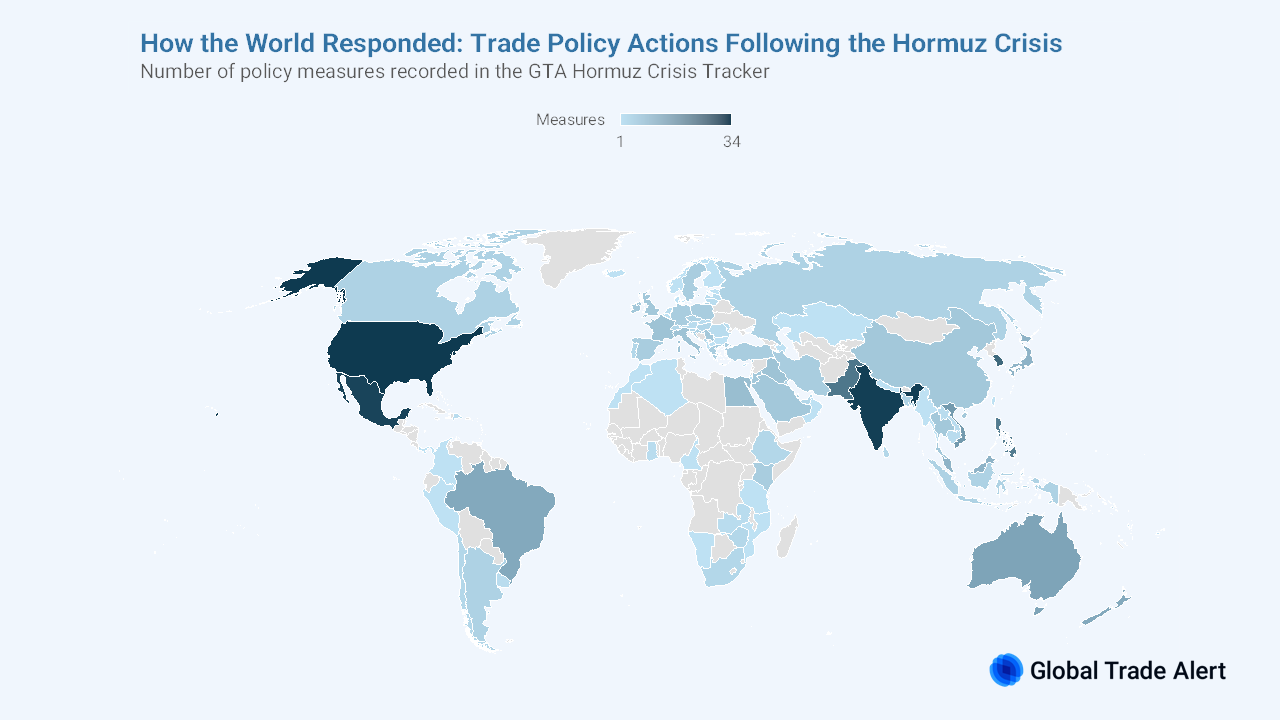
This section summarises policy actions adopted across the world. The measures documented in this section fall under the reporting scope of the GTA database. Currently, this tracker has identified 207 different actions spanning seven different policy areas.
Export barriers (48)
This category includes export controls such as bans and taxes, as well as local supply requirements for export.
Domestic subsidies (94)
So far, actions concentrate on tax cuts, price stabilisation and subsidies.
Import barriers (31)
Policies in this field have so far taken the form of import tariffs and licenses.
Affected sectors: energy (petrol, crude oil, petroleum oils, fuel production materials); fertilisers (urea), plastic products, gold
Implementing jurisdictions: European Union, India (x2), Iraq (x2), Malaysia, Mexico (x13), Pakistan, Philippines (x4), Republic of Korea, South Africa, Turkiye (x3), Vietnam (x2)
Capital controls (30)
Recorded actions focus on capital controls on commercial transactions and trade payment measures.
Affected sectors: energy, agricultural commodities, services
Implementing jurisdictions: Australia, Canada, Egypt, European Union, Switzerland, United Kingdom (x2), United States of America (x23)
Localisation (2)
The recorded action refers to local operations and local content requirements.
Affected sectors: energy (energy commodity shipments and oil)
Implementing jurisdictions: India and United States of America
Other (2)
The actions under this category referred to ordering production suspension and authorising more operators to trade in certain sectors.
Affected sectors: energy (natural gas, crude oil and petroleum)
Implementing jurisdictions: Israel, Vietnam
Check the live GTA thread covering GTA-relevant measures here.
This tracker has so far identified 302 government actions that fall outside the scope of the GTA database. They cluster around eight policy areas, including:
Price management (53 actions)
These actions include retail price caps, freezes, tax cuts, subsidy adjustments, and direct fiscal transfers to consumers.
Affected sectors: energy, agricultural commodities
Implementing jurisdictions: British Virgin Islands, Chile, China (x3), Chinese Taipei, Croatia (x3), Czechia, Dominican Republic (x2), Egypt (x3), Ethiopia, Germany, Ghana, Greece, India (x4), Kenya (x2), Kuwait, Malaysia, Mexico (x3), Montenegro (x2), Mozambique, Pakistan (x8), Republic of Korea (x3), Romania, Saudi Arabia, Solomon Islands (x2), United Kingdom, Uruguay (x2), Zambia, Zimbabwe
Supply management (63 actions)
This policy area included mechanisms such as reserve releases, rerouting of supply flows, production adjustments and rationing.
Affected sectors: energy
Implementing jurisdictions: Algeria, Australia (x5), Austria, Belgium, Canada, Czechia, Denmark, Estonia, EU, Finland, France, Germany, Greece, Hungary, India (x3), Indonesia, Iran, Iraq (x2), Ireland, Italy, Japan, Jordan, Kazakhstan, Kuwait, Latvia, Lithuania, Luxembourg, Mexico, Netherlands, New Zealand (x4), Norway, Oman, Poland, Portugal, Qatar, Republic of Korea (x3), Russia, Saudi Arabia (x2), Serbia, Spain, Sweden, Tanzania, Türkiye, United Arab Emirates, United Kingdom, the United States of America (x3), Vietnam (x2)
Demand management (31 actions)
This policy area includes measures aimed at reducing or controlling demand. For example, austerity measures and purchasing limits.
Affected sectors: energy
Implementing jurisdictions: Argentina, Australia (x2), Bangladesh (x3), Cook Islands, Egypt, India (x2), Indonesia (x2), Japan, Malaysia, Moldova, Myanmar, New Zealand, Pakistan (x4), Philippines, Republic of Korea (x2), Slovakia, Slovenia, Sri Lanka (x2), Thailand, Vietnam (x2)
Domestic subsidies (96 actions)
Affected sectors: energy, households, diesel users
Implementing jurisdictions: Albania, Anguilla, Argentina (x2), Australia (x2), Austria, Brazil (x3), British Virgin Islands, Cambodia, Canada (x2), Chile, Cyprus, Czechia, Ethiopia, Fiji, France, Germany (x2), Ghana, Greece (x2), Hungary, Iceland, India, Indonesia, Iraq, Ireland, Italy (x3), Japan (x4), Jordan (x2), Kenya, Kuwait, Laos, Latvia, Lithuania, Malaysia (x4), Montenegro, Namibia, New Zealand (x4), North Macedonia, OPEC, Pakistan (x5), Panama, Philippines (x7), Poland (x4), Qatar, Republic of Korea, Saint Kitts and Nevis, Serbia, Slovenia, South Africa (x2), Spain, Sri Lanka, Sweden (x4), Thailand, United Arab Emirates (x2), United Kingdom, Vanuatu, Vietnam (x2), Zambia, Zimbabwe
Regulatory and administrative responses (19 actions)
This group so far covers transparency rules and task force appointments.