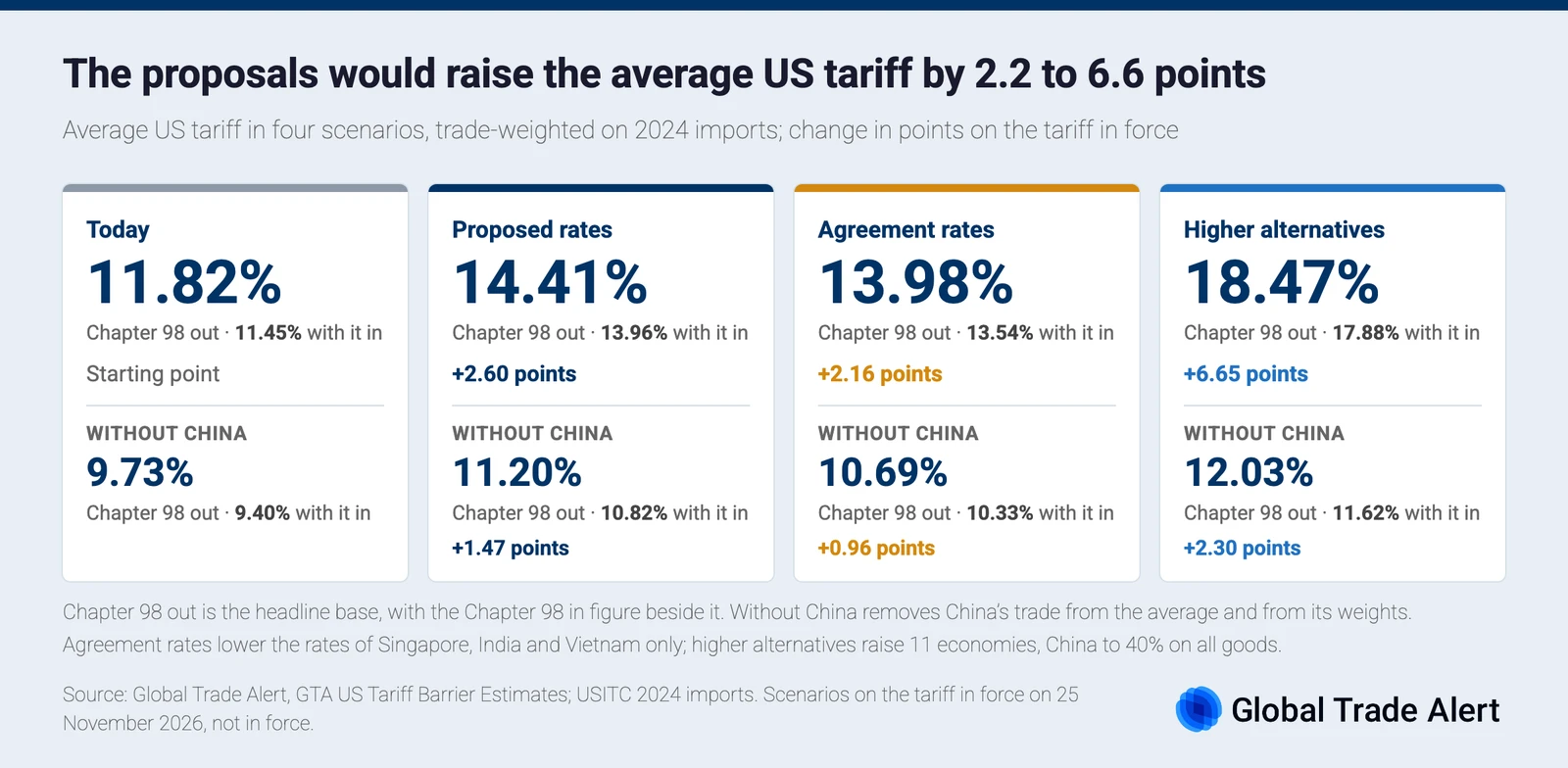
By the Global Trade Alert's U.S. tariff estimates, the USTR's proposed tariff increases would lift the average US tariff from 11.8% to 14.4%. Without China the average would rise from 9.7% to 11.2%. The average weights each tariff line by its 2024 imports.
We model three scenarios, each following a condition the notices state. Proposed puts all 14 economies at the rates their notices propose. Agreement rates put Singapore, India and Vietnam at the lower rates their notices provide for, should each reach an Agreement on Reciprocal Trade. Higher alternatives put the 11 economies whose notices provide for a higher rate, China among them, at that rate: China at 40% on all goods, net of the forced-labour Section 301 duty in force since 24 July 2026.
The agreement rates would add 2.2 points (to 14.0%) and the higher alternatives 6.6 (to 18.5%). Without China, the averages would be 10.7% and 12.0%. Including Chapter 98, the four averages are 11.4% today, 14.0% proposed, 13.5% under the agreement rates and 17.9% under the higher alternatives. Every figure is a scenario on the tariff in force on 25 November 2026, and none of the proposals is in force.
China, Vietnam, India and Singapore would lose relative ground
The proposed rates run from 35% for Vietnam to 15% for five economies, the EU, Japan, South Korea, Switzerland and Taiwan. That is a 20-point gap in headline rates. Our Relative Trump Tariff Advantage (RTTA) measures an origin's tariff position against its competitors in the US market. For each product line that at least one other origin also exports, we take the average tariff those competitors pay, weighted by their trade, subtract the origin's own, and weight the result by the origin's own trade. A positive value means competitors pay more.
If all 14 proposals apply, China's RTTA falls by 6.3 points, Vietnam's by 5.8, India's by 3.7 and Singapore's by 0.5. The other 16 of the 20 largest origins improve their position, by 0.3 points for the EU and Malaysia, 3.6 for Turkey, Mexico by 2.5, Thailand by 1.8, the UK by 1.6, and Canada, Japan and Taiwan by 1.4 each. Ten of the 14 economies improve although their own average tariffs rise, because tariffs on competing origins rise more on the products these economies export. Mexico improves with no change in its own tariffs, because USTR made no determination for it.
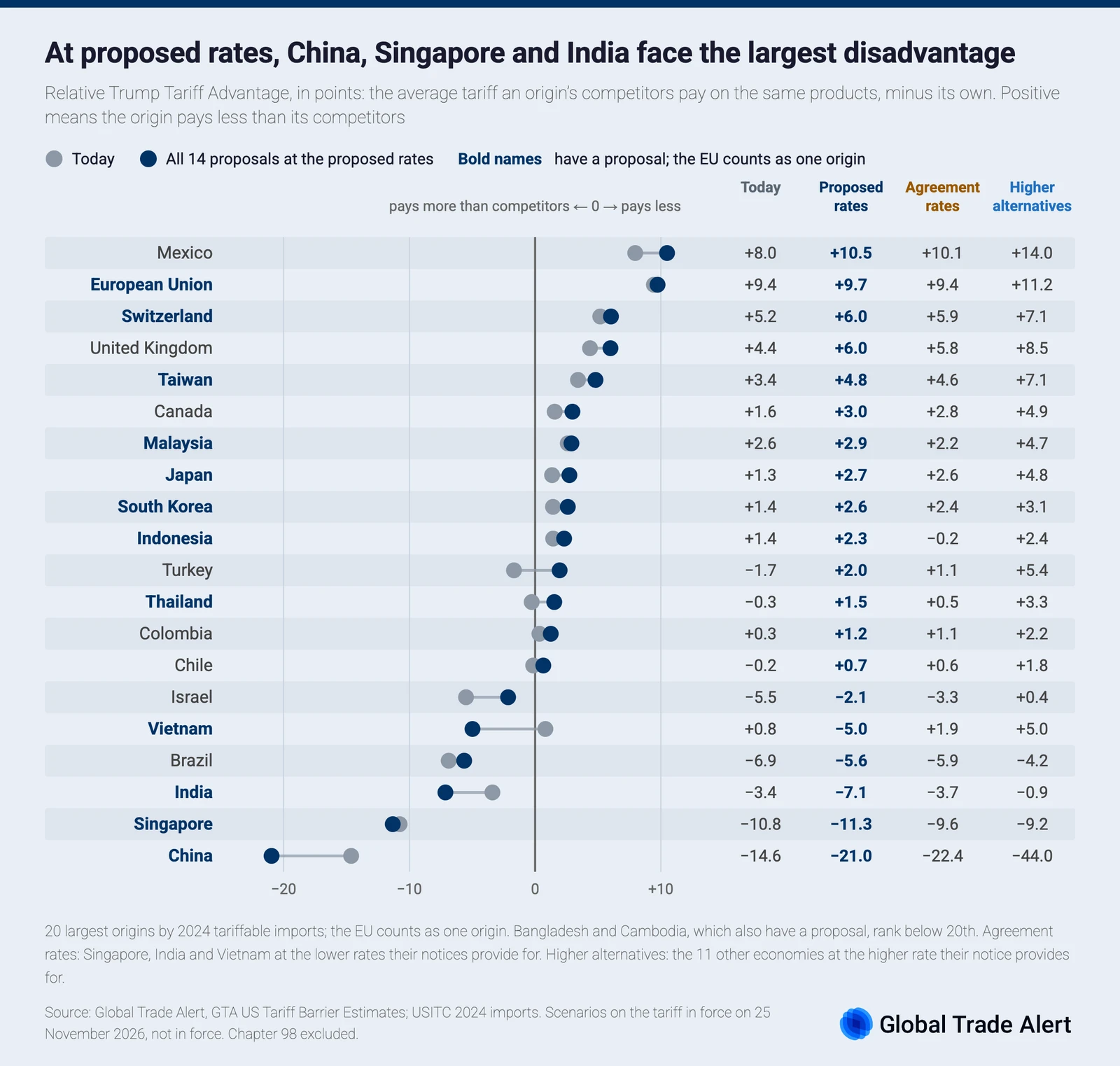
Under the agreement scenario, Vietnam's RTTA change reverses from a fall of 5.8 points to a gain of 1.1, and Singapore's from a fall of 0.5 to a gain of 1.2. China's fall deepens to 7.8 points. Bangladesh, Cambodia and Indonesia swing from gains to falls of 3.4, 1.9 and 1.6 points, because Vietnam, India and Singapore, their competitors, would pay less. Under the higher alternatives, China's RTTA falls by 29.4 points, and the other 19 of the 20 largest origins improve their position, with Vietnam up by 4.1.
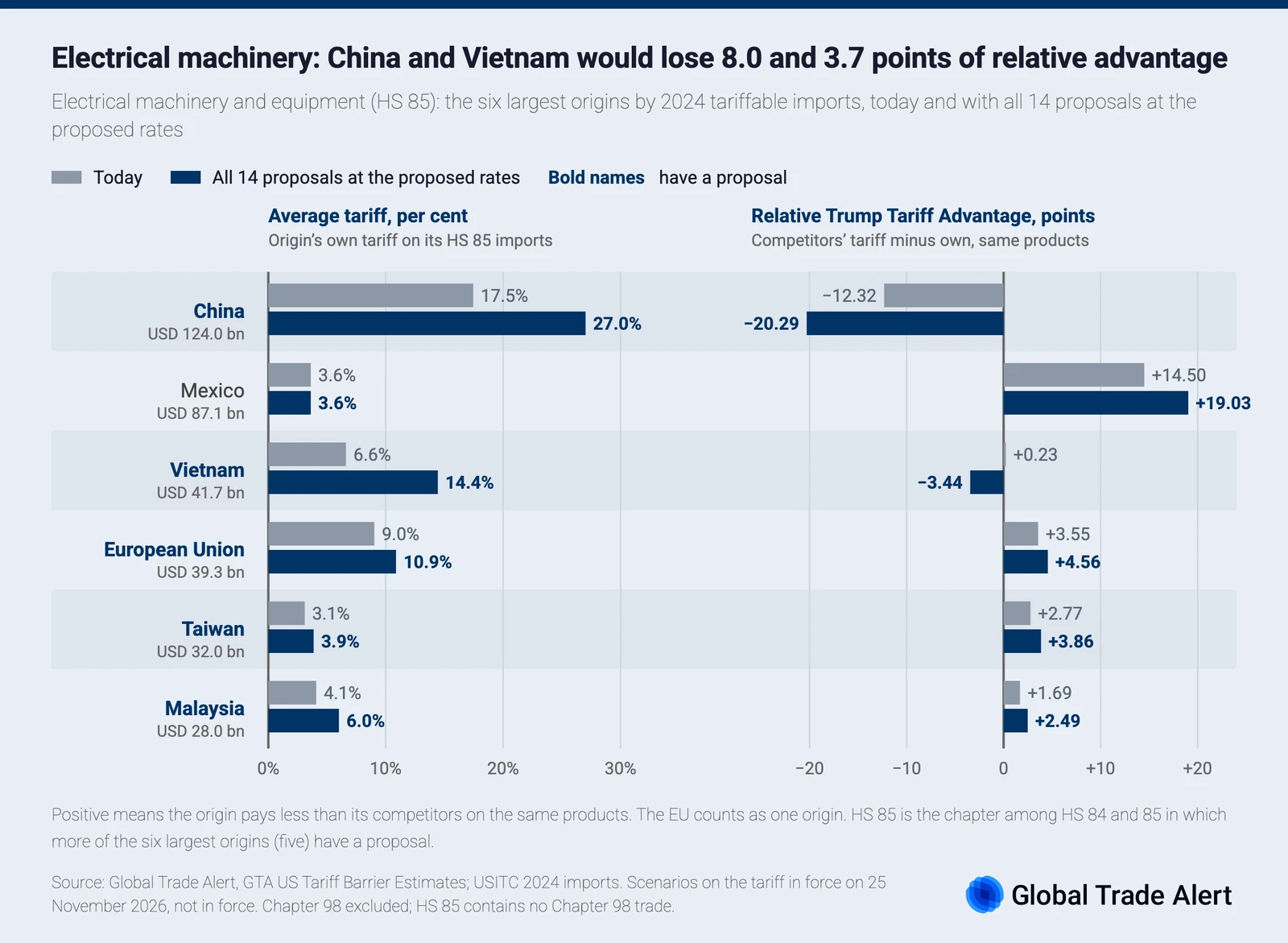
In HS 85, electrical machinery and equipment, China's RTTA falls by 8.0 points, more than its 6.3 overall, and its average rises from 17.5% to 27.0%. Vietnam's RTTA falls by 3.7 points, less than its 5.8 overall, from +0.23 to -3.44, so Vietnam moves from a small advantage to a disadvantage in the chapter. Mexico's RTTA improves by 4.5 points, the EU's by 1.0 and Taiwan's by 1.1.
China would account for at least half of the rise
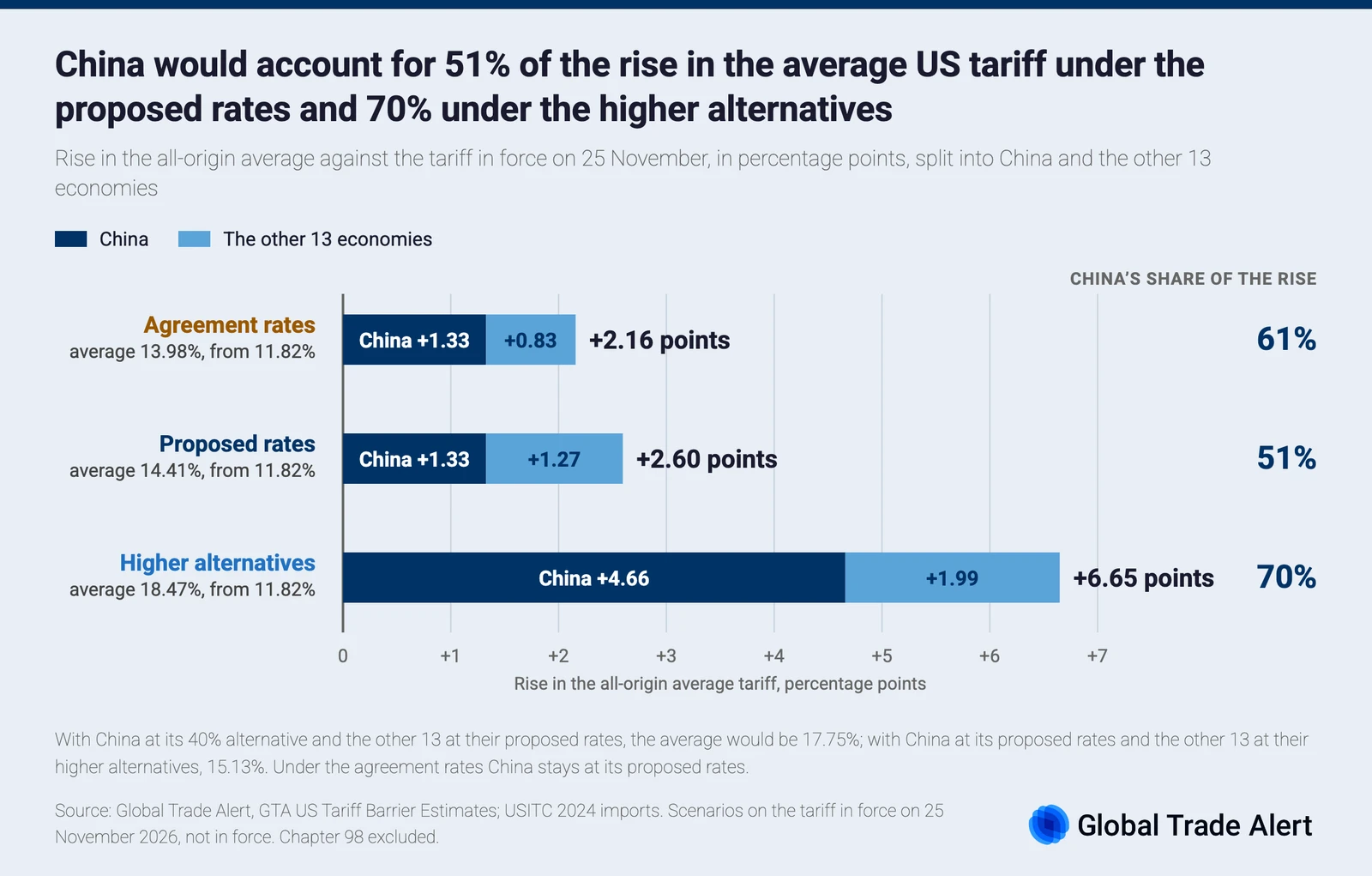
The average U.S. tariff on Chinese imports would rise from 25.0% to 34.8% under the proposed rates, and to 59.2% under its 40% alternative. That alternative is net of the forced-labour duty, so the average rises by 34.2 points, not 40. Of the 2.6-point rise in the all-origin average, China contributes 1.3 points, or 51%. Of the 6.6-point rise under the higher alternatives, China contributes 4.7 points, or 70%. Under the agreement rates its share is 61%, because the rises of Singapore, India and Vietnam shrink and China's does not. The other 13 economies contribute 1.3 points under the proposed rates and 2.0 under the higher alternatives.
China accounts for most of the difference between the proposed and the higher-alternative scenarios. Raising China alone to its 40% alternative lifts the all-origin average from 14.4% to 17.7%. Raising the other 13 alone to their higher alternatives lifts it to 15.1%.
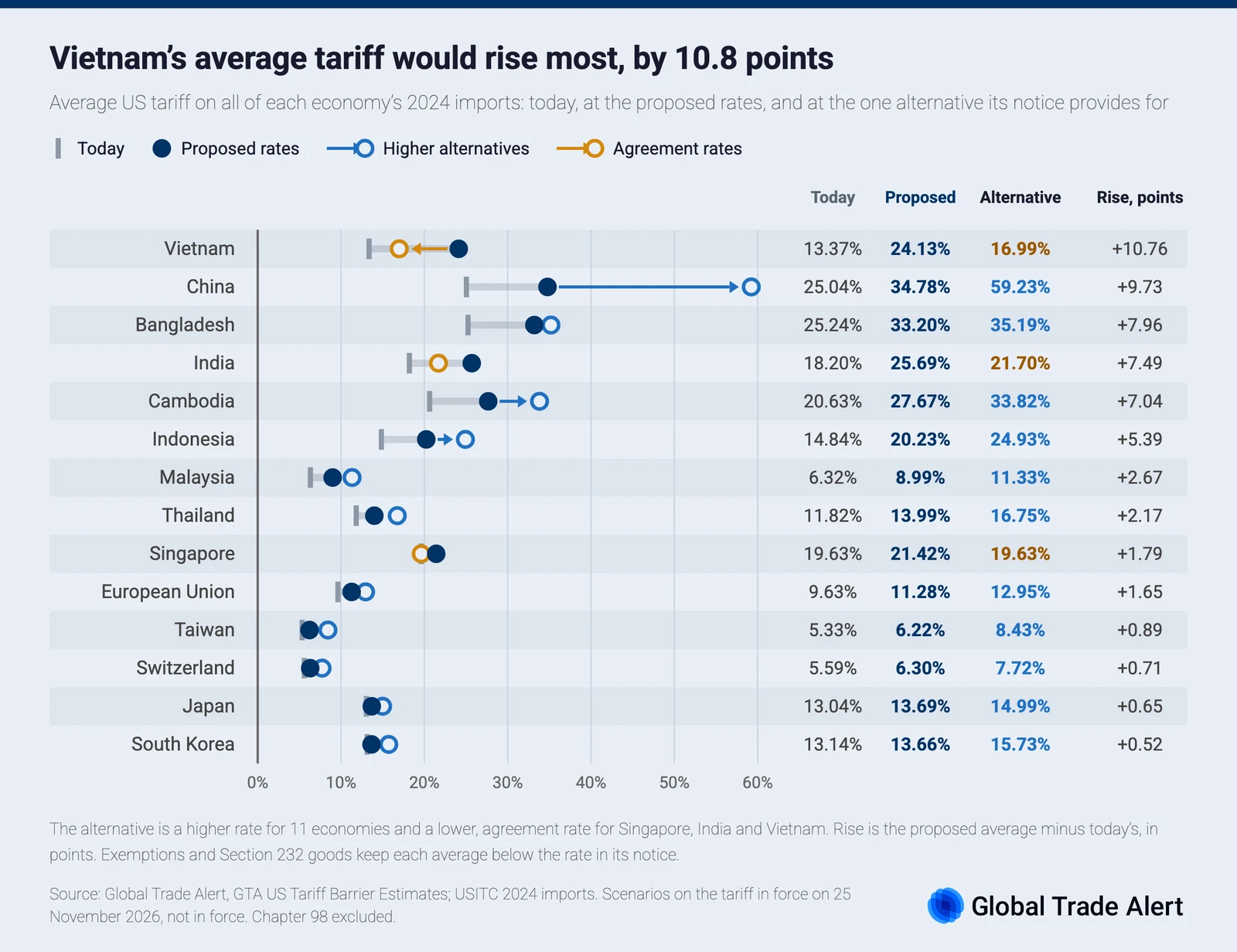
Vietnam's average would rise most, by 10.8 points
Under the proposed rates, Vietnam's average would rise from 13.4% to 24.1%. China's would rise by 9.7 points, Bangladesh's by 8.0 and India's by 7.5. Four economies would rise by less than a point: South Korea's by 0.5, Japan's and Switzerland's by 0.7 and Taiwan's by 0.9. The EU's would rise by 1.6. All five have a 15% proposal. For them the new duty only tops up what a good already pays, in the ordinary most-favoured-nation (MFN) tariff and the forced-labour duty, to 15%: a good already paying 12% in those duties would face 3 points of new duty, and a good paying 15% or more none. Exemptions from the new duty for annex-listed goods, and for goods already under Section 232 duties, which the United States applies on national-security grounds, remove much of their trade.
The higher alternatives would add 34.2 points to China's average, 13.2 to Cambodia's and 10.1 to Indonesia's. Under the agreement rates, Vietnam's and India's averages would still rise, by 3.6 and 3.5 points, against 10.8 and 7.5 under the proposed rates. Singapore's average is 19.6% today, 21.4% under its proposed rate and 19.6% under its agreement rate.
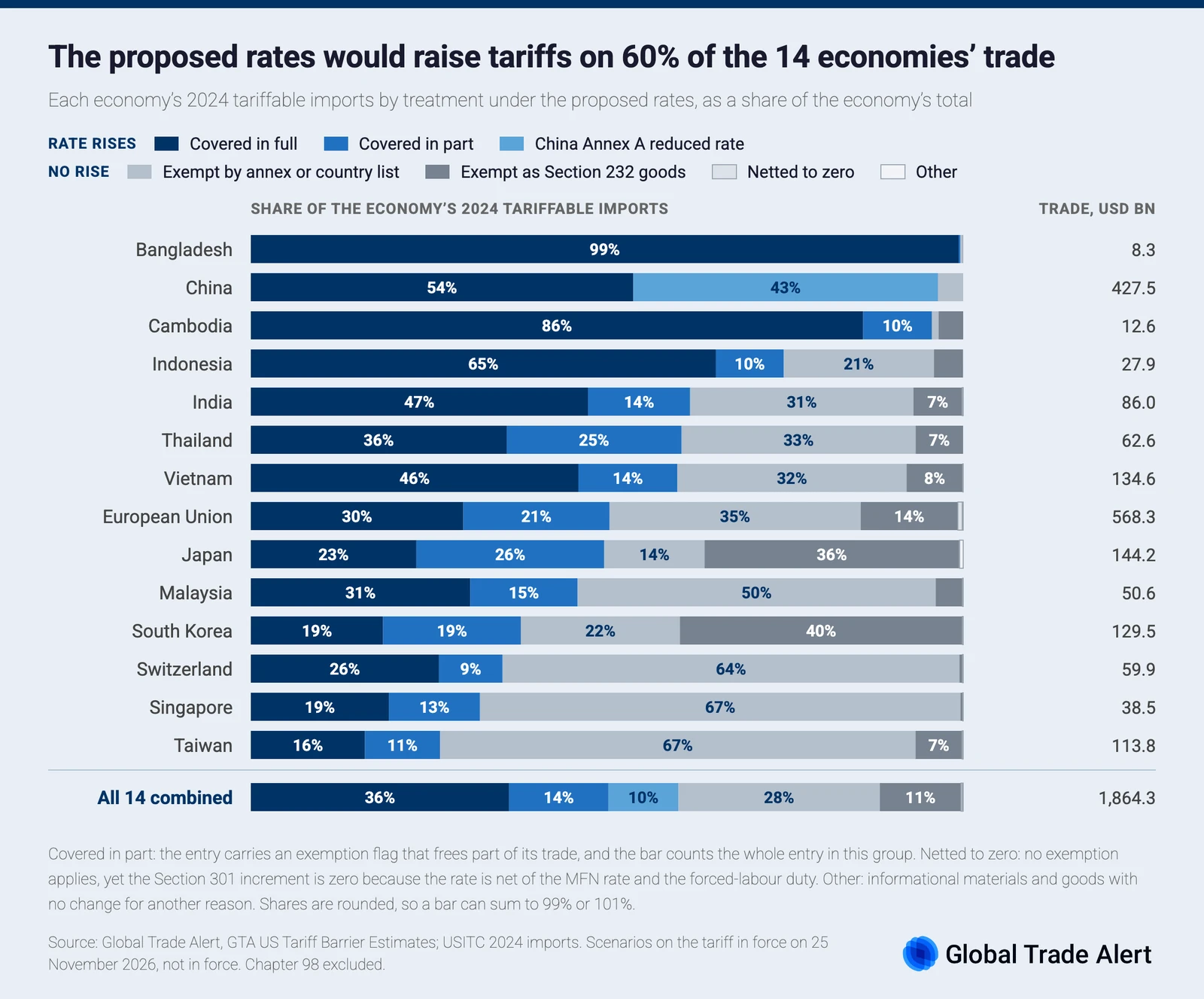
The observed spread is largely due to exemptions. Of the 14 economies' USD 1,864 billion of tariffable trade, we estimate that 60% would face a new duty: 36% at the full proposed rate, 14% on part of its value, where an exemption covers only part of a line's trade, and 10% at China's reduced Annex A rate. Another 28% would be exempt from the new duty on the annex and country lists and 11% as Section 232 goods. The remaining 0.3% is informational material or already netted to zero, and the shares are rounded. The annex lists exempt 67% of Taiwan's trade, and Section 232 goods account for 40% of South Korea's and 36% of Japan's. For Bangladesh, 99.6% would face a new duty.
Status and method
Status. These are proposals. USTR published them on 25 November 2026 as pre-publication notices with no effective date. Comments are due on 5 January 2027 and hearings begin on 25 January 2027. USTR made no determination for Mexico and Norway, the other two economies it investigated. The baseline is the tariff in force on 25 November and excludes the Section 232 duties on polysilicon that start on 4 December.
Rates and exemptions. Where a notice proposes a rate "net of" existing duties, we read it good by good: the new duty is the gap between the proposed rate and what those duties already charge on that good, never below zero. We read China's notice as written, with no Section 232 exemption. The annex flags "Ex", "Aircraft" and "Pharma" limit an exemption to a listed article, to civil aircraft or to pharmaceutical use, and the notices do not say how much trade that covers. We assume that 50% of "Ex" and "Pharma" trade and 90% of "Aircraft" trade is exempt, the shares we used for the earlier Section 301 action on forced labour. These are assumptions, not findings. We have not tested how they move RTTA values near zero, such as Singapore's -0.5 and the EU's +0.3.
Data. Weights are static 2024 imports, with banned trade removed, and the dataset carries both Chapter 98 bases. Our RTTA implementation reproduces all 225 country figures published on 24 July. The figures say nothing about trade after the proposals. The rates, netting and exemptions in the notices are set out in Section 301 Excess Capacity: The Proposed Rates, the Alternatives and the Exemptions, Economy by Economy.