With its determinations of 25 November 2026, the USTR proposes two regimes: one for 13 of the investigated economies and one for China specifically. This article first discusses the 13 and then turns to China specifically.
The USTR determination proposes to split institutional partners on whether the new proposals account for MFN and Section 301 rates or only the latter. Five notices propose a tariff "net of MFN rates and existing Section 301 tariffs": the European Union at 15%, and Japan, South Korea, Switzerland and Taiwan at up to 15%. Eight propose a tariff "net of existing Section 301 tariffs": up to 18% for Bangladesh, Cambodia, Indonesia, Malaysia and Thailand, up to 20% for Singapore, up to 25% for India and up to 35% for Vietnam.
Ten of the 13 would consider a higher rate should USTR find consultations and commitments unsatisfactory. It would be up to 20% for the EU, Japan, Switzerland and Bangladesh, and up to 25% for South Korea, Taiwan, Cambodia, Indonesia, Malaysia and Thailand. Taiwan's higher rate would be net of existing Section 301 tariffs only. Singapore, India and Vietnam would consider 10%, 17% and 20% if they reach an Agreement on Reciprocal Trade "responsive to the determinations" (Singapore: "or other negotiations"), with no "up to" and no stated basis. The higher rates for the EU, Japan and Indonesia would apply "except as identified in the Annex", where the other seven provide for "exemptions for certain goods identified below". The EU notice also proposes that "this adjustment terminate on December 1, 2028", without saying which rate it ends.
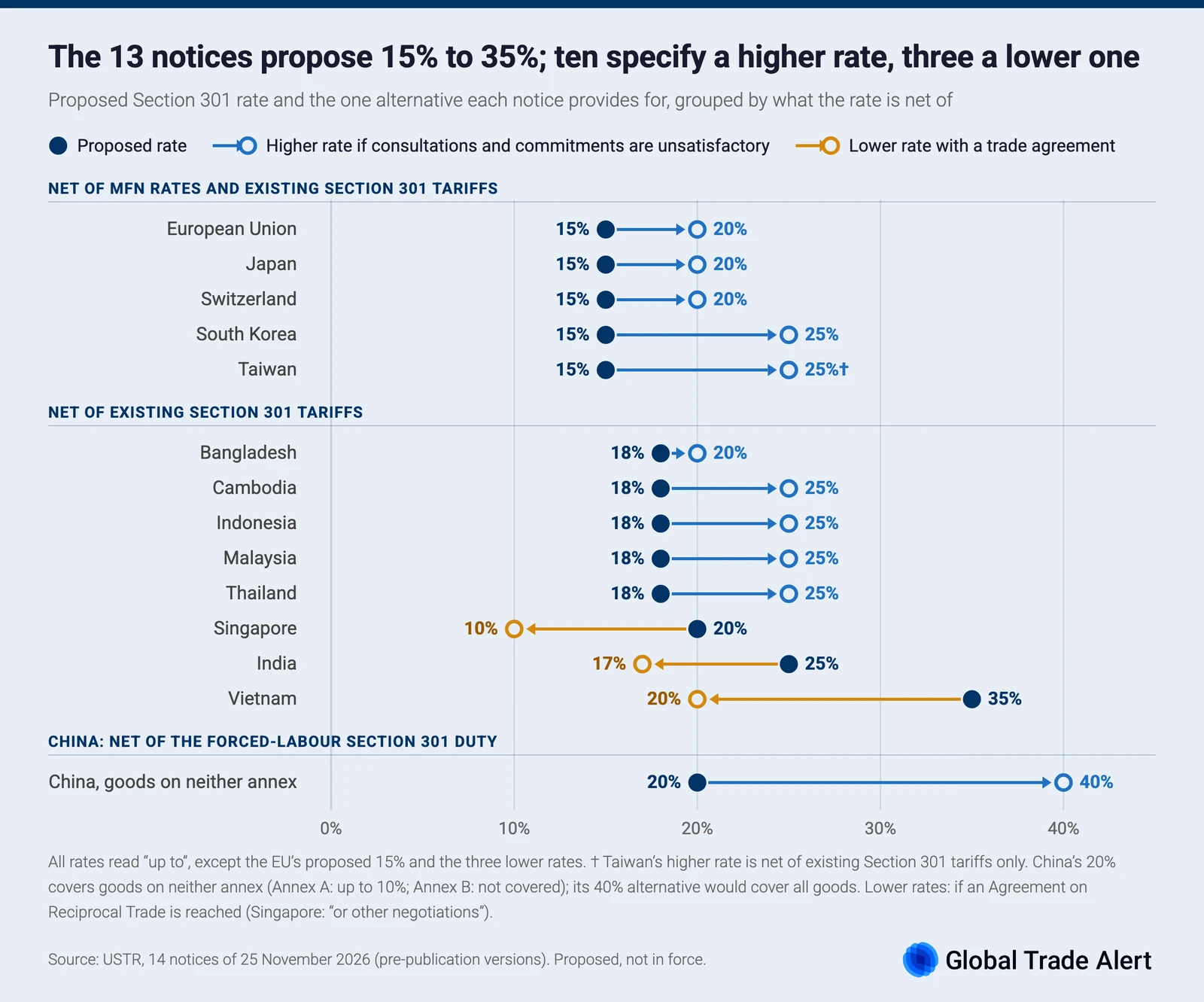
Rates specified in the notices: the proposed rate and the one alternative per economy, grouped by netting basis. China is shown separately.
The new duty would top up what is already charged
The notices do not define "net of". Based on previous practice, we interpret that the new duty would be the gap between the proposed rate and the listed duties already charged, never below zero, with MFN credited at the rate charged. The new rate would then absorb the forced-labour duty in force since 24 July 2026. For the five economies whose new rate is net of MFN, that duty is already net of MFN too. In those five, MFN plus Section 301 would be topped up to the stated rate, and a good whose existing duties already exceed it would pay nothing more. In the other eight, MFN would stay on top.
Illustrations on this reading, assuming the maximum is adopted, both actions cover the good and no other duty applies: a Japanese good with 2% MFN pays 12.5% in total today and would pay 15%. A Vietnamese good with 3% MFN pays 15.5% today and would pay 38%.
The 13 notices would leave listed goods outside the proposal
All 13 notices exclude a general list, the forced-labour universal list plus HS 2601.12.00, and seven add an economy-specific list. The EU's list adds Champagne produced in France and Irish and Scotch whiskies. Listed products "are not covered by the proposed action, except as provided in the 'Scope Limitations' column": "Ex" limits an entry to the article described, "Aircraft" to civil-aircraft articles meeting General Note 6 of the HTSUS, and "Pharma" to pharmaceutical use.
The text also proposes to exempt articles "currently subject to tariffs under Section 232" in listed categories, informational materials, donations, accompanied baggage and "certain agglomerated iron ores and concentrates".
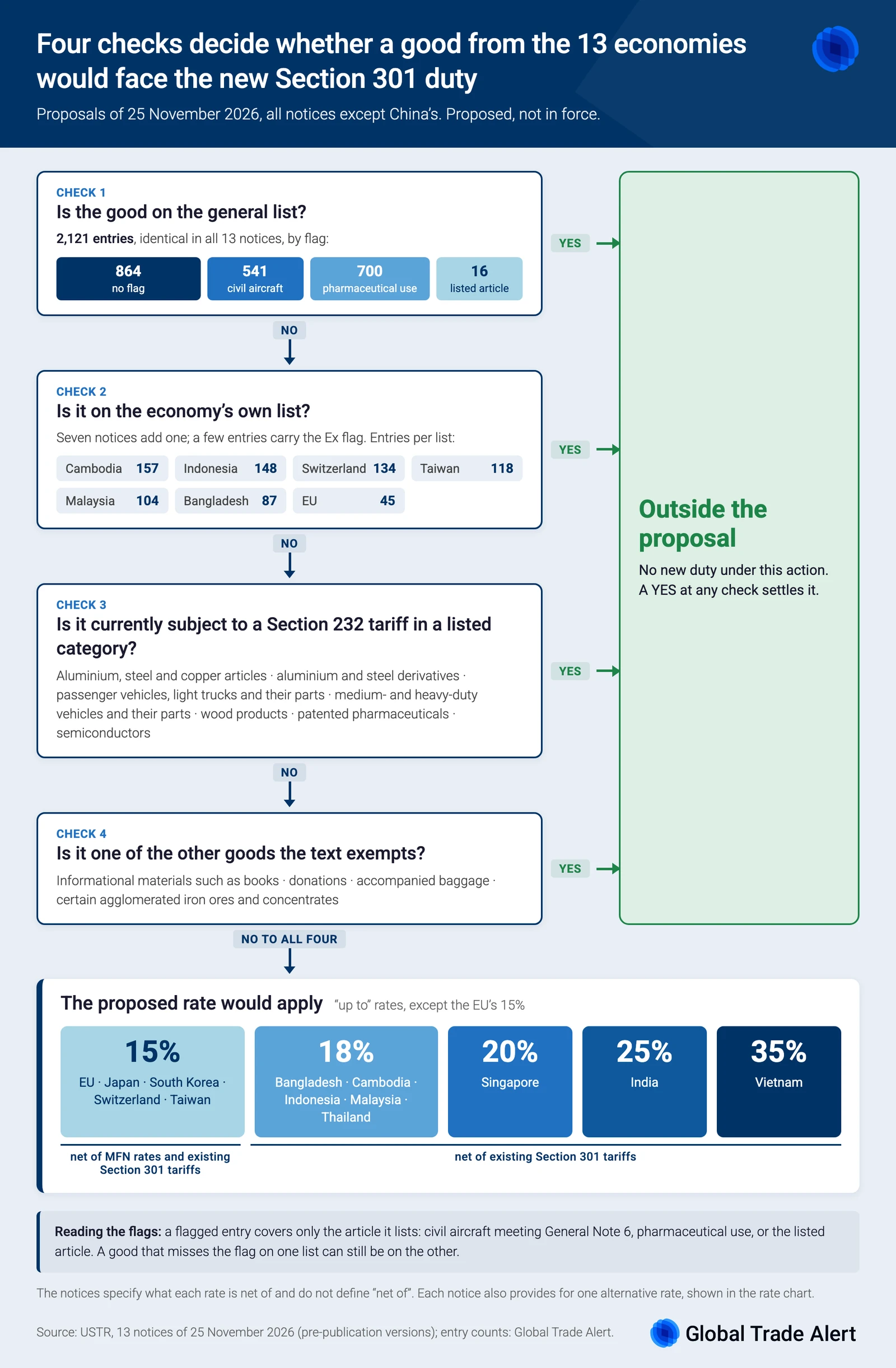
How a good of the 13 economies would be checked. A YES at any of the four checks leaves it outside the proposal.
China's notice would set up to 20%, up to 10% or no new duty by annex
The USTR proposal for new Section 301 duties against China differs markedly from the other 13. Goods outside the annexes would face up to 20% "net of the rate of duty applied to the good" under the forced-labour investigation, which is 12.5% on the goods that duty covers. The offset lists neither MFN nor earlier China duties. Annex A, the 2,121 general-list entries, would face up to 10%, subject to its flags, with no netting stated. Annex B, 77 entries from the US-China Board of Trade "30-For-30" list, is "not covered by the proposed action, except as provided in the 'Scope Limitations' column". The notice has no general exemption for Section 232 articles, informational materials, donations or baggage. Should engagements "inadequately address the issues", it would consider up to 40% "on all goods of China", net of the forced-labour duty, with no annex treatment stated.
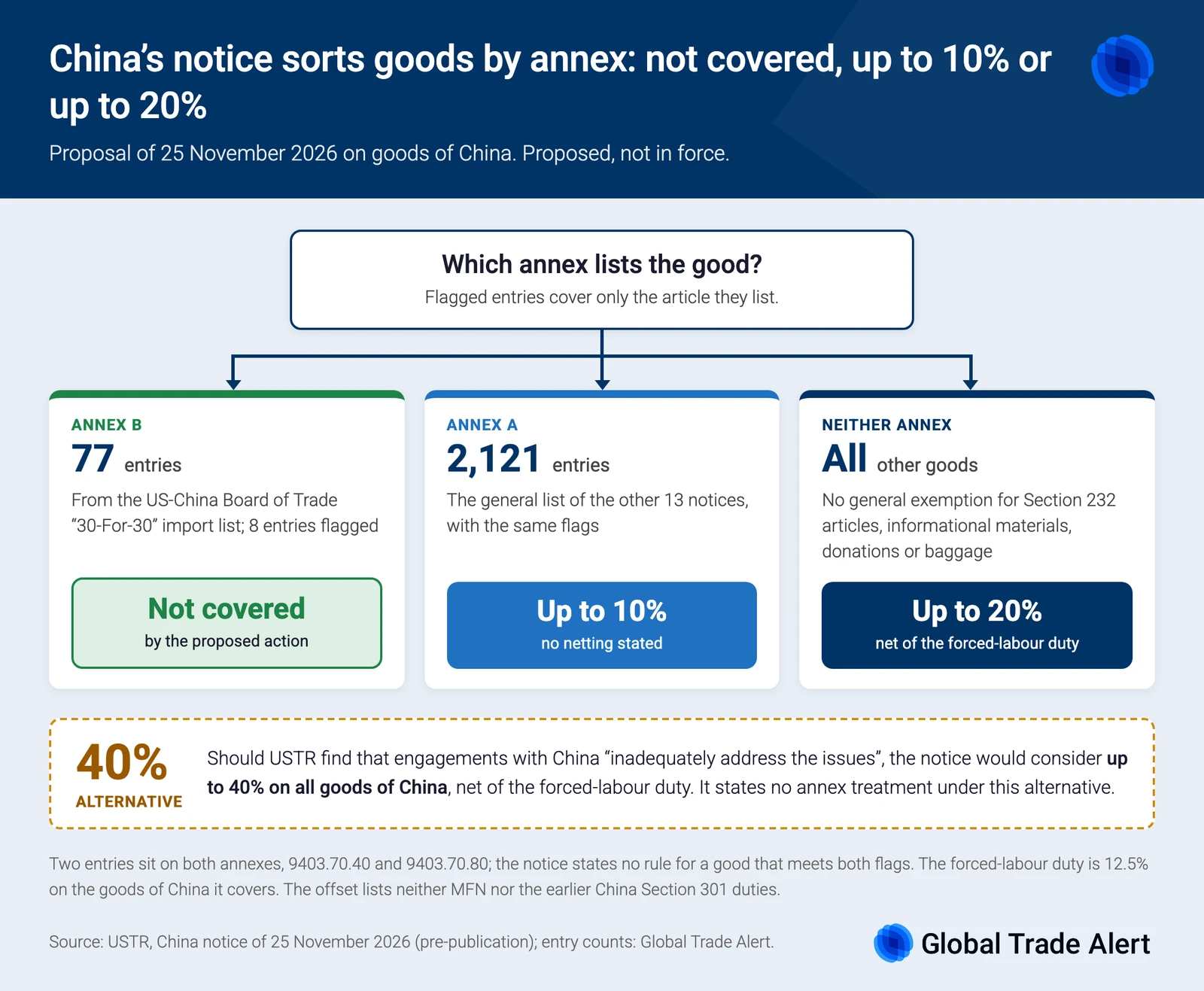
How a good of China would be treated, by annex, and the alternative the notice provides for.
Comments go to 14 dockets, and the request docket is shared
Four notices (Bangladesh, Cambodia, India, Malaysia) ask whether a textile mechanism should allow "a certain volume of apparel and textile imports" at a reduced rate, and propose neither a rate nor a volume. Requests to appear, with a summary of testimony, go to docket USTR-2026-0741 by 5 January 2027, and written comments to each economy's docket on comments.ustr.gov.
| Economy | Comments docket | Economy | Comments docket |
|---|
| Bangladesh | USTR-2026-0727 | South Korea | USTR-2026-0734 |
| Cambodia | USTR-2026-0729 | Malaysia | USTR-2026-0735 |
| China | USTR-2026-0278 | Singapore | USTR-2026-0736 |
| European Union | USTR-2026-0730 | Switzerland | USTR-2026-0737 |
| India | USTR-2026-0731 | Taiwan | USTR-2026-0738 |
| Indonesia | USTR-2026-0732 | Thailand | USTR-2026-0739 |
| Japan | USTR-2026-0733 | Vietnam | USTR-2026-0740 |
In section VIII, the Cambodia, Japan, Singapore and Vietnam notices print their own comments docket in place of USTR-2026-0741.
Download the 14 notices and the annex lines
All 14 notices as one archive: ZIP of 14 notices
| Economy |
Pages |
Notice |
| Bangladesh |
133 |
PDF |
| Cambodia |
139 |
PDF |
| China |
134 |
PDF |
| European Union |
132 |
PDF |
| India |
131 |
PDF |
| Indonesia |
138 |
PDF |
| Japan |
130 |
PDF |
| South Korea |
131 |
PDF |
| Malaysia |
136 |
PDF |
| Singapore |
130 |
PDF |
| Switzerland |
134 |
PDF |
| Taiwan |
136 |
PDF |
| Thailand |
129 |
PDF |
| Vietnam |
129 |
PDF |
Source: United States Trade Representative, notices of 25 November 2026. Global Trade Alert.