Broad Economic Support Leads Hormuz Policy Response
GTA Monthly Newsletter: April 2026
Authors
Global Trade Alert
Date Published
15 Apr 2026
Related Topics:


GTA Monthly Newsletter: April 2026
Global Trade Alert
15 Apr 2026
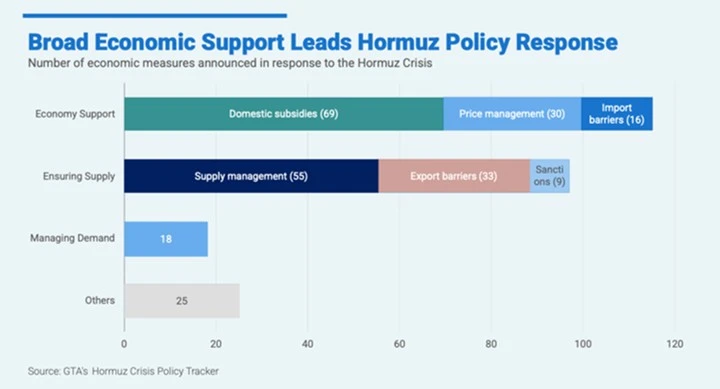
The Hormuz Crisis is the largest supply disruption in the history of the global oil market. Six weeks in, it is becoming a long-term crisis. Traffic through the strait remains severely restricted, and infrastructure damage across the region will take years to repair. The policy response reflects its nature: broad-based, defensive, and driven by supply security rather than strategic confrontation. GTA's Hormuz Crisis Tracker has recorded over 250 policy interventions. Over half fall outside the GTA's traditional reporting scope. What governments are doing, and with which instruments, reveals the kind of crisis this is.
The measures deployed to contain the price shock are mostly economy-wide and consumer-oriented, not targeted at specific industries. Almost a third of the measures captured by the Tracker are subsidies, taking the form of fuel tax cuts, excise reductions, and VAT relief applied across the board. These go alongside caps on retail energy prices. The adopters span the income spectrum and every region: from Zambia to Germany to South Korea.
The sectors being liberalised map directly onto the crisis transmission channels. Almost 90% of import measures in the Tracker are liberalising. Energy goods are the primary focus, but reductions extend beyond energy. Türkiye eliminated import duties on fertilisers, and India introduced temporary exemptions on ammonium nitrate, chemicals and plastics.
The tension between collective coordination and unilateral hoarding defines this response. The IEA coordinated a stock release with commitments from over 25 members. OPEC+ members announced additional voluntary production adjustments. But alongside this, at least 19 jurisdictions have imposed export restrictions on energy, fertiliser, and agricultural products. India established and increased excise duties on exports of diesel and aviation turbine fuel. China reportedly instructed refiners to suspend diesel and gasoline exports and banned sulfuric acid exports.
Supply access overrides sanctions logic, even for belligerents and traditional allies. Washington is simultaneously conducting military operations against Iran and easing restrictions on Iranian crude. OFAC issued temporary authorisations easing sanctions on Iranian, Russian and Venezuelan oil. London followed the same logic, re-allowing Kazakh-origin crude transiting through Russia to prioritise supply access over sanctions consistency.
The demand-side response reveals Asia's dependence on Hormuz energy flows. Nine Asian economies, including Bangladesh, Indonesia, Pakistan, the Philippines, and Vietnam, introduced measures to reduce energy consumption. Only five jurisdictions outside Asia appear in the Tracker under this category. Measures range from shortened workweeks and mandatory office closures to fuel purchase limits, reduced street lighting, and bans on hoarding.
The nature of a shock shapes the policy response. Previous crises with an identifiable source and concentrated sectoral harm produced targeted, discriminatory trade measures. This crisis has multiple transmission channels and diffuse cost pass-through, making targeted trade measures an ineffective response. The result is broad-based subsidies, price controls, import liberalisation, and a scramble for supply that overrides even sanctions logic.
Whether the policy mix shifts from economy-wide cushioning toward sector-specific support and more restrictive trade measures will signal how governments judge the crisis trajectory. As the situation evolves, so will the data. The full dataset is available through GTA's Hormuz Crisis Tracker.
Sign up here to receive every Monthly Newsletter prepared by the GTA.