


This note draws on Small Markets, Global Winners: Pathways to Competitive Industries Beyond Trade Distortions, the study Simon Evenett and Fernando Martín Espejo wrote for the World Economic Forum with IMD Business School (October 2026). Over the coming weeks, we will release its case studies in this format, one industry at a time. Each case asks the question the study asks, which is what made firms invest, and each draws lessons on productive development and industrial policy for emerging economies: policy that changes the decisions of investors, removes a specific obstacle firms cannot clear alone and works without a large budget or a large home market.
Authors
Fernando Martín Espejo
Date Published
05 Nov 2026
Related Topics:

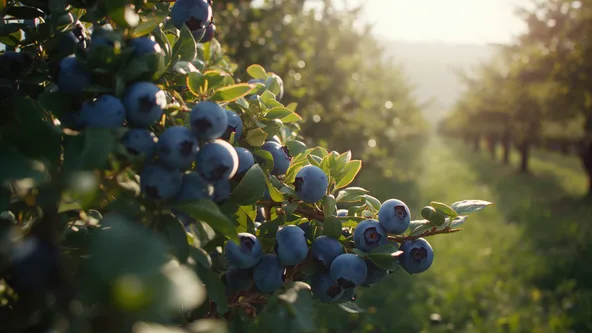
Peru built the world’s largest blueberry export industry without choosing the crop: the state paid for water, plant health and market access, and later for a tax break worth about 1,850 million soles a year. But those public goods served every crop and were in place years before the first blueberry was planted. What chose blueberries was a season in which no rival could ship and an idea that made the coast fruit in it. A season is worth nothing until someone finds the crop that uses it, and the finding is the one thing Peru did not pay for.
Industrial policy has a familiar argument with itself. One side says governments cannot pick winners and should build roads, ports and courts, while the other says markets underfund new industries and the state must back them directly. Peru’s blueberries are usually cited for the first side, because exports rose from US$17 million in 2013 to US$2.457 billion in 2025 and no ministry ever named the crop.
The case is better than that, because the record shows which public goods mattered and where the state was missing. It also shows two factors that appear on no budget line, the season and the entrepreneur’s idea, and those two decided which crop the public goods would end up serving.
The public goods served every crop
What the state built is not in dispute. Peru’s governments turned coastal desert into farmland with irrigation projects such as Chavimochic and Olmos, and SENASA, the agrarian health service, opened China in November 2016. United States rules already admitted treated Peruvian blueberries in 2005, when Peru exported almost none, and in March 2018 the US authorised irradiation as an alternative to fumigation. Peru also signed trade agreements with the US, China and the European Union. None of these measures mentioned blueberries, and all of them had served asparagus, grapes and avocados first.
Peru’s agrarian promotion law, which cut the income tax to 15 per cent, completed the set. Two of these measures were designed for scale: the Chavimochic project auctioned its desert to the bidders who committed the most capital in the shortest time, which put the land in the hands of firms able to plant thousands of hectares at once. SENASA mattered most because the private sector could not replace it, since a firm can buy research abroad but cannot negotiate a plant-health protocol with China. All of these measures lowered the cost of growing anything on the coast, which is why they cannot explain why the coast grew blueberries.
Consider asparagus. On the same canals Camposol had become the world’s largest asparagus producer by the time of the 2008 financial crisis. Blueberries waited: Chavimochic was delivering water in the 1990s and the US door was open from 2005, yet Peru still exported almost no blueberries in 2010. If public goods were enough, the crop would have followed the water as asparagus did. Why did it wait?
The price was a rent on the calendar
The first half of the answer is the calendar. The US harvest runs mainly from March to October, and Peruvian fruit can fill the months after it, before Chile’s season has started. In 2022-2025, 62 per cent of the blueberries the US imported from Peru entered in August-November, when Chile, the incumbent supplier, sent almost nothing, and even in December-February, Chile’s own window, Peru sent more: 49 thousand tonnes a year against 40. Peru has the American autumn almost to itself.
That position carried a large premium. Early Peruvian blueberries fetched US$14-15 a kilogram free on board, against US$2-3 for asparagus, the crop they displaced, and even at the US$6-7 of the mid-2020s they paid more than any other fresh produce a Peruvian grower could plant. At about five times the price of the crop they replaced, blueberries needed no crop-specific subsidy, and the treasury paid nothing for the premium.
Firms moved fast once the premium was known. Camposol, the largest agro-industrial company in Peru, went from one trial hectare in 2009 to an order for plants for 2,000 hectares in 2011, when the whole country held about 50. Peru passed Chile in the US market in 2019 and in 2025 shipped 4.2 times as much.
A season needs a crop
But the calendar was not new. The textbooks said the coast could not grow blueberries, because the plant needs winter chill hours to flower and a coast at 18-22°C all year, with no frost, has none. Comparative advantage is a label applied after the fact. A season is worth nothing until someone finds the crop that uses it. In Peru that someone was Carlos Gereda, an agronomist who founded Inka’s Berries in January 2009 with no land, no laboratory and almost no capital.
Of the 14 Chilean varieties Mr Gereda had tested on the coast, one, Biloxi, a low-chill variety that Chile had discarded as too small and soft, fruited almost all year. The find was partly luck, and the luck matters for policy: nobody screening for a winner would have picked a variety Chile had thrown away.
The second idea was where to stand in the chain. Plants imported from the US took up to two years to arrive and often died in quarantine, so Mr Gereda cloned his own in a laboratory rented from La Molina, the public agrarian university, in under six months. He then wrote to every large exporter in Peru, and Camposol planted his seedlings on one trial hectare in December 2009: that hectare is the one behind the 2,000-hectare order.
The season and the idea are one factor, not two. With Biloxi the August-November gap became a harvest, and without a low-chill plant the gap was a fact about the calendar with no price attached. Later ideas kept widening the season: by 2024 more than 62 varieties were grown or tested in Peru, including zero-chill varieties bred for the coast, and after the 2023 El Niño cut production by about a quarter, growers moved to heat-tolerant ones. Each new variety moves the edge of the window, and the window is what the market pays for.
The strongest objection to this reading is that the discovery was coming anyway. Hortifrut, the Chilean berry company, entered Peru once Camposol’s results were known, with plants from US nurseries, and the weight of comparative advantage implies that the coast would have found its crop sooner or later. The objection is probably right about the destination. It says nothing about the date, or about who paid for the first hectare, and a country that waits for discovery to arrive on its own is likely to wait longer than one that pays for it.
Nobody paid for the experiment
The money is where the state was missing. A private-equity investor walked away from a US$150,000 deal on signing day, every bank said no, and the nursery survived because growers paid for plants in advance: the first customer financed the first supplier.
Economists call this gap self-discovery: the pioneer pays the full cost of finding out what a country can produce, and followers copy the answer for free. Peru had innovation funds in 2009, small co-financing grants for projects, but we found no record that any reached Inka’s Berries. Seed capital for new firms arrived only in August 2014, through Startup Perú, with grants of up to 150,000 soles, worth about US$53,000 at the 2014 average rate and about a third of the cheque that vanished in 2009. The state appeared in the experiment only as the quarantine that imported plants had to survive and as the landlord of a university laboratory, and in neither role did it carry any of the risk.
The money went to scale
Money did flow later, to scale. Peru’s agrarian tax regime ran from 2000 to 2020, lapsed after protests in December 2020 and returned in September 2025 with a 15 per cent income tax rate until 2035. The finance ministry put its cost at about 1,850 million soles a year, mostly for large firms, while Startup Perú has granted about 190 million soles to the whole economy since 2014. Each year the scale subsidy costs almost ten times what the seed fund has granted in twelve.
A ledger of these instruments has two columns: the field, meaning canals, protocols and trade agreements, and the harvest, meaning the tax break. The two factors that chose the crop appear in neither column. The season cost nothing, and the idea was paid for by the man who found it.
The firms filled the gaps
Where capital is scarce, firms improvise the instruments the state does not supply, and the blueberry firms did it three times. Camposol was the first customer and the first investor: it tested the idea on its own land and paid for plants in advance, so its judgement replaced the collateral the founder lacked. Inka’s Berries owned the bottleneck, the plants every follower needed, and later reported serving 80 per cent of Peru’s exporters. Camposol then scaled with the irrigated land, packhouses and supermarket buyers it already had from asparagus, at a fraction of a newcomer’s cost of entry.
Upgrading ran against the usual advice as well. Development economists tell exporters to move into processing, but Peru’s growers moved into productivity: national yields rose from 2.5 tonnes a hectare in 2013 to 13.4 in 2023, about twice the world average. Fresh fruit sells for about six dollars a kilogram against one and a half for fruit sent to processing, so the value added is the season again. This kind of agribusiness is closer to manufacturing than to traditional farming, and ten such sectors would make Peru a high-income country.
The next window is harder
If that is right, the constraint on Peru’s development is the rate of discovery. Asparagus, grapes, avocados and blueberries each needed someone to prove the crop on the same water. The next frontier, the Andean valleys below about 2,800 metres, has less water, smaller plots and weaker links to buyers. It could add a July-April window, but someone still has to find the varieties that fill it, and that pioneer will find the work harder than the first one did.
The other objection is that the state should stay out of discovery, because it would have chosen the wrong crop. That objection is probably right too: in 2009 the textbooks said blueberries could not grow on the coast. But an instrument does not need to choose. A public co-investment that matches a buyer’s trial hectare or advance order lets the buyer do the screening, and a guarantee for nurseries and genetics finances the link every follower needs. A fast lane in quarantine for trial plant material removes the one cost the state itself imposed on the experiment. A sunset on scale subsidies would pay for all three.
Peru paid for the field and for the harvest, while the season came free and the idea was paid for by the man who found it. A season is worth nothing until someone finds the crop that uses it. The next blueberry needs someone to pay for the first hectare.
Figure 1. Peru ships 62 per cent of its US volume in August-November, when Chile ships almost nothing, and in December-February Peru ships more than Chile
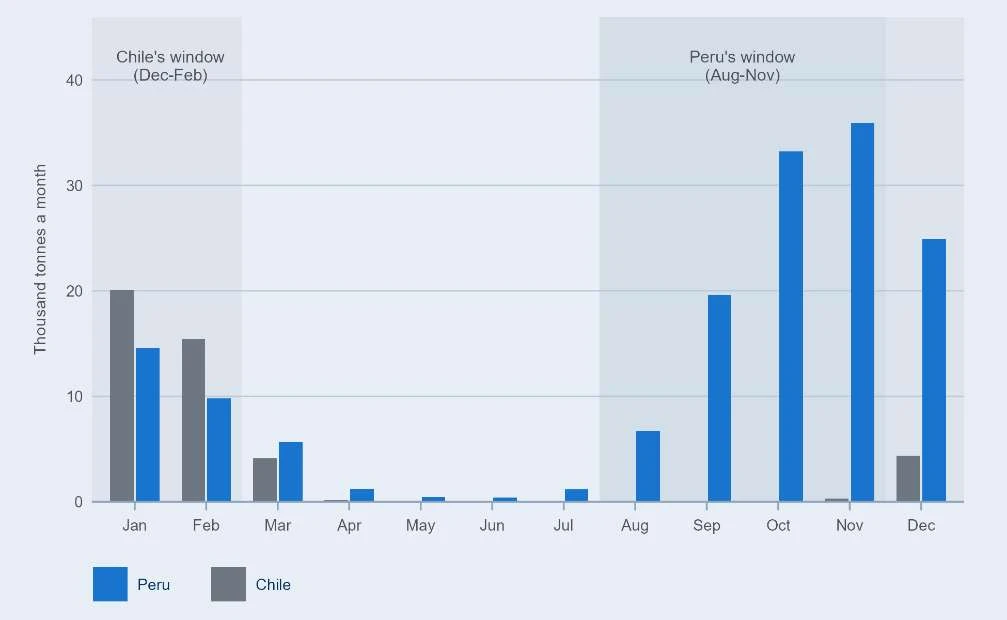
Source: Trade Data Monitor (TDM), US imports from Peru and Chile as reported by the United States, HS 0810.40 (fresh blueberries), product weight, downloaded 4 November 2026. Average monthly volume in thousand tonnes, mean of the complete years 2022-2025, by month of US entry, which runs a few weeks after shipment. August-November: Peru 95.5, Chile 0.4 thousand tonnes a year. December-February: Peru 49.2, Chile 39.9. Other suppliers and US domestic production are not shown.
Figure 2. Peru overtook Chile as a supplier of blueberries to the US in 2019, and shipped 4.2 times as much in 2025
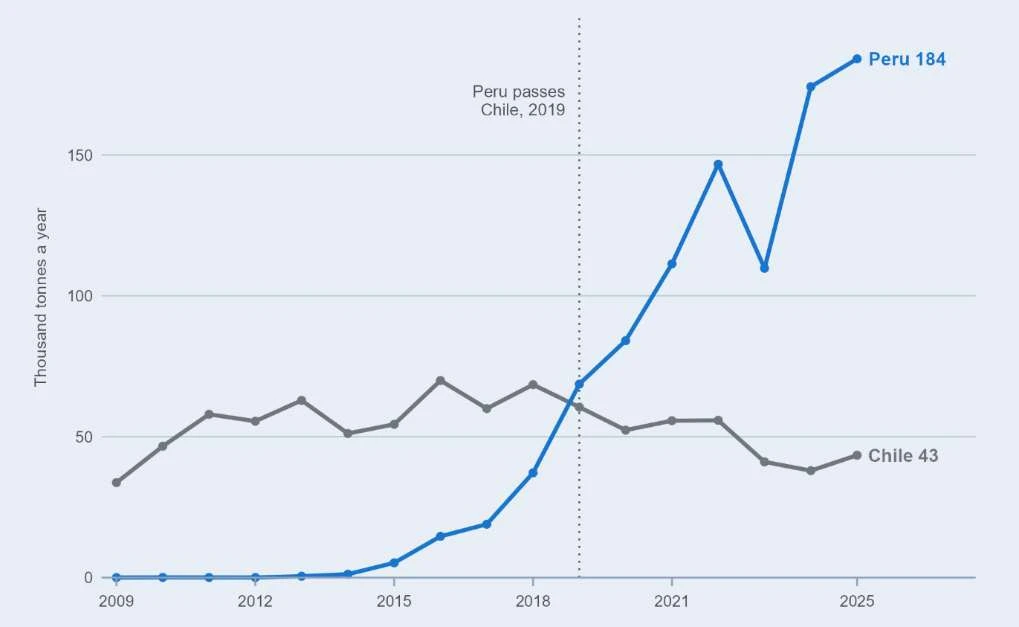
Source: Trade Data Monitor (TDM), US imports from Peru and Chile as reported by the United States, HS 0810.40 (fresh blueberries), product weight, downloaded 4 November 2026. Thousand tonnes a year, 2009-2025, the last complete year. Chile’s peak was 69.9 thousand tonnes in 2016. Other suppliers and US domestic production are not shown.