
Probe and Punish: The Rise of Unilateral Trade Investigations Outside WTO Rules
ZEITGEIST SERIES BRIEFING #92


ZEITGEIST SERIES BRIEFING #92
Ana Elena Sancho, Marius Risse
12 May 2026

Investigation-triggered trade instruments occupy an awkward position in global trade governance. They resemble traditional trade remedies: they frame actions as defensive, open with formal investigations, and can end in retaliatory measures. The critical difference is that they operate outside the WTO. No multilateral framework defines what counts as injury, what evidence is required, or how remedies are calibrated. The 2024 Chinese investigation into Canadian trade measures and the 2025 EU investigation into China's medical device procurement market illustrate the practice.
The proliferation of these instruments was not accidental but reflects a doctrinal shift in trade policy. These instruments are not new inventions; until recently, there were only a few. The US Section 301 and Section 232 authorities, China's Trade Barriers Investigation (TBI) regulation, and the EU's Trade Barriers Regulation (TBR) are the main examples. Their use was mostly tied to specific commercial grievances or, in the case of Section 232, to narrowly defined security threats. Over the past five years, that changed. Their proliferation follows how trade policy is increasingly organised around economic security rather than the enforcement of multilateral trade rules. This piece maps how these instruments have expanded and what governments now treat as worth investigating.
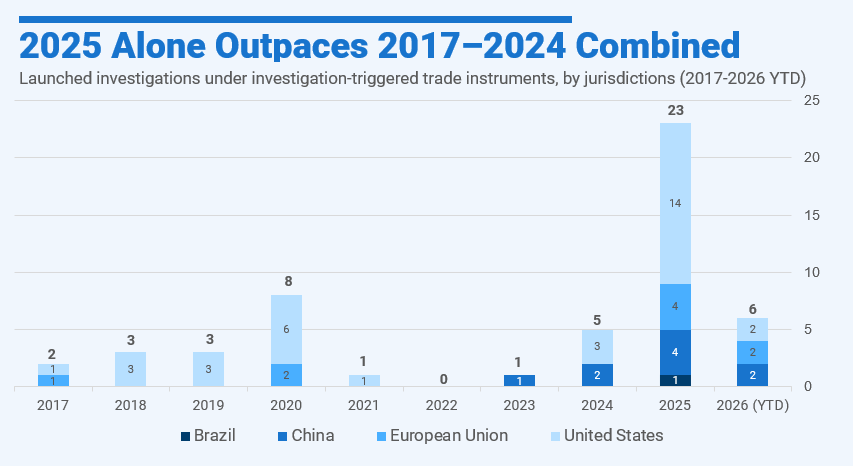
Old investigation frameworks are being deployed at a high frequency. From 2017 to March 2026, the GTA recorded 52 investigation-triggered measures (see Figure 1). 85% were linked to instruments designed before this period. Out of those, nearly half of the investigations were announced between 2025 and early 2026. Three legacy instruments account for the bulk of that activity: US Sections 301 and 232, and China's TBI regulation.
Political appetite drove governments to repurpose Section 301 and the TBI beyond their original design. Section 301 was built to convert private grievances into government findings, then into WTO cases. China's TBI gave MOFCOM broader discretion: bilateral consultations, dispute settlement, or direct countermeasures, with no required sequence. Both now put foreign government practices on a public docket, demonstrate domestic action, and give governments a negotiating card regardless of whether measures follow. Section 301 saw 13 launches between 2017 and March 2026, with seven in the last two years. China's TBI was used essentially once between 2005 and 2022. Six investigations have followed since, targeting the US*, Taiwan, Canada, the EU, and Mexico.
Section 232 was not repurposed but reinterpreted. Designed as a narrow Cold War instrument, it allowed the Commerce Department to investigate whether specific imports threatened the defence industrial base. The "national security" predicate has since expanded to cover supply chain resilience, technological competitiveness, and industrial policy. The GTA has recorded 20 launches since 2017, 12 in 2025 alone.
At least five G20 members have adopted or are actively considering new investigation-triggered instruments in the last five years. The EU adopted three in quick succession: the Foreign Subsidies Regulation (FSR), the International Procurement Instrument (IPI), and the Anti-Coercion Instrument (ACI). In 2025, Brazil enacted a law allowing it to suspend trade concessions against foreign measures harming its competitiveness. China added two new frameworks allowing for investigations in March and April 2026, covering extraterritorial jurisdiction and supply chain security. South Africa is considering legislation giving its trade minister similar investigative powers. The UK parliament has called for its own version of the ACI. Other G20 members have not yet moved in this direction, though some are assessing whether they have the right tools to advance their economic security interests**.
These new instruments differ qualitatively from the old ones. Legacy frameworks focused more narrowly on trade barriers and multilateral rights. The new ones extend into territory the older statutes did not cover: investigating and responding to foreign subsidies, procurement asymmetries, economic coercion, extraterritoriality, and supply chain risks. Their investigation triggers are broader and more open-ended. China's new frameworks illustrate this most starkly. The extraterritoriality framework activates on threats to sovereignty, security, and development interests; the supply chain framework on threats to the security of China's industrial and supply chains. Their countermeasure menus span trade, investment, finance, and personal sanctions.
The language governments use to justify these instruments has shifted from multilateral rights to unilateral security and economic interests. Older frameworks cited multilateral trade rights. For instance, China’s TBI regulations referred to “protect the legitimate rights and interests of foreign trade”, and the EU's TBI justified the adoption of the regulation to "ensure the effective exercise of the rights of the Union under international trade rules". Newer frameworks invoke distortion, coercion, reciprocity, sovereignty, and supply chain security. Section 232 is singular. It established the national security framing early, and until recently, it was a US peculiarity. It no longer is.
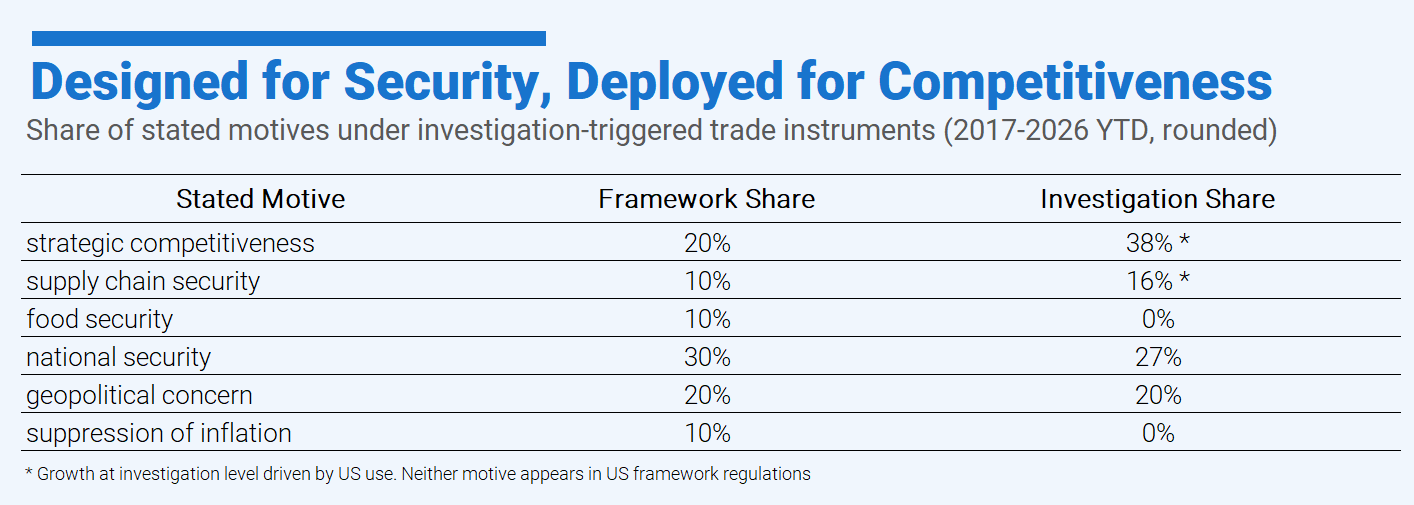
The motives governments cite when designing these instruments differ systematically from those they cite when deploying them (see Figure 2). National security dominates framework regulation language, cited in 30% of instruments adopted since 2017. Strategic competitiveness and geopolitical concern follow. When investigations are launched, the hierarchy inverts. Strategic competitiveness rises from 20% to 38% of stated motives. Supply chain security rises from 10% to 16%. Both shifts are driven almost exclusively by the United States, a country that referenced neither motive in its own framework regulations.
What this mapping reveals is the emergence of a category. Investigation-triggered instruments are not a scattering of national peculiarities but a coherent class of trade-policy tools. Some old instruments were repurposed well beyond their original design. New ones were built, extending the investigate-and-retaliate logic into territory the old frameworks never covered.
The expansion is also conceptual. Each new instrument enlarges the set of practices governments treat as worth investigating. The operating definition of economic security expands with it. The concept itself remains unsettled, its boundaries drawn instrument by instrument. As more governments build their own versions and reach for them more often, the accumulated practice will fill in the operative meaning of economic security.
*The relevant investigations target global supply chains and green product trade. China also adopted an anti-discrimination investigation on US measures in the field of integrated circuits without explicit reference to the TBI.
**For instance, Canada launched a public consultation in 2024.