The Transshipment Alibi: What the White House Report Leaves Unasked
ZEITGEIST SERIES BRIEFING #100


ZEITGEIST SERIES BRIEFING #100
Simon Evenett
14 Aug 2026
“The United States under President Trump will simply not allow its manufacturing and defense industrial foundation to be hollowed out by trade fraud masquerading as commerce,” declares The Great Transshipment Scam, published yesterday by the White House. Last year’s tariff hikes on Chinese goods and those imposed in 2018 were meant to “protect U.S. workers and industry.” By hiking tariffs in this manner, thereby abandoning the most-favoured-nation principle in tariff setting, the United States created tariff differentials across trading partners. According to this report, Chinese exporters responded by routing goods through other countries: “What began as smaller scale tariff evasion became industrial-scale customs fraud and then a global business model.”
Transshipment—which under some circumstances is a form of fraud—is not new, as the report acknowledges. The United States already has an active enforcement programme against transhipped products. As the report acknowledges, it is difficult to accurately estimate the value of Chinese exports that were formerly sent directly to the United States and are now being redirected through economies that face lower tariffs in the American market. The evidence presented in yesterday’s report is merely suggestive rather than definitive.
The question is not whether fraudulent transshipment occurs, but whether it occurred on anything like the scale alleged and whether it explains the failure of tariffs to revive American manufacturing. Fair-minded readers might note the mismatch between the strident language denouncing foreign practices and the lack of smoking-gun evidence. So, what is really going on here? Why now?
It should now be apparent to the White House that there has been no renaissance in American manufacturing employment following the imposition of punitive tariffs on China in 2018 and 2025 (see Figure 1). If anything, total manufacturing payrolls are falling, especially in the Rust Belt states.[1] The electoral significance of this failure will not be lost on political advisors in both parties.
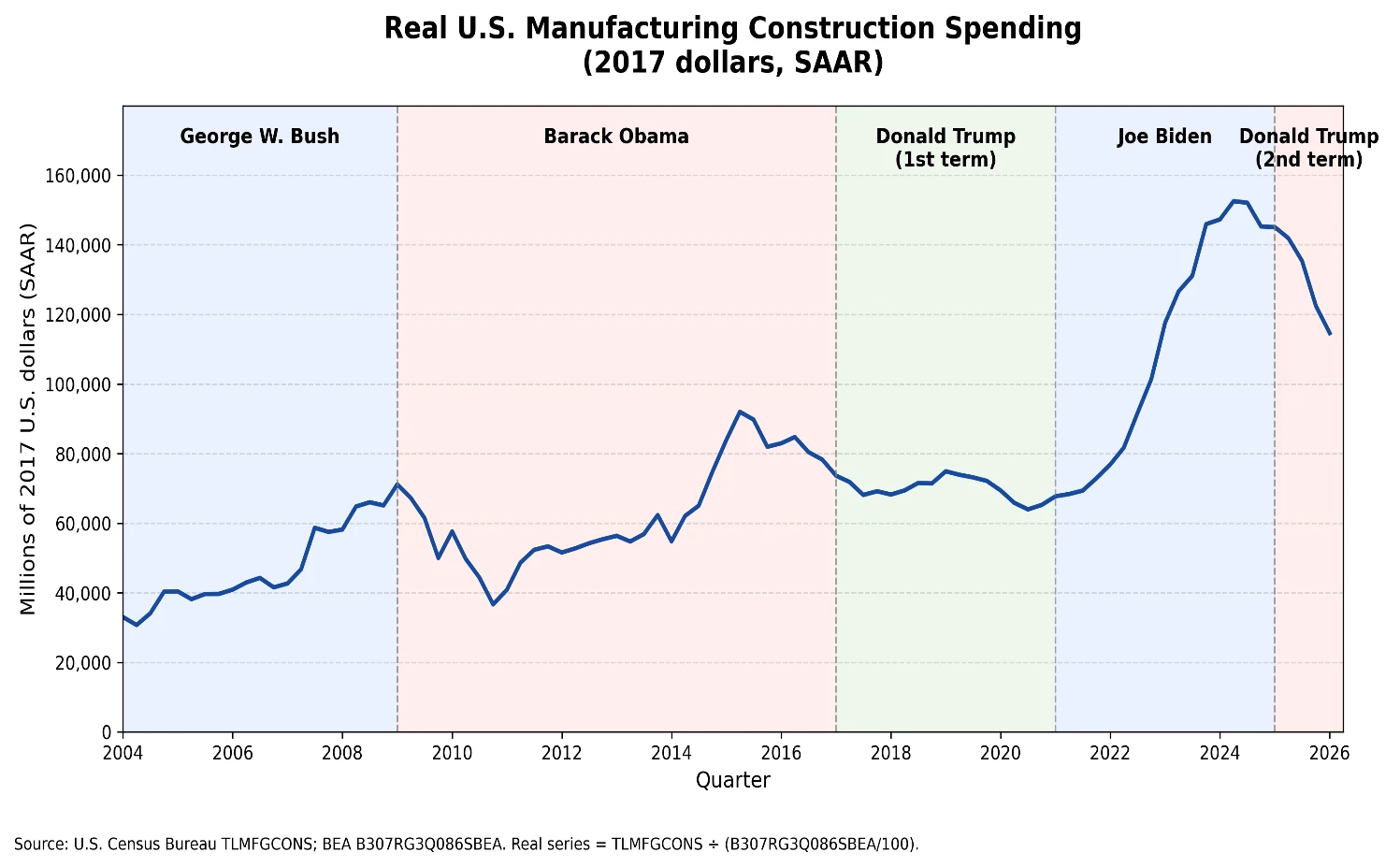
Moreover, once official US data on the cost of factory building is taken into account, the real value of manufacturing construction expenditure is falling sharply from the peaks set during the Biden administration (see Figure 2). Such findings cast a shadow on any claims that a renaissance is just around the corner.
Lastly, the latest Department of Commerce report on inward foreign direct investment flows shows only a trickle of spending in 2025 on new greenfield sites ($4.6 billion) and on the expansion of existing foreign-owned plants in the United States ($9.6 billion). Foreign executives are even more reluctant to expand their commercial footprint in the United States than their American counterparts, it seems.
Of course, this White House won’t concede that its tariff hikes are part of the problem. The goal, then, appears to be to persuade us that tariffs would have worked if only fraudulent transhipment by foreign firms had not occurred. That argument avoids discussing two fundamental matters: how imposing uneven tariffs affects American buying behaviour and the factors that affect the extent of any American manufacturing production response to higher tariffs.
Firms serving American individual and corporate buyers have three broad sourcing options. They can buy from China, buy from another foreign supplier, or buy from a producer based in the US. A tariff on China makes the first option more costly. It does not ensure that the third becomes the preferred choice. US producers must still offer the required goods at an acceptable price and quality, in the required volume and by the required delivery date. When they cannot do so, American purchasers may turn to firms in Mexico, Vietnam, India, Europe, Korea or other economies. No Chinese involvement and no customs offence are needed. The White House report accepts that some of the post-2018 change reflects lawful shifts in production, investment, and sourcing. It does not estimate how much demand shifted to US producers or how much moved to independent foreign suppliers; nor does it identify the factors accounting for either shift.
An alibi succeeds if it sustains the original account of events. That is the role allegations of transshipment fraud play here. The White House need not ask why US producers failed to capture demand diverted from China if it can argue that foreign firms and governments defeated the policy through deception. Talk about foreign cheating crowds out discussion of deficiencies in the US business environment that hold American manufacturers back. One such deficiency is the difficulty so many firms face in recruiting and retaining workers. In its Q1 2026 survey, the National Association of Manufacturers found that 44 per cent of firms reported difficulty “attracting and retaining a quality workforce.”
The transshipment alibi is meant to shield current US tariff policy. But it does so at a cost. Exporters to the United States may have to prove that ordinary production links are not evidence of fraud. American firms reliant on imported goods and components may face delays, higher compliance costs and greater uncertainty over future sourcing. Tighter transshipment enforcement is yet another example of this administration knowingly adding uncertainty to cross-border commerce.
Simon J. Evenett is Professor of Geopolitics & Strategy, IMD Business School, Lausanne, Switzerland; Co-Chair, Trade & Investment Council, World Economic Forum; Founder, St. Gallen Endowment for Prosperity Through Trade, the institutional home of the few remaining independent trackers of digital, trade, industrial, subsidy and investment policy.
AI tools assisted in the preparation of this briefing. Their use was directed and reviewed by the author, who is solely responsible for the analysis, judgements and final text.
Figure 1:
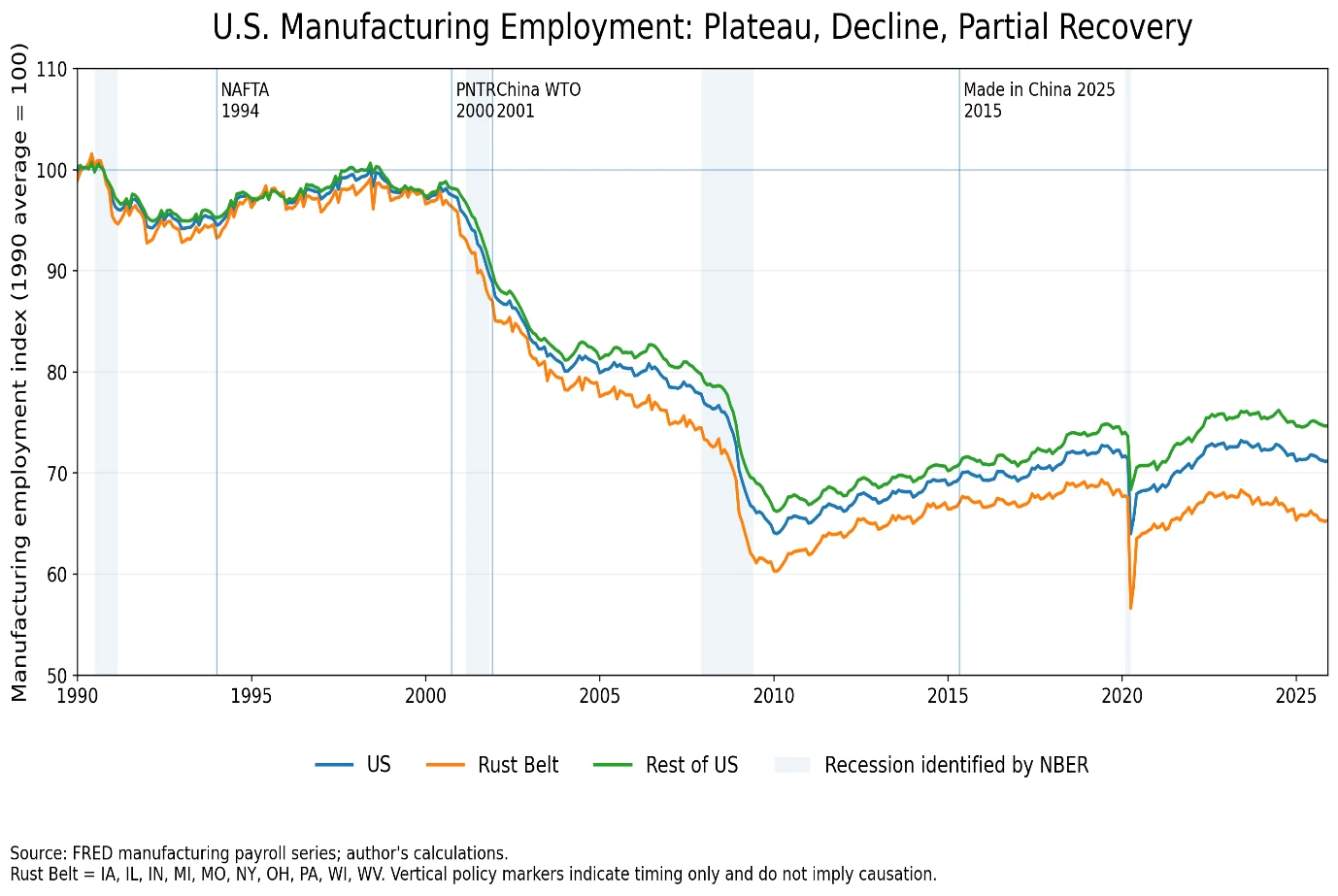
Figure 2:
In another recent piece in this series of briefings, I examine US manufacturing employment data at the national and state levels to identify what any credible explanation must explain.