
The Supreme Court Rules, Uncertainty By Design Remains: A Guide to the New US Tariff Regime
ZEITGEIST SERIES BRIEFING #86


ZEITGEIST SERIES BRIEFING #86
Simon Evenett
23 Feb 2026

Since returning to office, President Trump has repeated issued threats to raise tariffs to advance a range of foreign policy, economic, and security objectives. Unlike many other trade policies, tariffs are easy to explain and understand. Threats to impose tariffs are said by the President’s defenders to be an effective tool for bringing foreign governments and companies to the negotiating table.
Only China has retaliated to such tariffs with trade curbs of their own; other trading partners have sought deals with Washington, DC. These threats have also elicited investment promises from firms (American and foreign) and governments alike. The use of such tariffs in this manner is now in question following a ruling by the U.S. Supreme Court.
On 20 February 2026, the Supreme Court of the United States ruled, by a majority of six to three, that the International Emergency Economic Powers Act (IEEPA) does not provide a legal basis for the imposition of tariffs. One arrow has been banished from the trade policy quiver of the Trump Administration.
The ruling does not, however, affect tariffs that had been imposed under Sections 232 and 301 of US trade legislation. Therefore, the sectors implicated — steel, aluminium, copper, lumber, and automobiles and parts — remain subject to existing duties. Equally, the tariffs imposed on China during the first US–China trade war of 2018–19 are unaffected by the ruling.
The Supreme Court’s ruling did not address the matter of refunds for tariffs deemed illegal.
The removal of IEEPA tariffs would have reduced the trade-weighted average US tariff rate from 15.3% to 8.3%. Since IEEPA tariffs varied considerably across trading partners, their removal had the potential to significantly reshuffle competitive conditions facing exporters to the United States.
The removal of IEEPA-imposed tariffs would have caused the effective tariff rate faced by Chinese exporters to the United States to fall from 36.8% to 21.2%; Brazilian exporters from 26.3% to 6.8%; and Indian exporters from 22.3% to 8.2%. Brazil, China, India, Indonesia, and Vietnam would all see their effective tariff rates fall by more than ten percentage points. Certain smaller economies that had been singled out for especially high IEEPA tariffs — including Myanmar, Laos, Bosnia-Herzegovina, Moldova, Tunisia, and Serbia — would see reductions of twenty percentage points or more. In light of these statistics, the much-discussed redirection of Chinese exports from the United States market would be significantly blunted should its effective tariff rates fall that much.
At the sectoral level, significant tariff reductions would be felt in knitted apparel, furniture, toys, plastics, optical and medical equipment, aircraft, and precious metals and stones. Some sectors, however, would see only modest relief: the average tariff on motor vehicles would fall only from 13.8% to 11.5%, and on pharmaceuticals from 7.1% to 6.4%. Product-level estimates have been produced by my colleague Johannes Fritz and are available here.
Following the ruling, President Trump held a press conference at which he condemned the Court’s ruling and then announced two moves. First, he declared his intention to immediately impose a 10% tariff on imports, to be imposed under Section 122 of the Trade Act of 1974. The next day the President raised this tariff to 15%. Second, he announced the launch of new investigations under Section 301 and other[1], as yet unspecified, authorities. The latter investigations could ultimately result in tariffs being set at levels higher than those that prevailed under the now-invalidated IEEPA regime. The President explicitly raised this possibility.
The relevant portion of the President’s social media post is reproduced here:
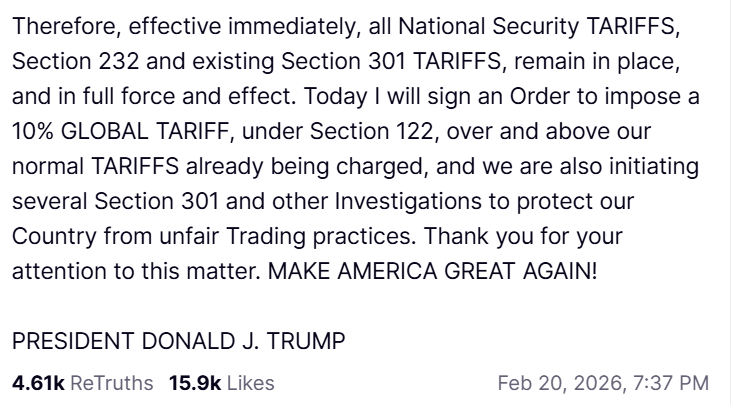
Section 122 of the Trade Act of 1974 permits the imposition an import tariff of up to 15%, or equivalent import quotas, for a period of up to 150 days, where the United States faces international payments difficulties. These powers have never previously been invoked.
Their legality is already being challenged on the grounds that the U.S. does not face an international payments problem (an outcome some have argued is impossible in an era of floating exchange rates). In light of the Administration’s defeat in the Supreme Court, litigation against any Section 122 tariffs is likely.
Some have argued that the 1974 statute requires that any tariff imposed be applied on a non-discriminatory basis across trading partner. In fact, section 122 permits the President to exempt countries that do not maintain a large and persistent bilateral surplus with the United States, and to exempt certain products, provided the original balance-of-payments rationale remains central to the measure’s design.
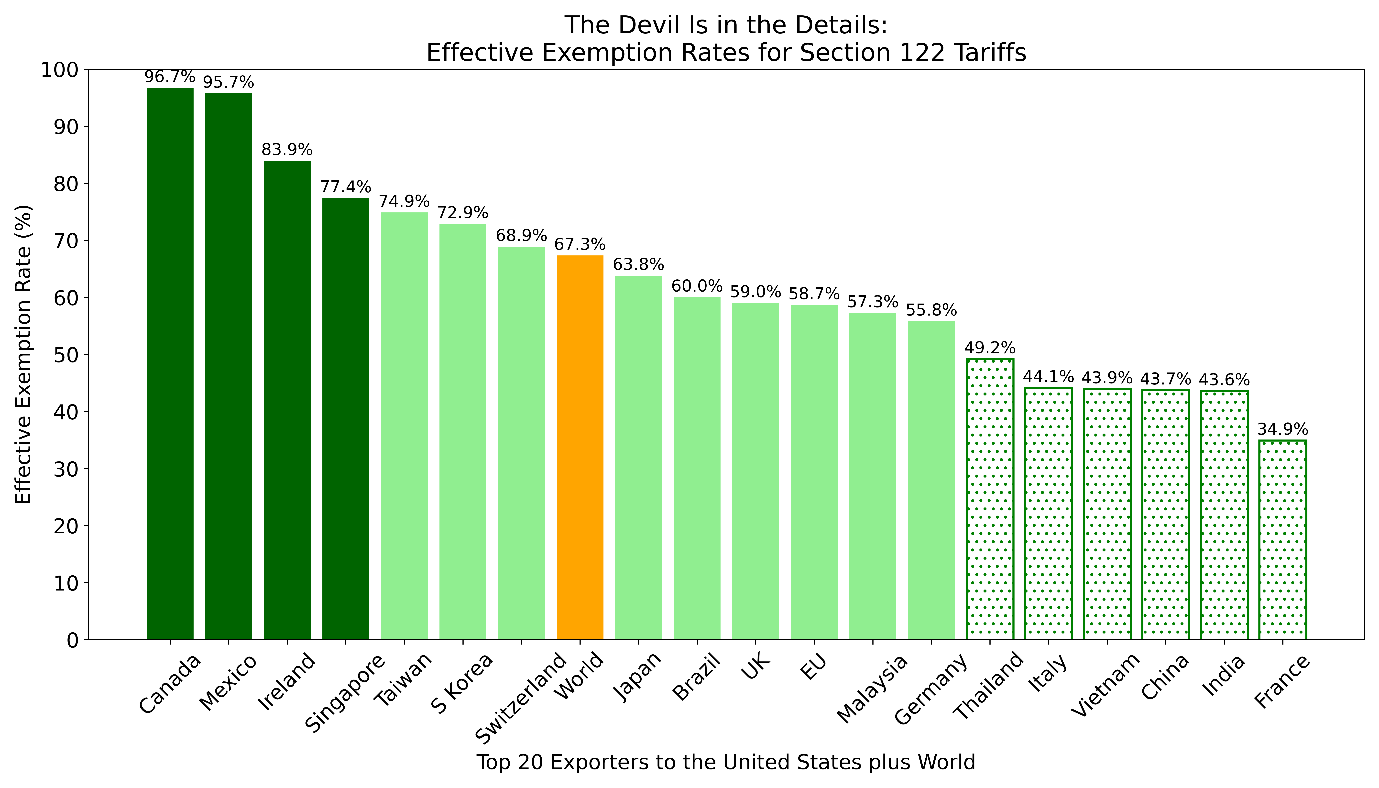
In the accompanying Proclamation, many product-level exceptions where specified. Close examination reveals that this list of exceptions is not too different from those applied to the IEEPA tariffs. Granular calculations by the Global Trade Alert team revealed that, once the exemptions were included, the average tariff rate of imports into the United States would rise by 4.9%, not the 15% headline rate.
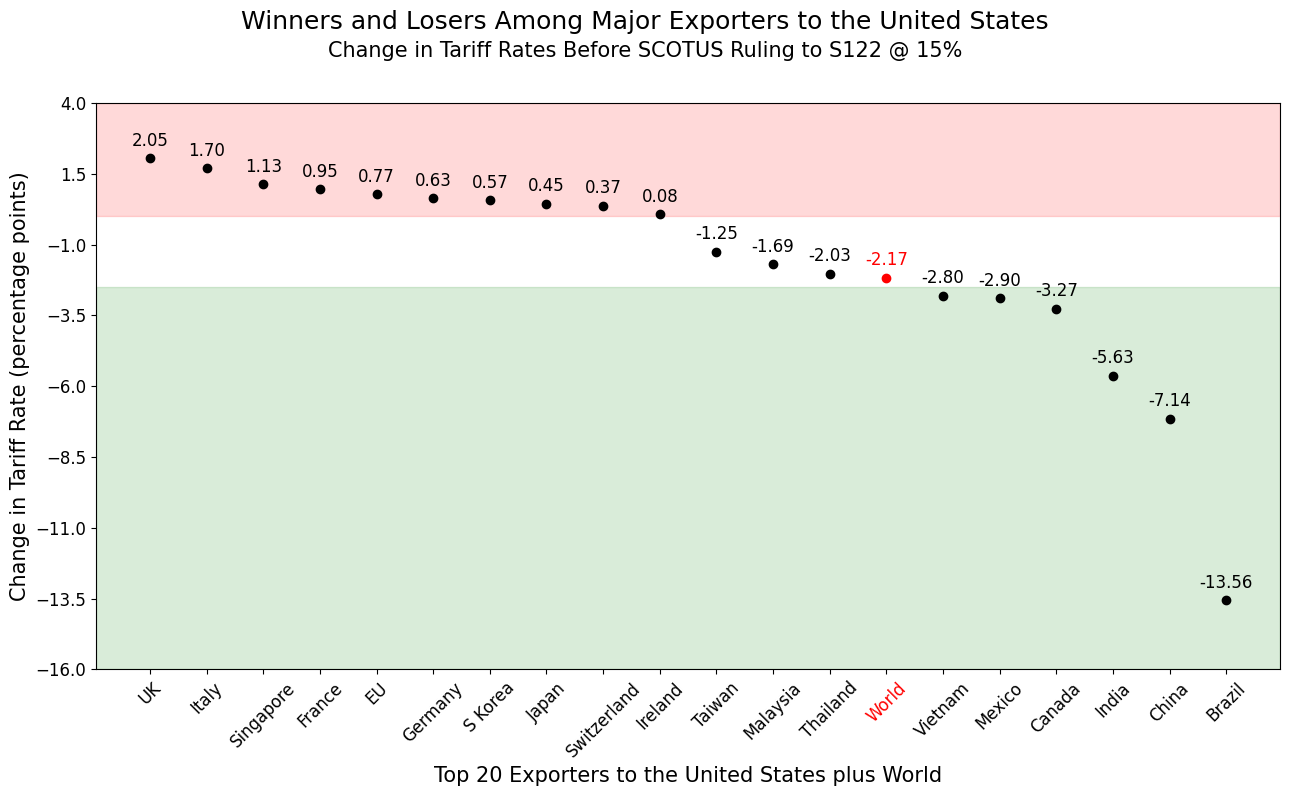
Since export composition varies considerably across America’s largest trading partners countries such as Canada and Mexico were almost entirely exempted, whereas France received the last number of exemptions. See the charts in the Annex.
Section 301 of the Trade Act empowers the United States Trade Representative to investigate violations of trade agreements and unfair trading practices by foreign nations. Tariffs resulting from such investigations carry no statutory cap and are, in principle, imposed for four years, though they may be renewed — as was the case with the China tariffs from the first trade war. Nothing in the statute appears to prevent Section 301 investigations from being directed at entire countries rather than specific sectors or practices.
At today’s press conference, US Trade Representative Ambassador Greer described Section 301 as “incredibly legally durable,” signalling that the administration regards it as the primary instrument for rebuilding and potentially heightening the US tariff wall once the Section 122 period expires.
For exporters to the United States that had been subject to IEEPA tariffs, the critical near-term question is whether the IEEPA tariff rate applied to the nation from which they shipped goods exceeded 15% (for relevant evidence see here). If so, their tariff treatment will improve in the short run. Within certain regions, this will alter relative competitive conditions: in Europe, for example, the tariff advantage enjoyed by the United Kingdom relative to continental European exporters will be eroded.
While Section 122 tariffs may face legal challenge, it is unlikely that any such challenge would reach the Supreme Court for final determination within the 150-day window. So, exporters can reasonably expect the 15% rate to hold for that period. What follows after 150 days will depend critically on the scope and conclusions of the Section 301 and other investigations now being launched. It is not yet clear which countries or sectors will be prioritised, and that uncertainty is itself significant.
That very uncertainty may encourage those exporters that fear tariffs will jump after 150 days to surge shipments to the United States. This effect is likely to be most pronounced in those American trading partners that faced higher IEEPA tariffs. Similar shipment surges occurred during the staggered U.S. tariff changes of 2025. Perversely, such surges are likely to expand the United States’ trade deficit in the near term, counter to the objectives of American policy.
President Trump was adamant at today’s press conference that trade deals previously concluded with the United States remain in force. Given the Court’s judgement, naturally, there will some question about the legal standing of these accords (which recall where never put to Congress for approval). For its part, the European Commission has sought clarity on the tariff treatment of its exporters.
Moreover, the prospect of lower near-term tariffs might in principle tempt some foreign governments to slow their implementation of commitments made under those deals. In practice, this outcome seems unlikely: the Administration retains the ability to deploy ongoing investigations to impose punitive tariffs on any country that fails to honour its obligations.
Another factor that will discourage some trading partners from reneging on their bilateral trade arrangements with the United States is that they contain preferential tariff treatment on certain politically-sensitive sectors that face Section 232 tariffs in the United States. Yet another factor is that, in some cases, the United States has defence-related leverage over third parties.
For countries currently in negotiations with the United States, or with interim deals in place — such as Switzerland — the threat of high tariffs after the 150-day period maintains, and arguably intensifies, the pressure to make concessions. Overall, expect little change here.
Unless his team find a compelling new narrative that allows the President to issue tariff threats as readily and aggressively as he has during the past 12 months, then surely the Supreme Court’s ruling will take that particular gambit off the table. In effect, however, this may not have far-reaching consequences for four reasons.
First, there have been instances where the President has said he would impose tariffs that were not followed through. For example, in Q4 2025 Mr. Trump said he would impose tariffs on Canada following the airing of an old interview with Ronald Reagan that criticised resort to protectionism. Here the United States did not impose tariffs.
Second, China’s quick and unsparing counter-retaliation to American tariff threats brought Washington, DC to the negotiating table. In this case, the tariff threats boomeranged on the United States. Third, the financial markets have taken fright on a number of occasions to sweeping tariff threats by President Trump. The debate over TACO (“Trump Always Chickens Out”) turns on the central question of the credibility of these tariff threats. Clearly, not everyone is swayed by such threats.
Fourth, the United States has plenty of other leverage—in the trade policy and other domains—that it can bring to bear on foreign governments. For all of these reasons the form, rather than the overall, approach of President’s approach to megaphone diplomacy may change as a result of the Supreme Court’s ruling.
In important respects, the Supreme Court’s ruling does not diminish the leverage available to the US administration; it replaces one set of threats with another. IEEPA tariffs have been replaced by the threat of high Section 301 (and other) tariffs at the end of the 150-day period. It is not clear that the new threats are materially less powerful than the old ones.
The uncertainty now surrounding US tariff policy — over which countries and sectors will be targeted, at what rates, and on what timeline — appears to be a deliberate feature of this Administration’s approach, rather than an incidental consequence. Such uncertainty has been deployed to extract concessions from foreign governments and to encourage businesses to consider relocating productive capacity to the United States. This “tool” is unlikely to be retired anytime soon.
The uncertainty created by today’s announcements is likely to persist through much of 2026. Whether the administration follows through with sweeping tariff increases on foreign imports after the 150-day period will depend in part on the financial market reaction to any such announcements — a reaction the administration will have observed carefully following the market turbulence that accompanied the sweeping tariff announcements of Liberation Day in 2025.
It seems probable that the administration will avoid bundling significant tariff decisions, preferring instead to release them sequentially as individual Section 301 and other investigations are concluded.
As those conclusions draw closer to the mid-term U.S. elections, the political calculus will likely favour some restraint in B2C sectors where tariffs feed quickly and visibly into household costs. Business-to-business sectors face a less forgiving environment.
Finally, those sectors already subject to Section 232 investigations face a distinct and ongoing set of pressures that today’s ruling does nothing to alleviate.
Many firms chose to defer decisions about reconfiguring their commercial and manufacturing footprint during 2025, judging that year to be too uncertain to act upon with confidence. Today’s ruling and the President’s response do not resolve that uncertainty; they recast it.
The 150-day Section 122 window is too short a horizon on which to base significant investment decisions, and the tariff environment that follows will depend on the outcome of Section 301 and other investigations whose scope, timing, and conclusions remain unknown.
In some respects, firms that delayed now face a harder planning environment than before: the IEEPA tariff schedule, whatever its faults, was at least a known set of numbers. What replaces it will be determined sequentially, country by country and sector by sector, over a period that could extend well into 2027.
That degree of uncertainty over terms to access the U.S. market is likely to be intolerable for those foreign manufacturers that make a large share of their profits on sales to customers based in the United States. Faced with prolonged uncertainty, those manufacturers may accelerate their plans to move some production to the United States. Such firms may seek terms similar to those offered to TSMC for their investment—exemptions from tariffs for a quantum of imports linked to their planned capacity expansion plans in the United States.
Observers who have followed US trade policy since 2017 will recognise the pattern. Legal constraints are encountered, workarounds are found (e.g. resort to national security rationales for tariffs), and the pressure on trading partners to make concessions is maintained by other means.
The first trade war produced Section 232 and Section 301 tariffs on China that outlasted the first Trump Administration; the IEEPA episode will in all likelihood produce a new generation of Section 301 tariffs with similarly long half-lives.
The Court has ruled and does indeed rule.[2] Yet, the underlying dynamic of American trade policy—the systematic deployment of uncertainty as leverage as America retreats from the world trading system—remains entirely intact.
Simon J. Evenett is Founder of the St. Gallen Endowment for Prosperity Through Trade, Professor of Geopolitics and Strategy at IMD Business School, Lausanne, Switzerland and CoChair of the World Economic Forum’s Trade & Investment Council. Comments can be sent to him at simon.evenett@sgept.org
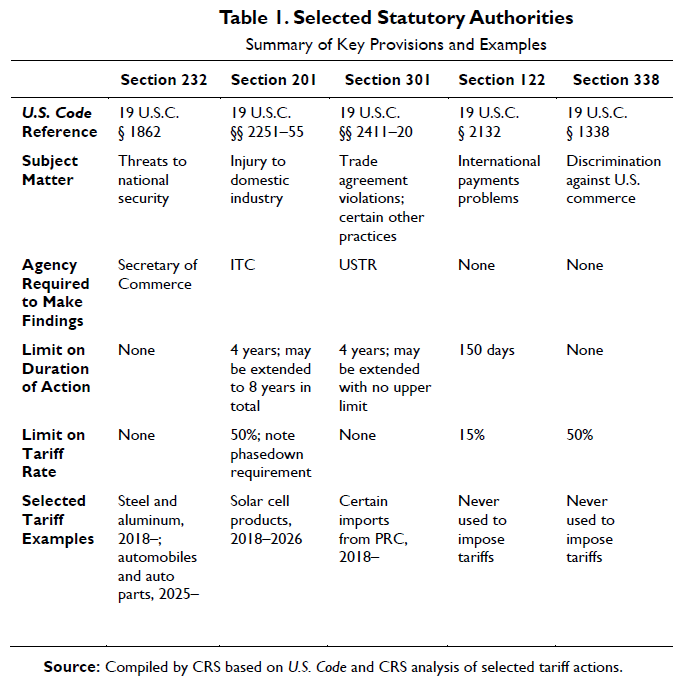
See the table at the end of this note for other possible tariff-raising authorities granted by Congress. This table was sourced from a Congressional Research Service report. The IEEPA column was deleted from that table in light of the Supreme Court’s ruling.
That the Trump Administration quickly published an announcement formally withdrawing tariffs based on IEEPA is evidence that the Supreme Court’s writ holds. As a constitutional matter, the fact that this check on executive power applies is both welcome and is likely to have broader social and economic consequences. The President’s unprecedented criticism of certain U.S. Supreme Court justices and the associated attacks on their integrity are unlikely to be quickly forgotten either.