
Beijing and Washington, DC Clash Over Excess Capacity: A Guide for the Bewildered
ZEITGEIST SERIES BRIEFING #98


ZEITGEIST SERIES BRIEFING #98
Simon Evenett
29 Jul 2026
Excess capacity in China remains a major point of contention in business and policy discourse this year. Some governments and commentators connect it to trade tensions, global imbalances, deindustrialisation in China’s trading partners, and threats to their economic and national security.
Accusations of excess capacity in particular sensitive sectors, such as steel, were first levelled a decade or more ago. Now, some seek to delegitimise the entire Chinese economic system by contending that it is based almost entirely upon state measures that allow excess capacity to persist in manufacturing sectors. Combined with slow growth of domestic demand in China, this is said to result in China “venting” its surplus production on to world markets. The resulting Chinese export “surge” is said to be causing a “China Shock 2.0”. Such exports could not occur if there was insufficient production capacity, hence the contention that excess capacity is a driver of Shock 2.0.
Therefore, excess capacity is at the centre of this delegitimisation campaign. Careful analysts will have noticed that excess capacity is not the sole factor mentioned and that alternative explanations for Chinese export success and the upgrading of its firms ought to be considered. None of this is to deny that the Chinese state actively intervenes in its economy. What matters for businesses abroad and for trade policy deliberation is cross-border fallout from Chinese state measures and whether trading partners have tools that can effectively curb adverse fallout or the causes of such fallout.
On 11 March 2026 the United States invoked Section 301(b) of the Trade Act of 1974 and opened an investigation into what the associated Federal Register notice calls “structural excess capacity in production and manufacturing sectors”. The investigation names sixteen jurisdictions: Bangladesh, Cambodia, China, the European Union, India, Indonesia, Japan, Malaysia, Mexico, Norway, the Republic of Korea, Singapore, Switzerland, Taiwan, Thailand, and Vietnam.
Notice that this Section 301 investigation does not target only China. Several of those American trading partners that supported the campaign mounted by the United States at the OECD on sectoral excess capacity (which largely targeted China) now find themselves under investigation on the same grounds. Trade officials in those trading partners should have an interest in what follows as it sheds some light on how the U.S. views the matter of excess capacity.
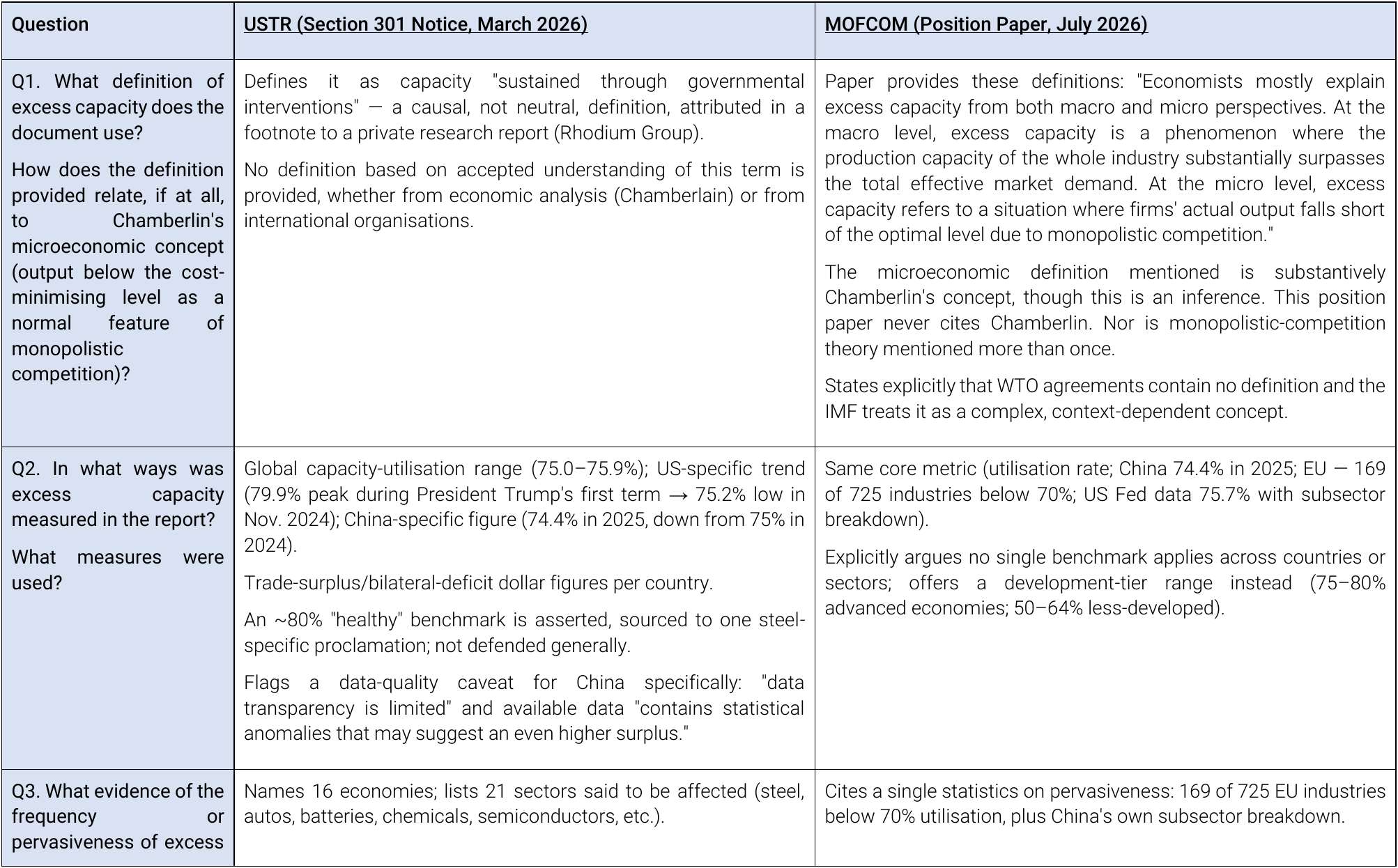
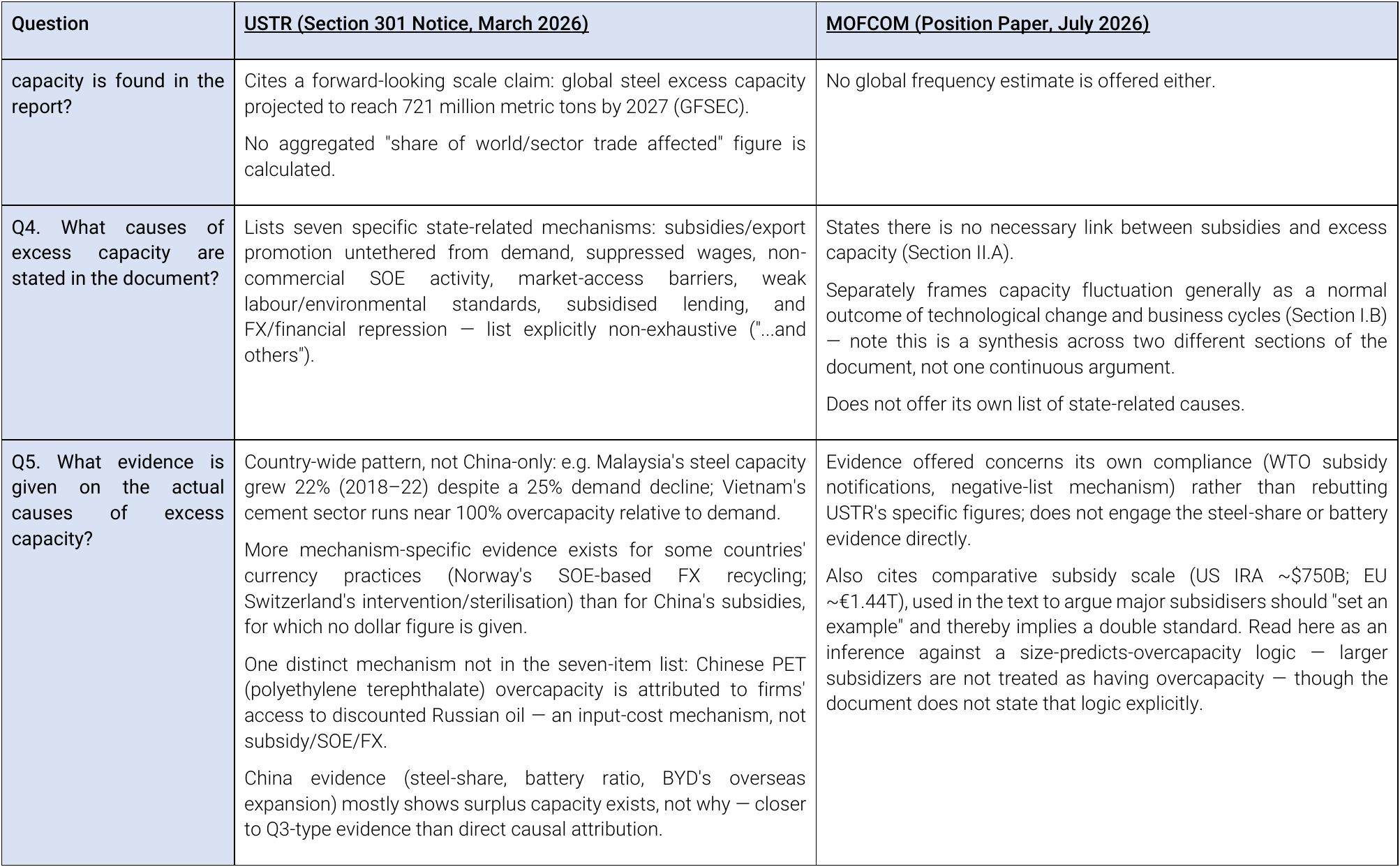
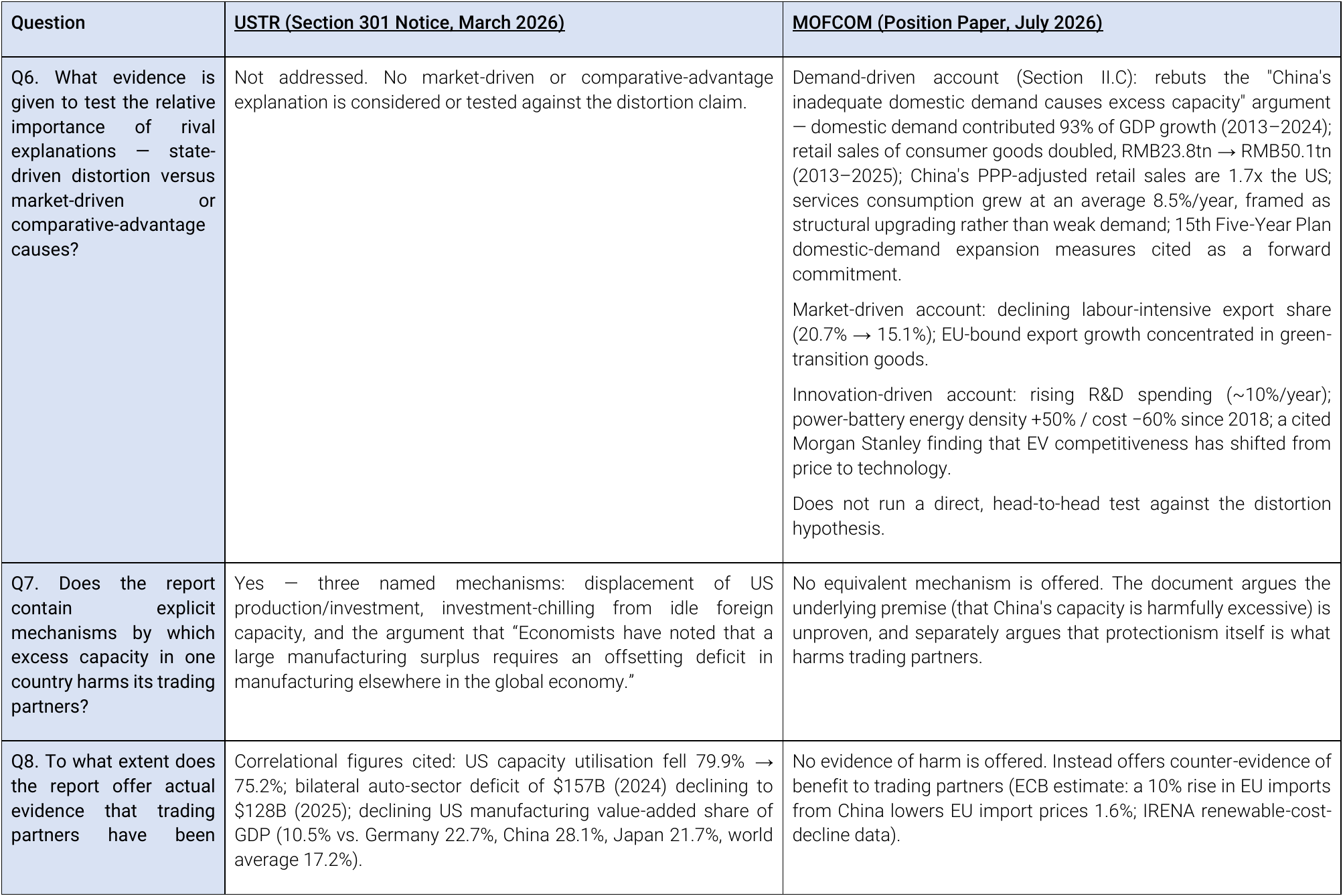
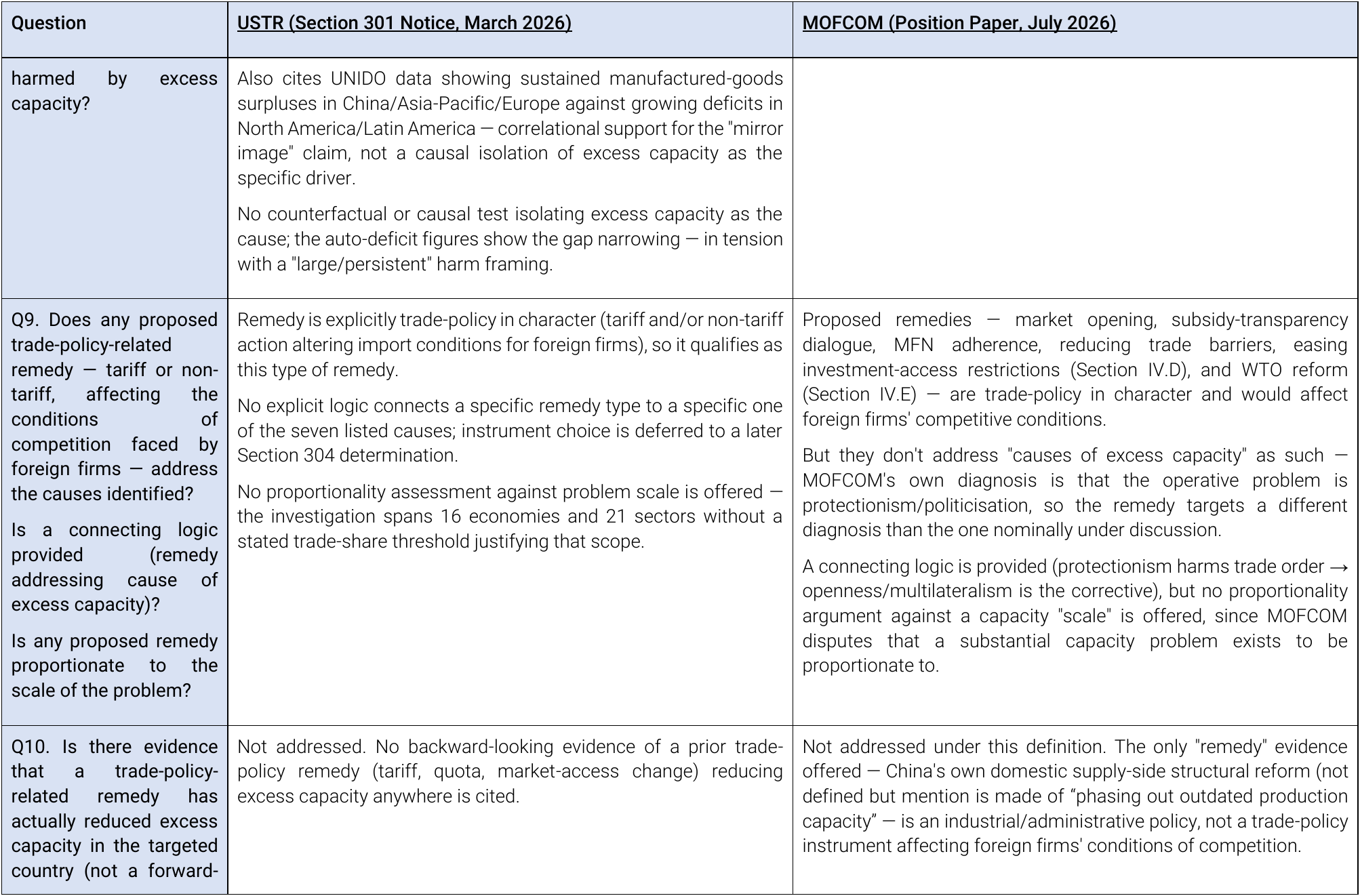
On 28 July 2026 the Ministry of Commerce of the People's Republic of China (MOFCOM) published a position paper on what it terms the so-called excess capacity question. Its release allows for a systematic comparison of the American and Chinese positions on excess capacity, set out in the table that follows.
The table organises this comparison around ten questions, each of which is stated precisely there. These questions fall into five groups:
Question 1 asks for a definition of excess capacity. A comparison between the two documents should start with an examination of what this term means to each party. Questions 2 and 3 turn to measurement: once a definition exists, the next question is what scale the phenomenon reaches and how often it occurs across countries and sectors.
Questions 4, 5, and 6 then ask why excess capacity arises, testing stated causes against evidence and against rival, typically market-based, explanations. These questions sit after measurement because a claim about cause can be judged only once the scale of the thing to be explained is known.
Questions 7 and 8 move from cause to consequence, asking whether excess capacity harms other countries and what evidence supports that claim. Questions 9 and 10 close the sequence by asking what trade policy-related remedy is proposed, whether its logic connects to the causes identified, and whether such a remedy has worked in the past. A remedy can only be judged once the questions of cause and effect of excess capacity have been answered.
Notice that this sequence of questions builds on each other. Contending that excess capacity is pervasive is not enough to justify restrictive trade measures because excess capacity may be the outcome of competition between firms uninfluenced by state action. Moreover, evidence ought to be provided that excess capacity has produced demonstrable harm to the commercial interests of trading partners (keeping in mind the possibility that benefits may have been created too.)
A credible theory of harm must be articulated and evidence provided (based on actual firm and market behaviour, not speculation or cherry-picked examples.) Moreover, a credible theory of remedy is needed as well. If an import restriction does not eliminate or sufficiently reduce the offending foreign excess capacity then the source of the harm will not have been dealt with—so any claims that the import restriction is only a temporary corrective measure can be set aside.
It follows from this sequence of questions that there is a significant burden on those making the case that excess capacity is a pervasive, harm-creating feature of the world trading system and that there is a case for deploying import restrictions to “fix” the problem.
Advocates of import restrictions need to provide compelling answers to all 10 questions outlined in the table that follows. U.S. law may demand less of officials conducting the Section 301 investigation. However, for those interested in the commercial logic for intervention, these 10 questions get to the substance of the matter.
In contrast, and here is a key asymmetry, the logical chain implied by this sequence of questions implies that claims about damaging excess capacity can fail at several points. Still, one should make clear that failure to demonstrate that a trading partner’s excess capacity has harmed U.S. commercial interests does not mean that that partner’s government policies have not harmed American interests through other means.
Three uses follow from this rubric of ten questions. First, the questions offer readers, officials, journalists, and corporate executives a systematic method to compare the Chinese and American positions on the trade-related implications of excess capacity in manufacturing.[1]
Second, trade diplomats in Geneva, officials in national capitals, and officials at international organisations such as the OECD and WTO can use this sequence of 10 questions to thoroughly explore the trade-related consequences of excess capacity. Consideration of these 10 questions will reveal where unwarranted shortcuts have been taken in current discussions on excess capacity.
Third, should U.S. officials find that harmful excess capacity exists in certain countries under investigation, the same ten questions then offer a method to evaluate the substance of any such determination.
Corporate executives operating in the sectors and jurisdictions under investigation by the U.S. should apply this method too. Why? Any measure subsequently adopted will bear on the conditions under which their company competes in the U.S. market in the near term and upon their expectations about the drivers and coherence of U.S. trade policy formation which, in turn, may affect their commercial footprint decisions.[2]
Given the widespread scepticism of the merits[3] of the recent forced labour-related import tariffs imposed by the U.S., coupled with the credibility gap surrounding last year’s fentanyl[4] tariff penalties, import restrictions introduced on excess capacity grounds will attract scrutiny.
Sweeping U.S. tariff measures that lack credible evidence and supporting logic undercut the high-level reindustrialisation objective of the Trump Administration. The contention of this Administration is that by erecting import barriers, the United States is incentivising foreign firms keen on supplying its markets to establish production facilities there. Doing so requires foreign corporate executives to have sufficient confidence in the business conditions within the United States.
Having an unpredictable and empirically unjustifiable trade policy raises questions about the processes, predictability, and credibility of the decisionmakers involved. That casts a shadow over whether policy towards the U.S. business environment will be made in a similar capricious manner going forward. Given the time and significant capital outlay involved in establishing manufacturing facilities, multi-year commitment to stable pro-business policies is vital.
Asking foreign executives to accept that U.S. trade policy is capricious does not sit well with cultivating a reputation for improving the business climate at home. Foreign executives would be right to ask if domestic tax, regulatory and other policies towards the U.S. business environment will soon become as inconsistent and unfounded as U.S. trade policy. The ten questions stated in the table that follows will enable foreign corporate executives and those that advise them to assess the case made in whatever report the United States Trade Representative publishes on its ongoing investigation into foreign excess capacity.
The trade policy of the second Trump Administration continues to break new ground. In the case of excess capacity, its fallout, and remedy, the incentives created for the private sector to invest in and maintain such capacity are central considerations and ought to receive more scrutiny. This is where an understanding of market processes—informed by corporate executive and economic insight—ought to contribute to formulation of trade policy. The trade-related implications of excess capacity are not solely a legal matter or a matter of geopolitical narrative.
The questions outlined here integrate a number of pertinent considerations that can be used to hold policymakers to better account. Should Beijing move on excess capacity matters, these considerations apply as much to them as to their counterparts in Washington, DC.
Simon J. Evenett is Professor of Geopolitics & Strategy, IMD Business School, Lausanne, Switzerland; Co-Chair, Trade & Investment Council, World Economic Forum; Founder, St. Gallen Endowment for Prosperity Through Trade, the institutional home of the few remaining independent trackers of digital, trade, industrial, subsidy and investment policy.

For reasons that are unclear to me, excess capacity in agricultural and service sectors is not in the spotlight. There again, the United States has significant trade surpluses in various lines of business in agriculture and services.
For their part, economists may be interested in learning how the microeconomic concept of excess capacity has been (mis)applied in trade policy circles.
Perhaps the most glaring mismatch is between the “examples” and “case studies” presented in the relevant USTR investigation report and the across-the-board nature of the import tariffs imposed. Using the latter to tackle localised problems is akin to using a sledgehammer to crack a nut. In short, it is not a proportionate policy response.
Multiple U.S. news reports indicate that official U.S. statistics show few seizures of fentanyl that originated or passed through Canada. Yet, Canadian products were hit with tariffs.