Since February 2026 the United States has applied or proposed broad import duties under two provisions of the Trade Act of 1974. Each action attaches an annex listing the products exempt from the duty. The three actions, and the annexes compared here, are:
- The Section 122 surcharge. A balance-of-payments surcharge of 10 to 15%, in force since 24 February 2026 and applying to all origins. Exempt products are listed in its Annex II.
- The proposed Brazil Section 301 duty. A 25% duty on goods of Brazil, proposed by the US Trade Representative on 1 June 2026 and open for comment. Exempt products are listed in an annex to the notice.
- The proposed forced-labour Section 301 duty. A duty of 10% or 12.5% on goods of about sixty economies investigated over forced-labour enforcement, proposed on 2 June 2026 and open for comment. It uses the same annex structure.
What the annexes share
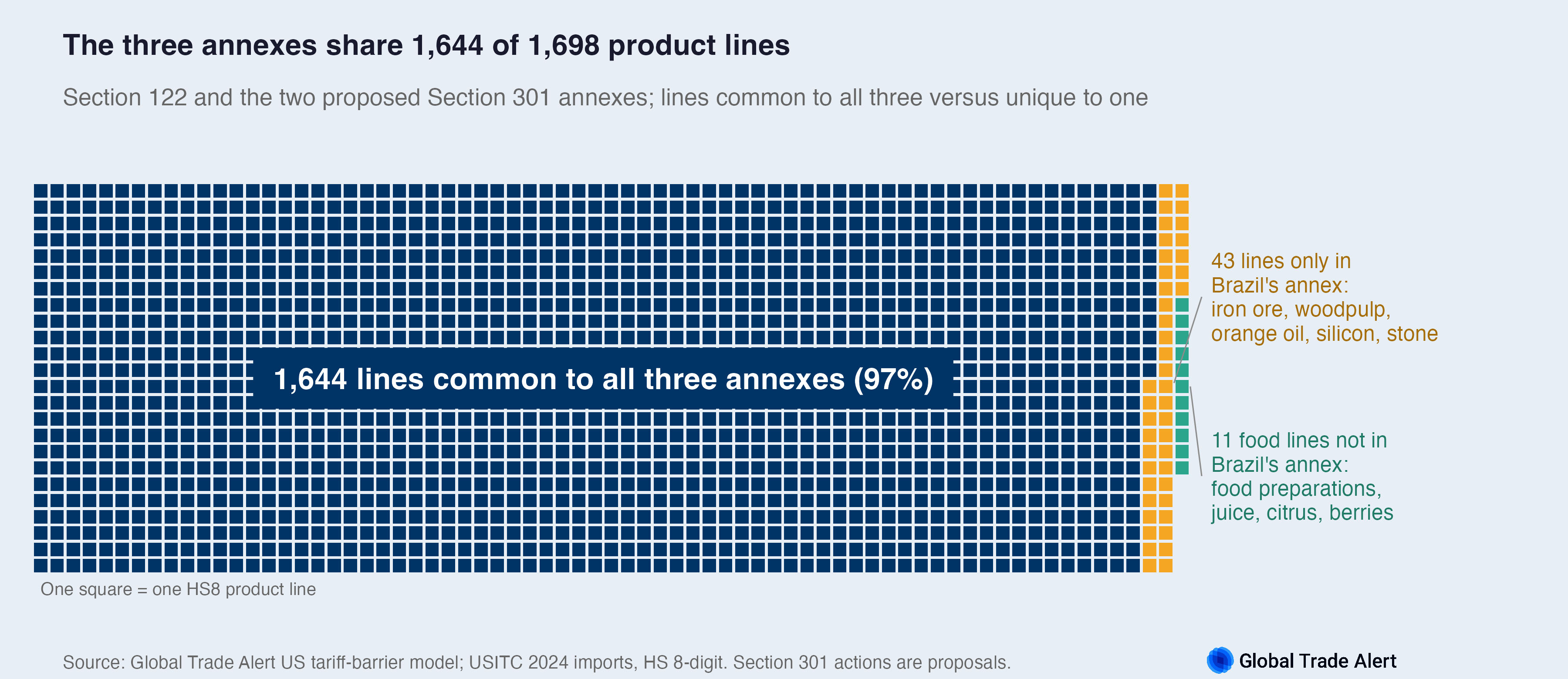
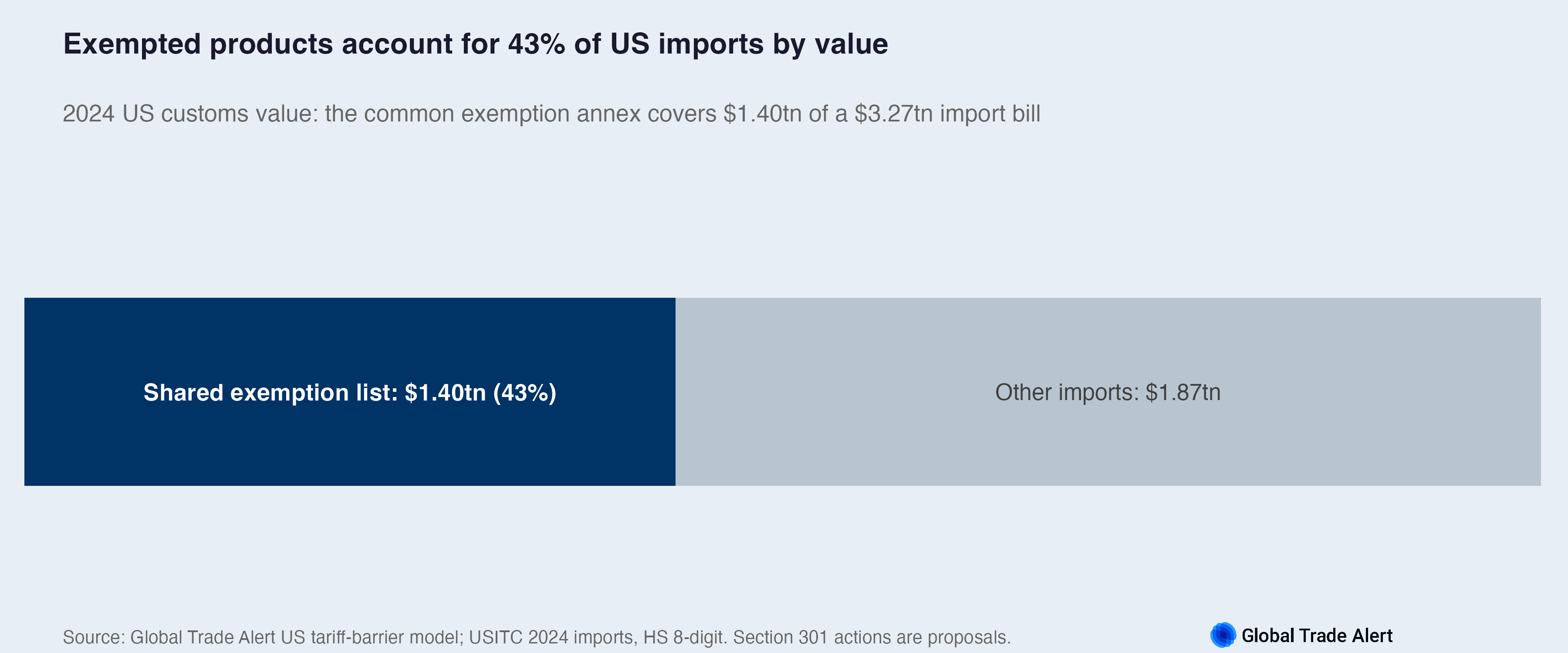
The three annexes hold 1,644 of the 1,698 eight-digit product lines named across them in common. By 2024 customs value those shared lines account for about $1.40 trillion, or 43% of US imports. Any two of the three annexes agree on between 95% and 99% of their product codes; the forced-labour and Section 122 annexes are 99.3% identical. A product exempt under one of these actions is, with few exceptions, exempt under the others.
Where the annexes differ
The differences between the three annexes are confined to two groups of products, which together account for all 54 lines outside the common set.
- Goods specific to Brazil’s export profile. Forty-three product lines appear in the Brazil annex but not the others. Forty-one are primary and semi-processed commodities, including iron ore, ferrous direct-reduced iron, chemical woodpulp, orange and citrus oils, metallurgical silicon and dimension stone: these are among Brazil’s main exports to the United States, worth about $1.5 billion in Brazilian trade, and no other provision of the Brazil action exempts them. The remaining two are a steel product and an auto-parts product that the other actions exempt through the Section 232 precedence rule rather than through their annexes.
- A consumer-food group. Eleven product lines that the Section 122 and forced-labour annexes exempt do not appear in the Brazil annex: food preparations, baked goods, fruit juice, citrus and berries. These are worth about $15.7 billion in all-origin imports but only about $169 million in Brazilian trade. The Section 122 and forced-labour annexes apply across many origins and exempt this group; the Brazil annex, drawn for a single country, does not include it.
No product is exempt under Section 122 alone or under the forced-labour action alone, and none appears in the Brazil and Section 122 annexes but not the forced-labour annex.
Reading the figures
Because the exemption annexes are extensive, the headline rate of each action applies to a minority of the trade it nominally addresses. The published sizing of the Brazil action puts the reach of the 25% duty at about 38% of Brazilian trade, once the annex, the Section 232 exemption and informational materials are accounted for. For the forced-labour action, which covers about sixty economies and so spans most of the import bill, the same exemptions account for roughly three fifths of the affected value. The annex, rather than the rate, determines how much trade each action reaches.
Method and downloads
Product scopes are read from the tariff-barrier model behind Global Trade Alert’s US tariff estimates, at the policy date for each action: 26 July 2026 for the two proposed Section 301 actions and 3 June 2026 for Section 122. Import values are 2024 US customs values. The two Section 301 actions are proposals open for comment, not duties in force; the figures size what they would reach and are not forecasts. All-origin value measures the economic footprint of a product list; for the Brazil-specific lines we report Brazilian-origin trade, because all-origin value there is dominated by goods Brazil exports little of.
Download: the 1,698-line product universe with exemption categories (Excel), or all charts and data (zip).