The tariff architecture flips from surcharge to country-specific duties
Three changes reach US import tariffs in the space of four days. On 22 July the Section 301 tariff on Brazil entered force; on 24 July the temporary Section 122 surcharge lapsed and a Section 301 tariff on goods made with forced labour took effect across some sixty economies.
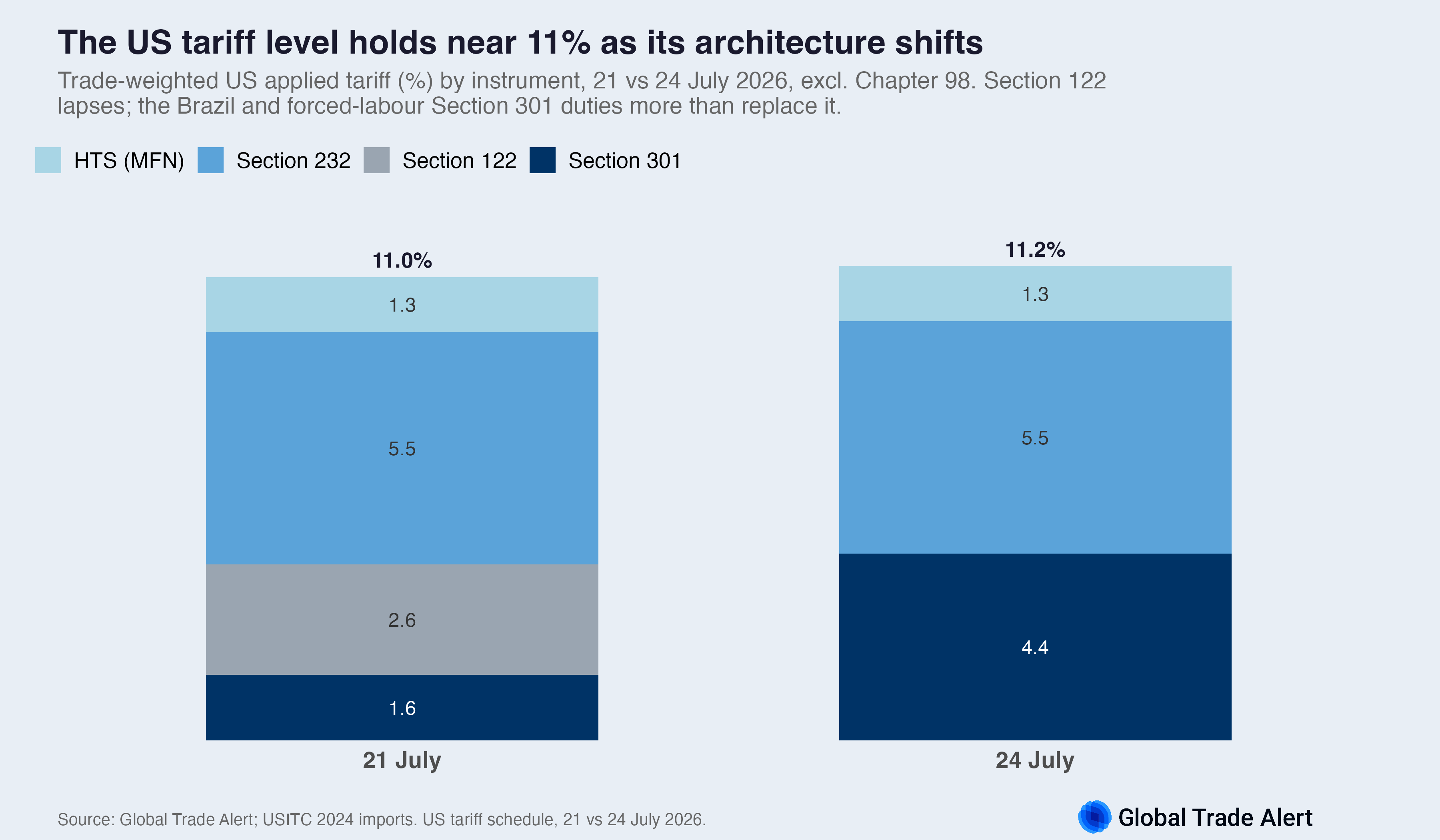
Comparing 21 July with 24 July, the trade-weighted average US tariff barely moves, from 11.0% to 11.2% of the value of imports excluding Chapter 98. The architecture beneath that average changes far more. Section 122, a near-uniform 10% surcharge, had added 2.6 percentage points to the average; it now adds nothing. The two Section 301 duties lift the Section 301 layer from 1.6 to 4.4 points, slightly more than replacing it. A broad, origin-blind surcharge has given way to two country-specific regimes.
Country tariffs move only modestly, and in both directions
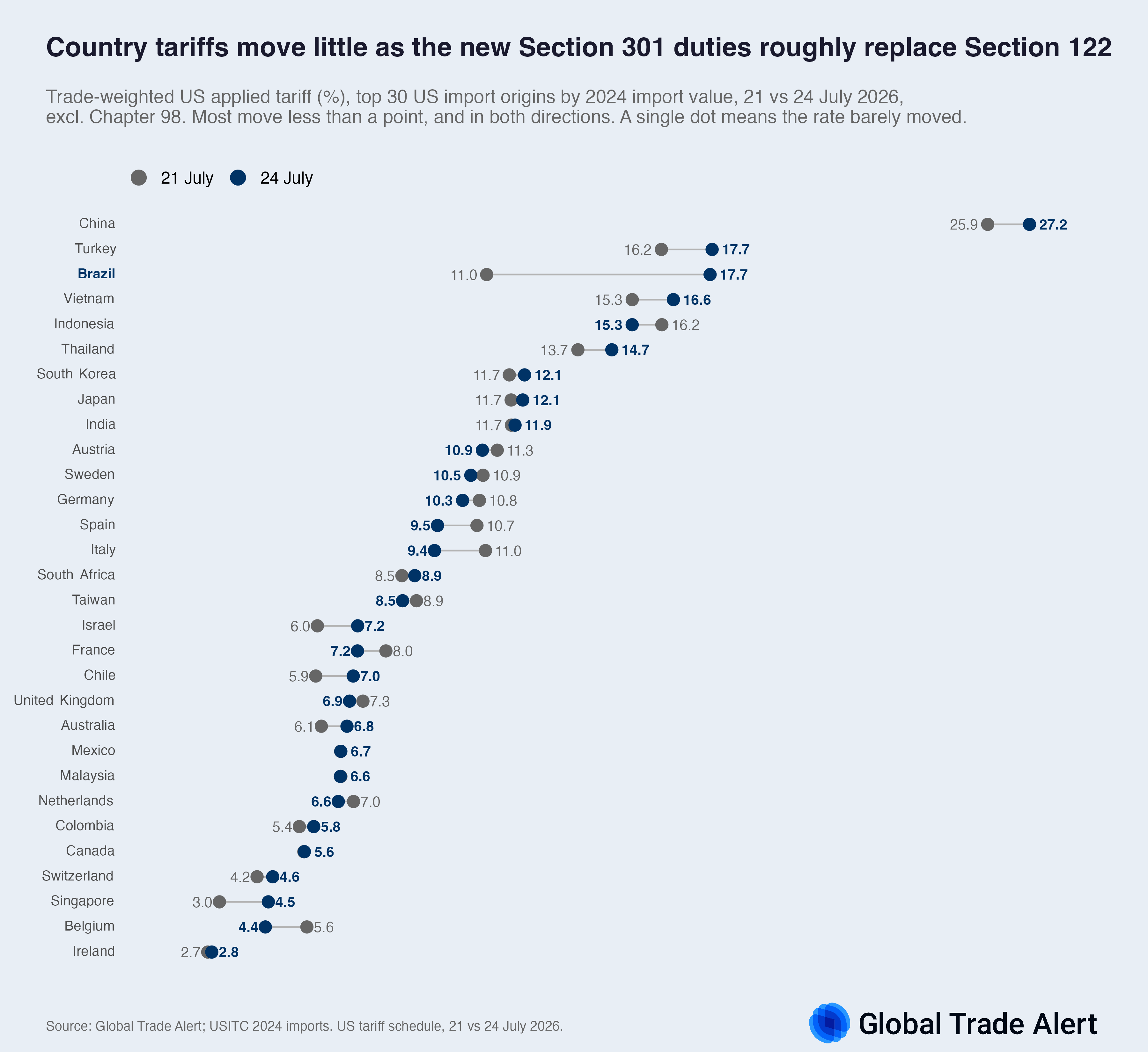
Most origins' average tariffs move less than a point, and in both directions, as the lapse of Section 122 and the two new duties roughly offset. The origins the new duties reach hardest rise: China's average goes to 27.2% and Brazil's to 17.7%, the two highest among major suppliers, and forced-labour-tier economies such as Vietnam and Thailand edge up. Origins the new duties largely spare drift down as the surcharge goes: Germany falls half a point, Italy a point and a half.
Two features of the design decide the direction. Goods already under Section 232 metal, vehicle and derivative duties never carried Section 122, so origins concentrated there had little surcharge to lose; Germany, with cars and parts at 23% of its US sales, is one. And civil aircraft are exempt from Section 122 and from the forced-labour duty alike, so aircraft-heavy baskets barely move on either date: France, whose civil-aircraft trade is a large share of its US sales, slips just 0.85 points.
Two-thirds of the forced-labour duty's covered trade is carved out
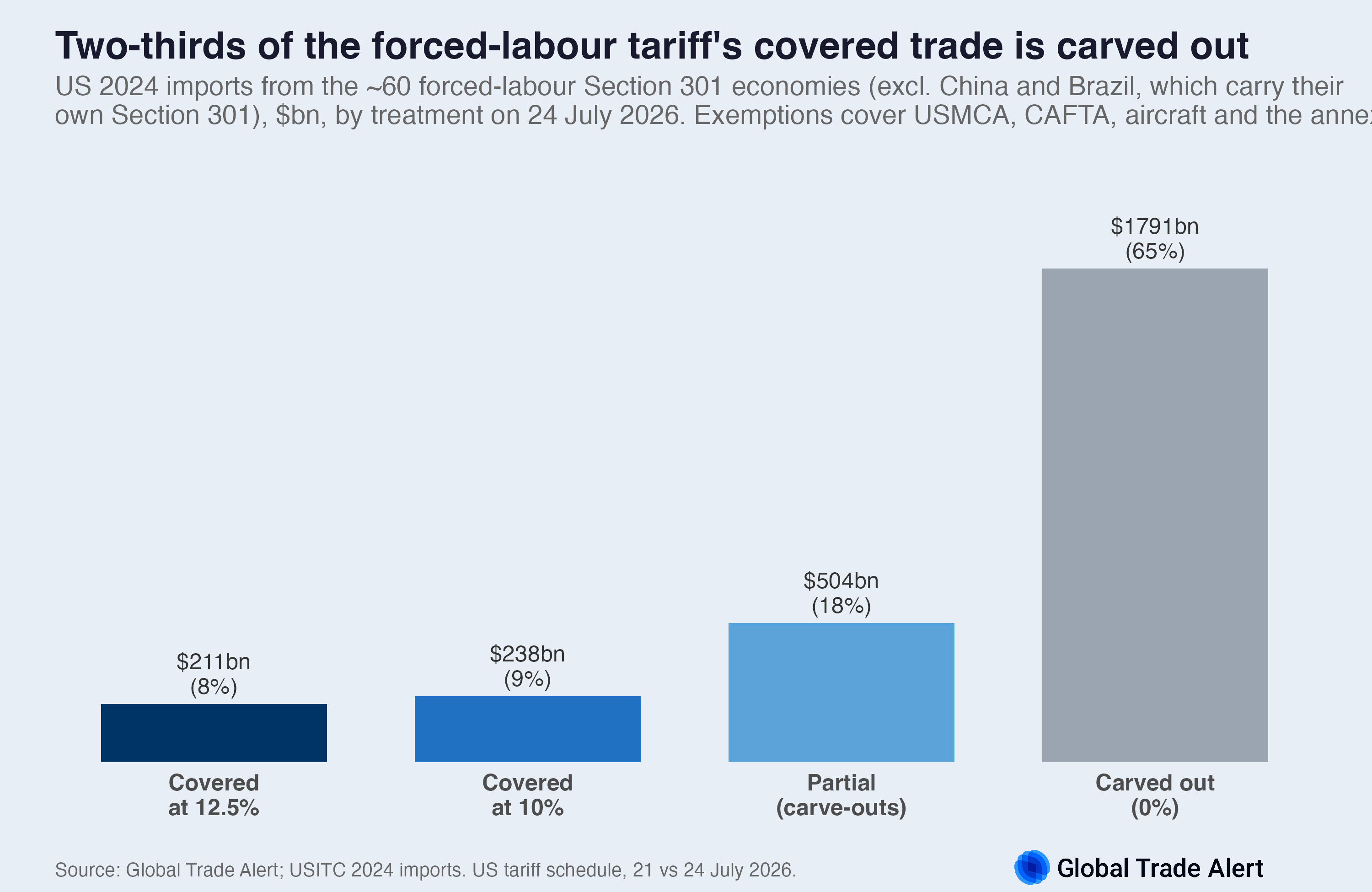
The forced-labour Section 301 tariff sets two headline rates, 10% and 12.5%, but a stack of exemptions determines what is actually paid. Of the $2.7 trillion in 2024 US imports from the covered economies other than China and Brazil, which carry their own Section 301 duties, 65% is carved out entirely. USMCA-compliant goods of Canada and Mexico, an annex of some 1,600 excluded product lines, goods already under Section 232, and civil aircraft together remove most of the base. A further 18% pays a reduced, partial rate. Only 17% pays a full 10% or 12.5%.
Relative market access spreads out again
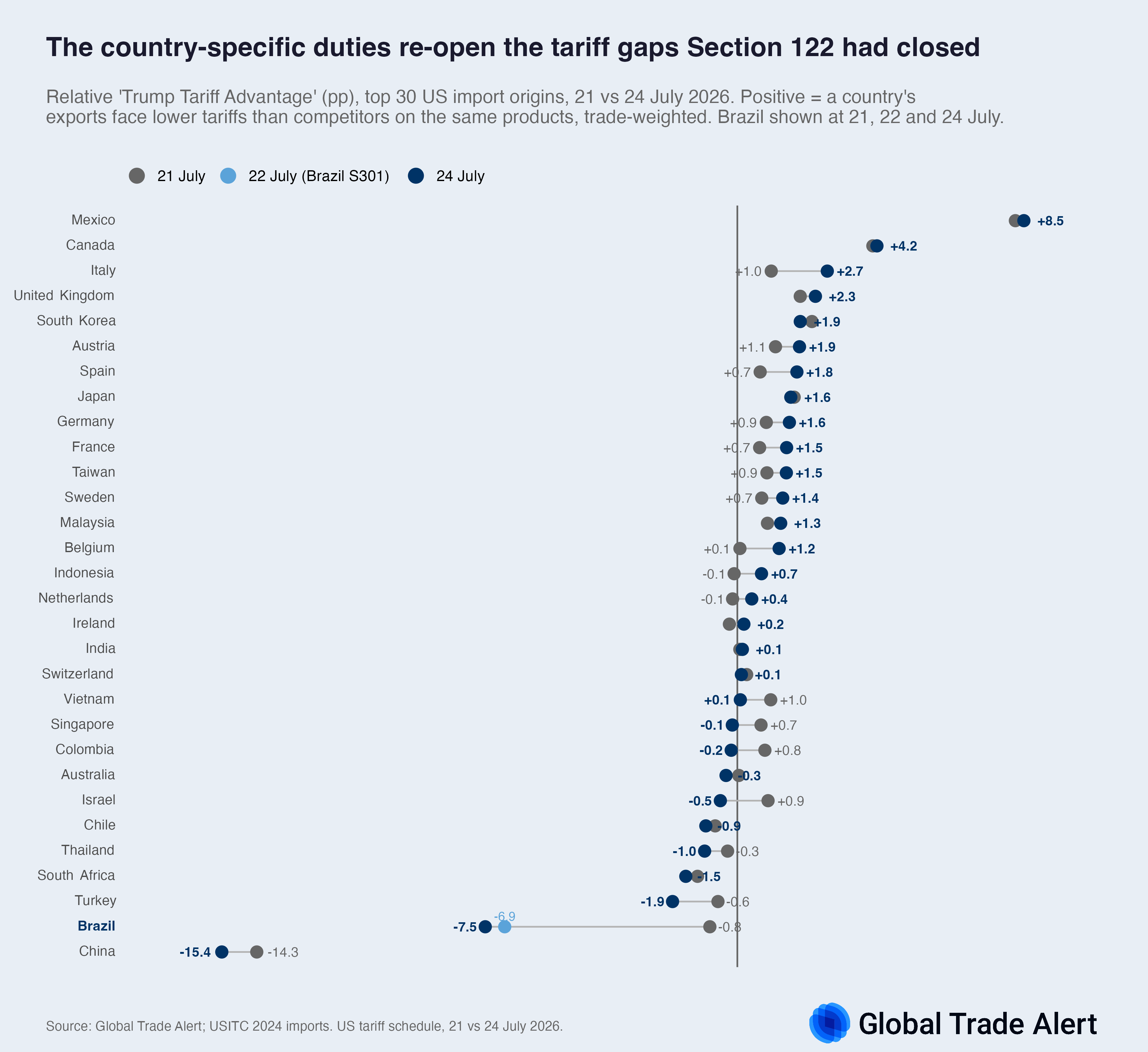
How the exemptions interact with each country's product mix determines whether exporters that had faced near-identical treatment now diverge. A useful summary is the relative tariff advantage: the average tariff a country's competitors pay on the same products, minus its own. A positive figure means a country's exports have an advantage in the US market over others selling the same goods. On 21 July, with Section 122 sitting almost uniformly on every origin, that measure clustered near zero for all but three suppliers: Mexico and Canada held an advantage through USMCA, and China a large disadvantage through its Section 301 tariff. The middle of the field was flat.
By 24 July the field diverges further. The interquartile range of the advantage across origins widens more than fourfold, from 1.3 to 5.6 points. European Union members gain ground as the net-of-tariff forced-labour tier and the exemptions favour their mix; Brazil falls from roughly level to −7.5 points, its two-step descent visible as it first takes the 25% Brazil duty on 22 July and then the forced-labour layer on 24 July. Mexico and Canada keep their USMCA advantage, and China stays furthest behind. The picture inches towards the reciprocal-tariff period that a Supreme Court ruling ended in February 2026, when headline rates varied sharply by country.
Status and method
Figures compare the tariff schedule on 21 July and 24 July 2026 and exclude HTSUS Chapter 98 (re-imports and special classifications) from rate averages. Rates are trade-weighted using 2024 US import values, held fixed across both dates. The relative advantage measure includes Chapter 98, following the chartbook convention, and excludes products for which an origin is the sole US supplier. Section 122's civil-aircraft exclusion (HTSUS 9903.03.05) is applied, as are the corresponding aircraft and Section 232 exemptions. Three carve-out parameters on the forced-labour side remain uncalibrated placeholders: a 0.9 civil-aircraft share, a 0.5 pharmaceutical-use share (which shapes pharma-heavy origins such as Ireland), and a 0.5 share for the annex "Ex" lines; the 24 July figures for aircraft- and pharma-heavy origins are sensitive to them. Data are available below, and the model is queryable through the Global Trade Alert tariff MCP.
Downloads