What is new is the generality. Trading tariff relief for future corporate conduct began in 2025: Proclamation 10925 created an automobile-parts offset calculated from US assembly value, and clause 13 of Proclamation 10984 let the Secretary halve the rate for certain Canadian and Mexican metal producers committing new US capacity. Both were narrow and formula-bound. Across pharmaceuticals, primary aluminium, polysilicon and drones the Secretary now assesses a company plan and determines the treatment that follows. The reward rises from an offset to a complete waiver, relief reaches supply-chain inputs and production equipment rather than one imported product, and the qualifying commitment extends past production to domestic pharmaceutical pricing.
The drone action shows what a company can now obtain
The company route has no ceiling. Published rates are 100% on larger drones, docking stations and certain components, and 25% on smaller drones. An approved onshoring plan instead lets a firm import covered products "without paying applicable section 232 duties", in volumes the Secretary judges commensurate with the new plant's expected annual output. What the firm gives in return is a construction undertaking: relief runs only while the promised facility is being built, and building must start before 20 January 2029. A further clause defers the tariff for firms on the Department of War's Blue UAS lists or the FCC's Conditional Approval List, which on 14 August held over 100 distinct companies.
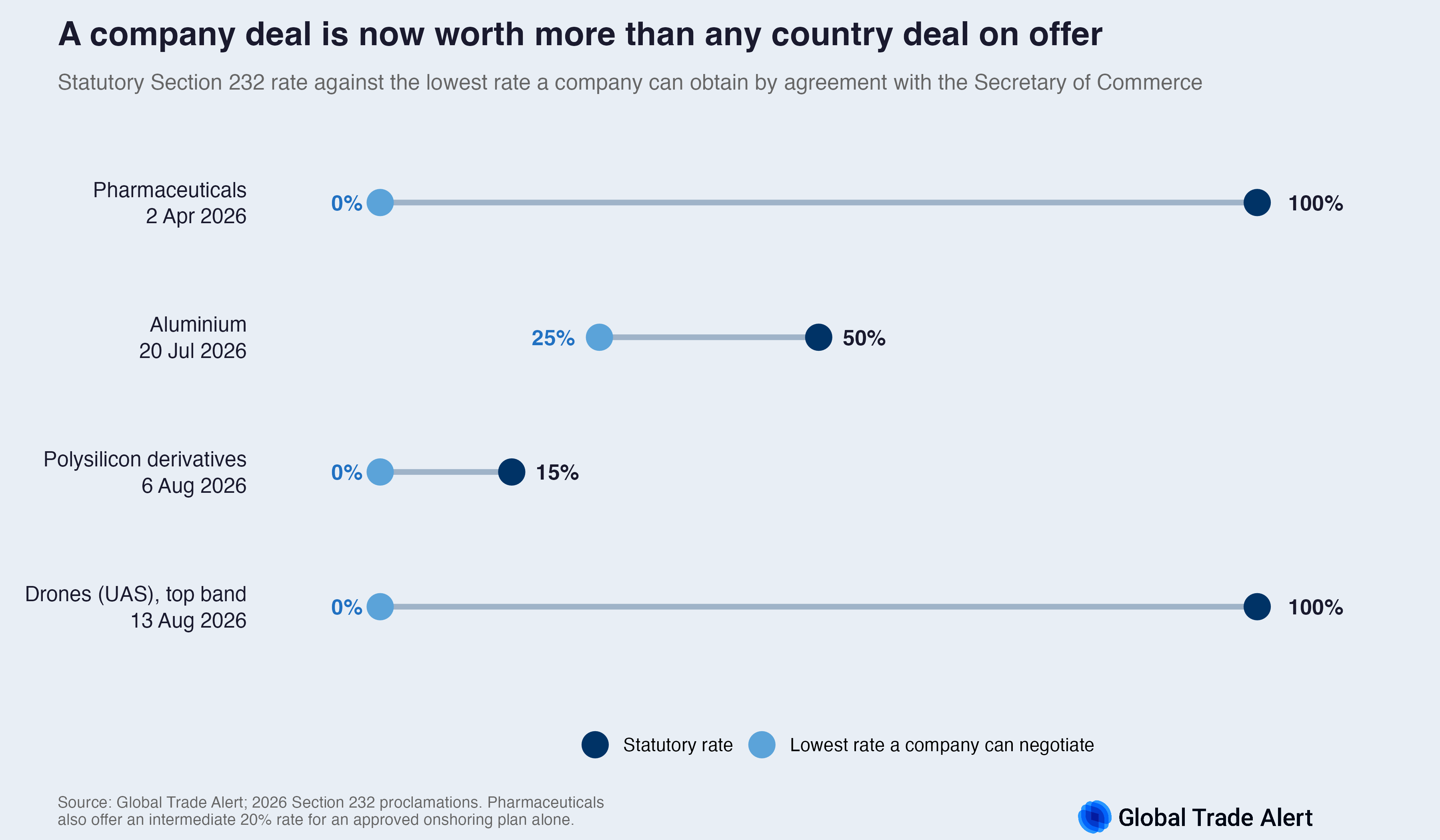
The reward rose from a lower rate to a full waiver
The pharmaceutical action of 2 April already revealed the pattern: 100% without an approved onshoring plan, 20% with one, and zero for firms that also agreed most-favoured-nation domestic pricing, a commitment about prices rather than about the imported product. It ratified 13 company-specific agreements already signed, the earliest dated 19 December 2025. The primary-aluminium proclamation of 20 July opened an application programme at half the otherwise applicable rate. The polysilicon proclamation of 6 August recorded that the Secretary "should have the authority to enter into company-specific deals with producers", and raised the reward to a full waiver. The drone action added the day-one deferral.
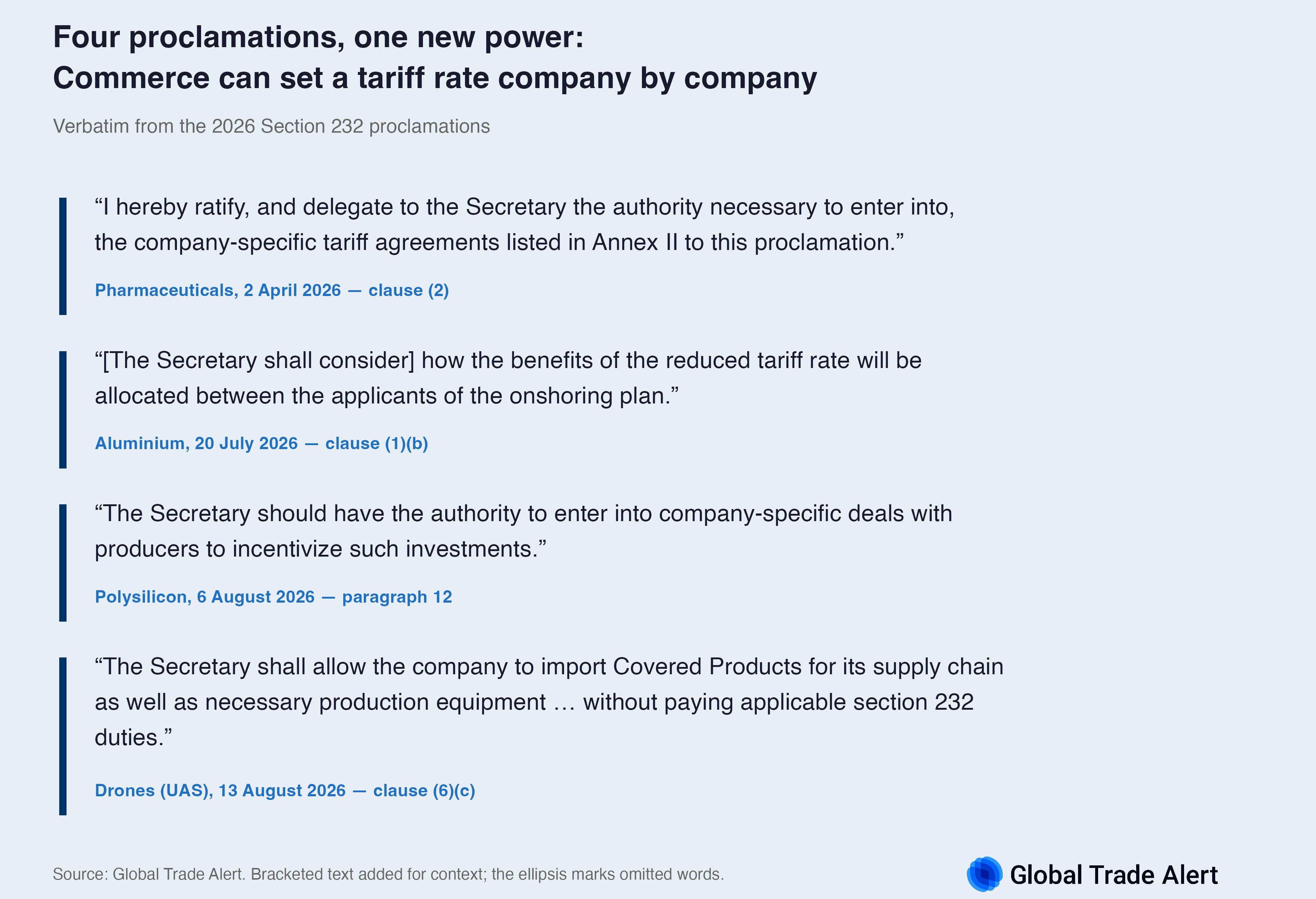
The sharpest consequence lies within industries rather than between countries. Two firms importing the same component from the same origin can face the full rate and none of it, on an administrative judgement about a corporate undertaking rather than any property of the imported good. Neither the public nor the firm paying more can inspect the successful plan or the decision record. That sorting already operates in drones: the deferral turns on membership of lists that agencies themselves control. A national tariff concession no longer guarantees a country's firms equal treatment, because a company-specific decision can beat what its government negotiated.
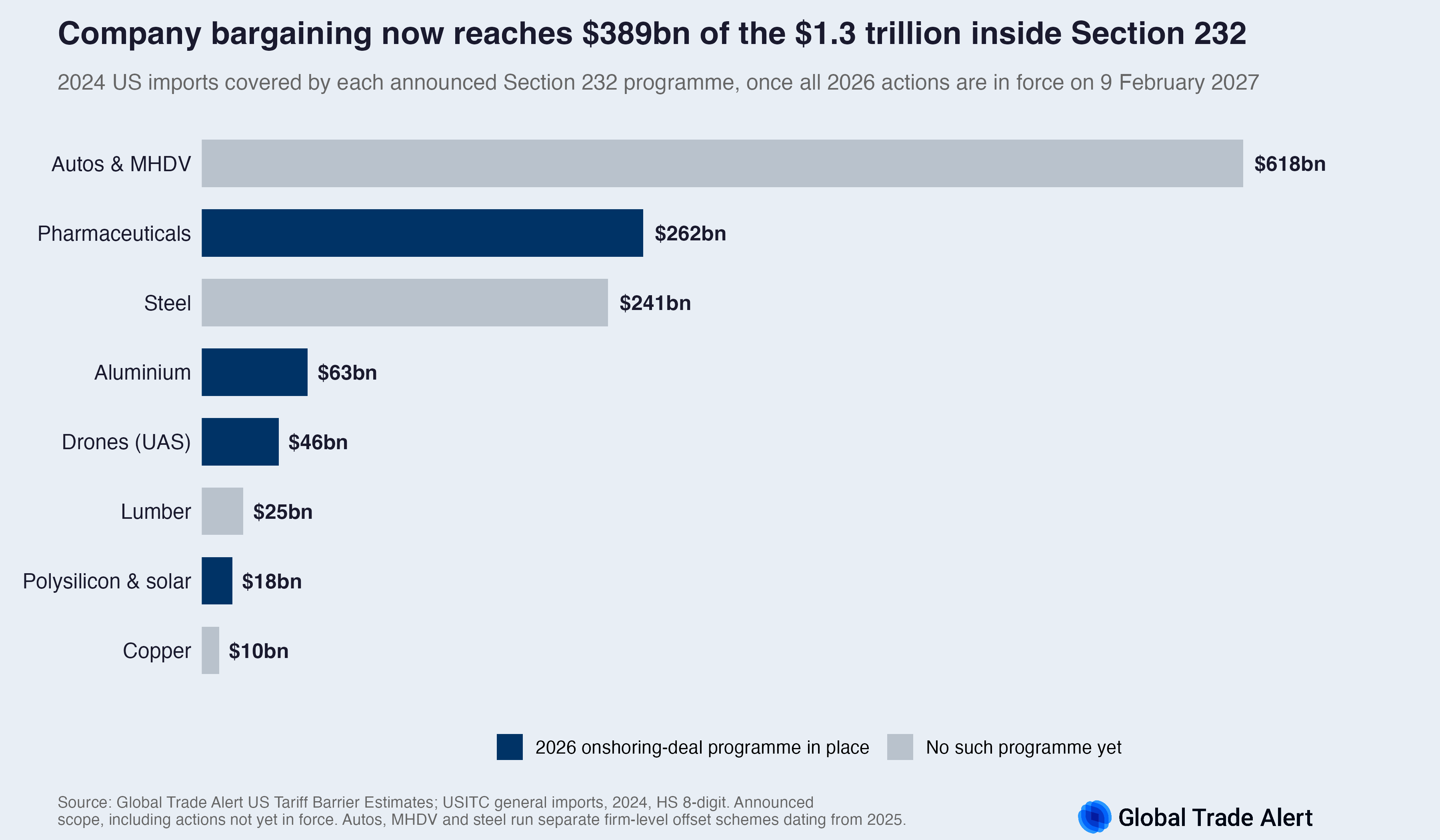
The programmes carrying the mechanism cover $389bn of imports
Using USITC data, Section 232 covers $975bn of 2024 US imports today and will cover $1,283bn, or 39.6% of goods imports, once the actions are fully in force in February 2027. The four programmes carrying a company-deal mechanism account for $389bn of that. This measures the trade those programmes cover, not the imports receiving relief. The pharmaceutical proclamation names 13 agreements and their dates but not their terms; under the newer programmes Commerce has published no plan, volume or reason. The architecture could extend to automobiles and heavy vehicles ($618bn) or steel ($241bn), neither of which has an onshoring-plan programme today.
From MFN to MFC: market access for most-favoured companies
The returns to the two kinds of bargaining have moved apart. Negotiation with governments produced ceilings of 15% and 10% here, while a firm whose plan is approved pays no Section 232 duty on its qualifying volumes, provided it commits to start building before 20 January 2029. Each programme rewards one particular decision, a commitment to build in the United States, and that decision belongs to the firm, not its government. Watch whether the next Section 232 action carries an onshoring programme as standard, whether autos or steel acquire one, and what Commerce discloses about approved plans. The proclamations require the approval criteria to be published, but not the approvals themselves.
Status and method
Rates, dates and authorities come from the proclamations of 2 April, 20 July, 6 August and 13 August 2026 and their annexes. Company counts come from the Blue UAS Cleared List, the Blue UAS Framework and the FCC Covered List as updated on 28 July 2026, each read on 14 August 2026; one firm appears on both a Blue list and the conditional-approval list. Pharmaceutical relief is time-limited: the zero rate runs to 20 January 2029 and the 20% rate becomes 100% on 2 April 2030. The 2025 offset schemes are those of Proclamation 10908 for automobile and vehicle-parts manufacturers and Proclamation 10984 for steel and aluminium producers. Import values are Global Trade Alert calculations on USITC general imports for 2024 at the HS 8-digit level, matched to each programme's announced scope; they measure trade covered by an action, not duties collected or relief granted. The drone figure is the full value of the tariff lines named in the annexes, some of which cover goods other than drones.