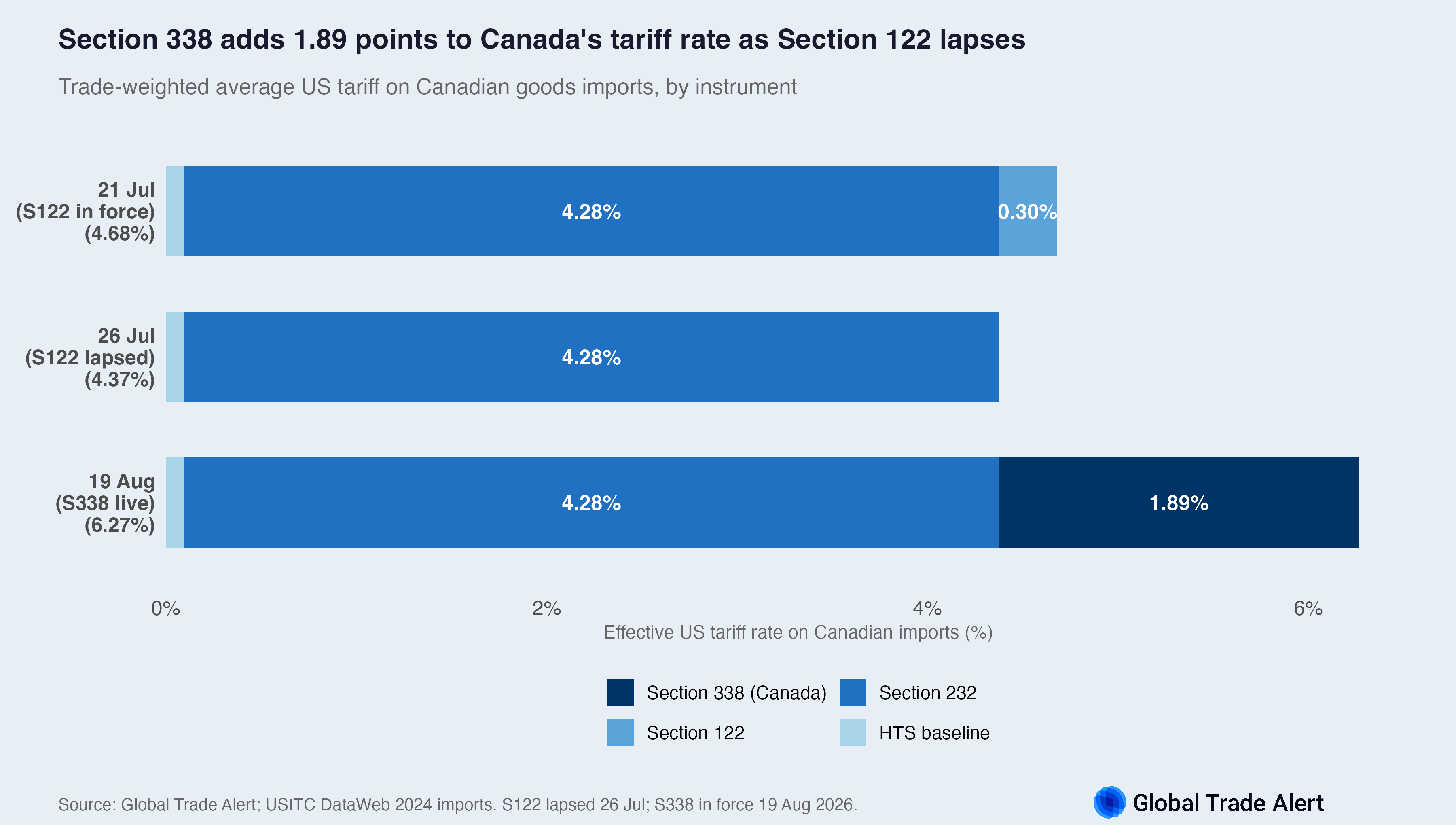
Three proclamations of 20 July 2026 rest on Section 338 of the Tariff Act of 1930 against Canada, the statute's first invocation since the 1940s. Each proclamation cites one Canadian practice: provincial bans on US alcohol, a dairy quota-eligibility rule that disadvantages US suppliers, and Canada's surtax on US-made cars. The remedy is the same in each case: a 50% duty on a designated basket of goods, with no USMCA relief. From 19 August, after the Section 232 carve-out, the duty covers $17.7bn of Canadian goods. This raises Canada's average US tariff by 1.89 points overnight, to 6.27%.
The response of motor vehicles dominates section 338's scope without appearing in it
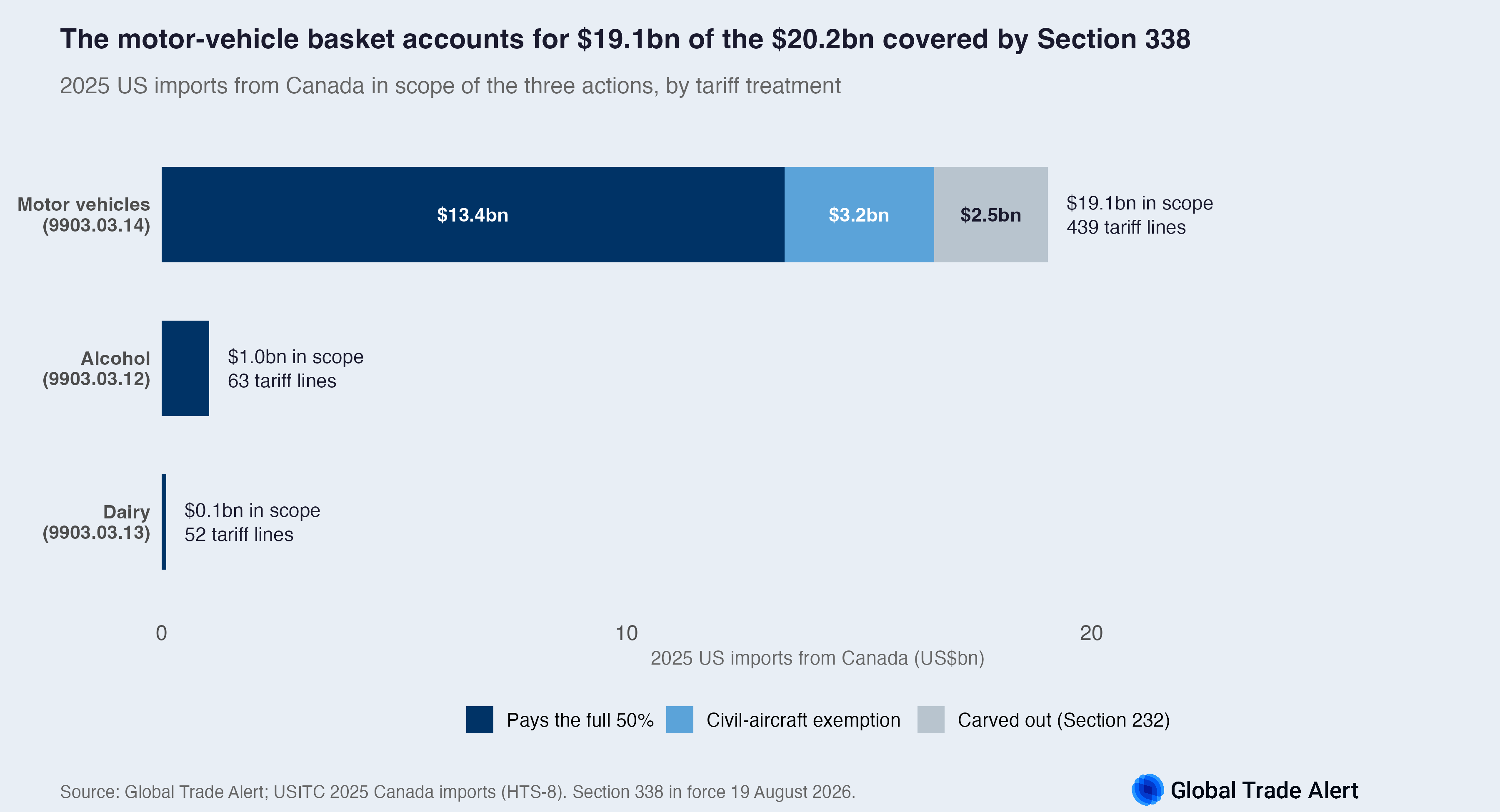
Motor-vehicle goods account for 19 of every 20 dollars in scope, yet none of its 439 traded lines sits in the tariff schedule's vehicles chapter. The closest it comes to a car is parts of car seats, classified as furniture. The affected products, in short, do not track the sectors under complaint.
Carve-outs only lower what is paid in practice. The motor-vehicle basket's effective Section 338 rate, the trade-weighted average across its lines, is 36.0%. $2.5bn of its trade is carved out because it already pays Section 232, and $3.2bn of aircraft-related lines pay 5% instead of 50%. The alcohol and dairy product categories have no carve-outs and pay the full 50%.
Canada's average tariff falls on 26 July, then rises to 6.27%
Canada's trade-weighted US tariff is 4.68% today. It falls to 4.37% on 26 July, when the temporary Section 122 surcharge lapses, then rises to 6.27% on 19 August as Section 338 enters into force. The 1.89-point increase makes Section 338 the second-largest layer in Canada's applied rate, behind only Section 232.
The largest covered lines mostly pay less than the full 50%
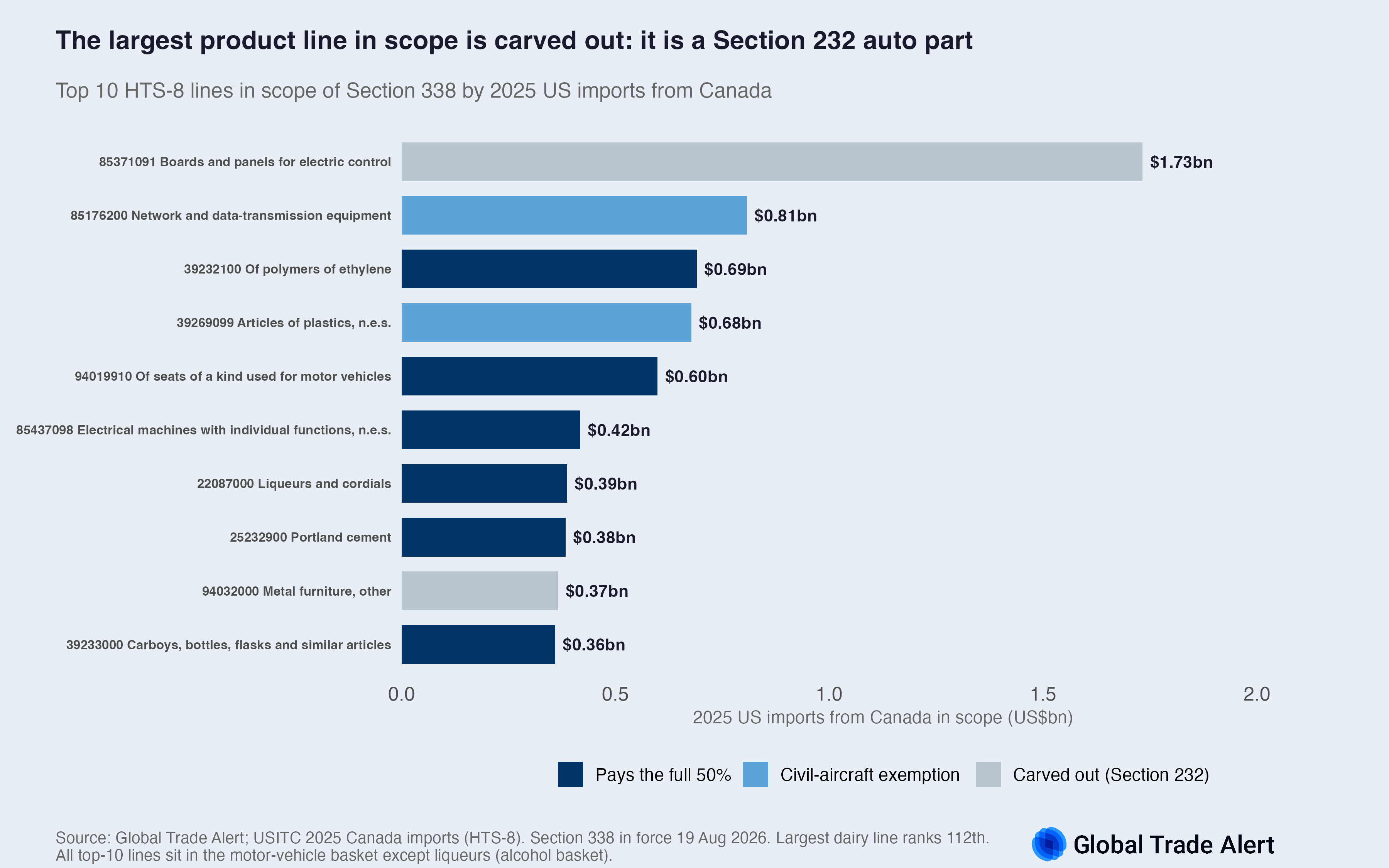
Ranked by covered trade, the largest lines are not the ones paying most. The single biggest, boards and panels for electric control ($1.7bn), pays no Section 338 duty: it is a Section 232 auto part, and the closed-list carve-out excludes that category. The auto-parts tariff itself spares USMCA-compliant goods, so most of this line's trade enters at low duty either way. The second, network and data-transmission equipment ($0.8bn), pays an effective 5% through the civil-aircraft list. The largest line paying the full 50% is plastic bags ($0.7bn). Liqueurs and cordials ($0.4bn) is the only alcohol line in the top ten, and no dairy line comes close. Across the ten largest lines, more than half the covered value pays less than the full rate.
Goods already under Section 232 are exempt from Section 338
Section 338 falls almost entirely on trade that other US tariff layers had so far spared. Each proclamation states that the new duties do not apply to articles already subject to Section 232 tariffs. No HS code pays both a Section 232 metal duty and Section 338 (a single $0.4bn furniture line retains a 3% model residual). The exemption is what sets the $2.5bn carved out above to zero.
By 19 August, $59.9bn of the $364.9bn in 2025 US imports from Canada pays tariffs USMCA cannot lower. The share USMCA can still shield falls from 85.6% in October 2025 to 82.3%. Section 232 instruments account for 70% of that unavoidable total: steel and aluminium ($30.8bn), lumber ($5.7bn), the heavy-vehicle-parts floor in force since November 2025 ($4.2bn) and copper ($1.4bn). Canadian exporters certified USMCA compliance heavily through 2025, lifting utilisation from 38% to 86% of eligible trade. However, in the latest 338 proclamations, these certifications will not lower the duty.
A Presidential finding overrides a trade agreement
Section 338's precedent matters more than the tariffs themselves. A dormant statute now overrides a trade agreement's core preference on a presidential finding alone. Carve-outs still let 82.3% of Canadian export value reach the US duty-free under USMCA. They narrow this action only where it overlaps Section 232. [1] The risk is repetition: this administration has now shown it will use the statute to bypass a trade agreement.
Status and method
Figures follow the proclamations of 20 July 2026 and exclude HTSUS Chapter 98 (re-imports and special classifications). Coverage shares and the scope figures use 2025 observed customs values; rate-path figures use the model's 2024 trade weights ($393.5bn base). Penn Wharton separately put combined Canada-Mexico USMCA utilisation at 83.8% in May 2026, near our Canada figure. Data are available below; the model is queryable via the Global Trade Alert tariff MCP.
Downloads