President Trump invoked Section 338 of the Tariff Act of 1930 against Canada on 20 July 2026, leading to an additional 50% duty on 554 Canadian tariff lines. Section 338 has not been referenced since the 1930s and 1940s, with no record of it ever being used to impose tariffs. This explainer sets out how the statute works, its historical precedents, and what the current proclamations against Canada actually cover.
The statute in a nutshell
Section 338 authorises the President to impose tariffs when a foreign country discriminates against US commerce relative to its treatment of other countries. The statute is triggered by two possible findings: an "unreasonable charge, exaction, regulation, or limitation" applied unequally to US goods, or de facto discrimination against US commerce in customs treatment, duties, or restrictions.
This statute has a maximum tariff ceiling of 50% ad valorem. This differs from sections 232 and 301, where there is no specific cap. If a country continues discriminating after the tariff is imposed, the president can escalate further and block imports from that country entirely.
Unlike section 122, Section 338 carries no domestic checks and balances. The statute requires no congressional consultation before action and no report afterwards. Likewise, it imposes no statutory time limit.
The US International Trade Commission has a standing duty to monitor foreign discrimination against US commerce. It reports its findings to the president along with recommendations. An investigation can begin on the Commission's own initiative or through a private-party petition. Unlike section 301, the statute does not require the president to consult with the accused trading partner.
The precedents
The current actions against Canada
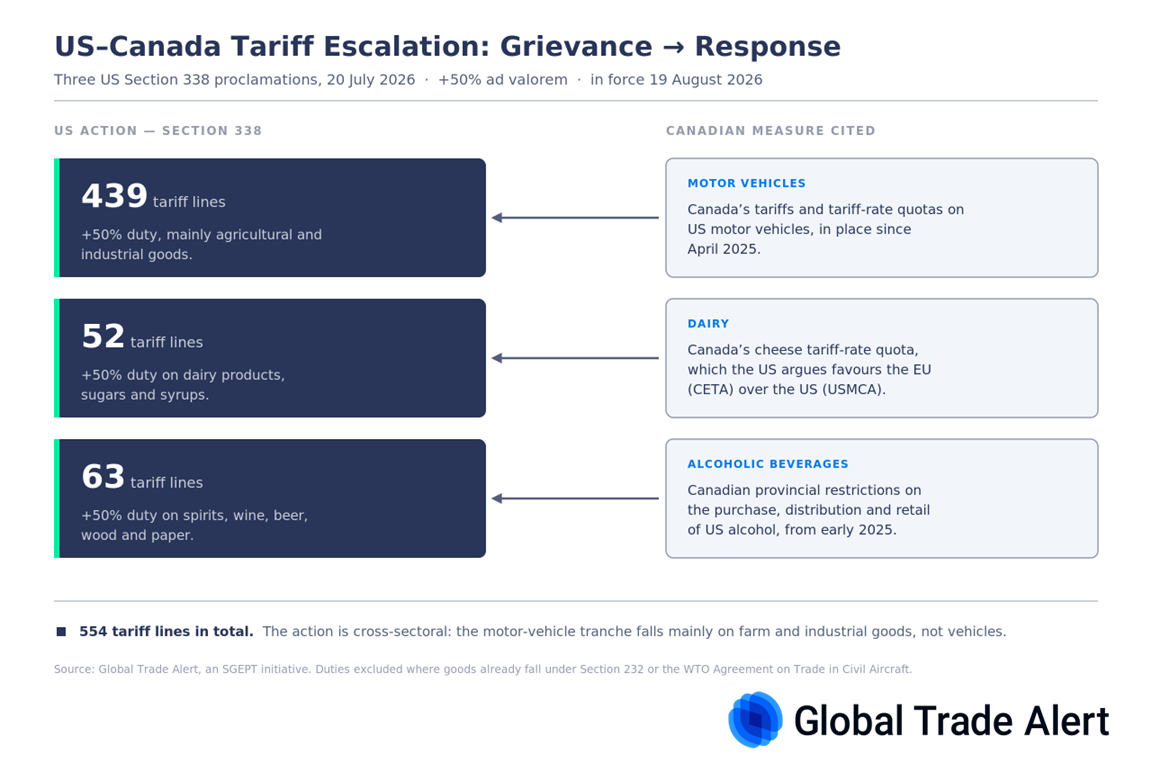
On 20 July 2026, the United States imposed an additional 50% ad valorem duty on Canadian imports under Section 338. The President issued three proclamations, each answering a distinct grievance and each entering into force on 19 August 2026. The motor-vehicle tranche covers 439 eight-digit tariff lines, the dairy tranche 52 lines, and the alcoholic-beverage tranche 63 lines. Together they hit roughly 554 tariff lines. Goods already subject to Section 232 duties, or covered by the WTO Agreement on Trade in Civil Aircraft, are excluded.
Each proclamation cited a specific Canadian measure rather than one blanket grievance. The vehicle action cited Canadian tariffs and tariff-rate quotas applied to United States motor vehicles since April 2025. The dairy action cited Canada's cheese tariff-rate quota, which it argues favours the European Union under CETA over the United States under USMCA. The alcohol action cited Canadian provincial restrictions on the purchase, distribution and retailing of United States alcoholic beverages, such as those in Alberta and British Columbia from early 2025.
The response reaches well beyond the sectors in dispute. The motor-vehicle tranche contains no vehicle tariff lines, and falls entirely on agricultural and industrial goods. The dairy and alcohol tranches do hit their named sectors. Each, however, also covers unrelated goods, from sugars and syrups to wood, paper and sports equipment.