The Commerce Department's Bureau of Industry and Security (BIS) is asking for public comment on adding 14 articles to the Section 232 steel, aluminium and copper tariff programme. Imports recorded under the cited tariff lines reached $13.0bn in 2025. The measurable part, excluding filled-container lines that record the chemicals rather than the containers, is $9.6bn, and about $9.0bn of that is not already covered by Section 232; both figures are upper bounds, for reasons set out below. Mexico and Canada account for the largest share of the measurable trade, 41.6%; China supplies 10.2%. The notice proposes duties of 25% on ten of the articles, 15% on agricultural trailers and 50% on filled steel containers, charged on the container's value rather than its contents; the two crane articles would take the rates of the June 2026 mobile-industrial-equipment proclamation. Nothing is in force, and any addition requires a joint decision by Commerce and the US Trade Representative. Comments close 27 August 2026.
The observable tariff-line universe is $9.6bn, and it is an upper bound
Excluding filled containers, imports under the 13 remaining articles totalled $9.6bn in 2025, up 13.4% on 2024 on the same basis. About $0.6bn of it already pays Section 232 duties, detailed below, leaving roughly $9.0bn the proposal would newly affect. Parts of linear-acting hydraulic power engines and motors are the largest article at $3.7bn, ahead of electric conductor cables at $3.2bn; the two together account for just over 70% of the measurable total. A further $5.7bn moved across all 14 articles in January–May 2026; that figure is not annualised.
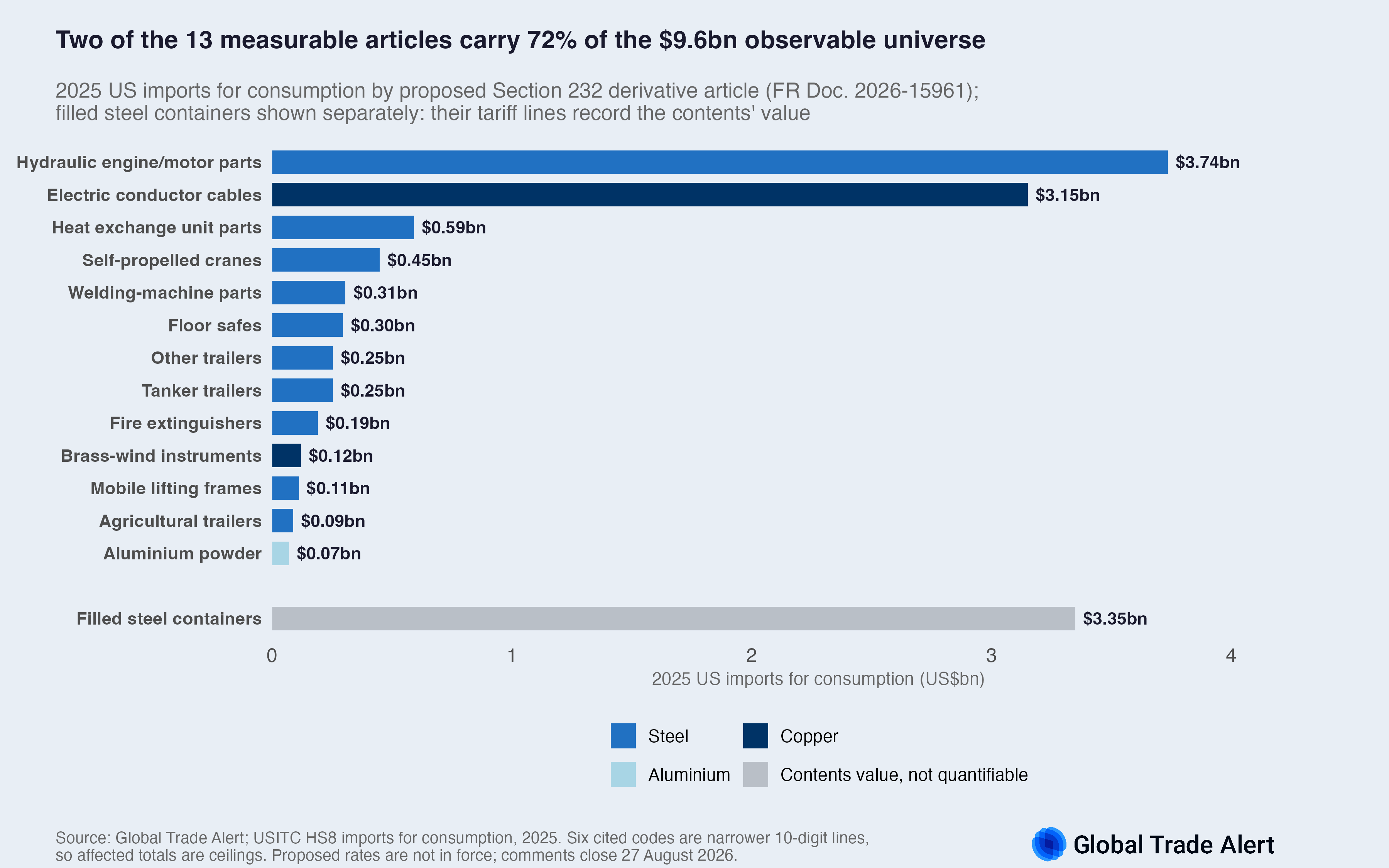
The hydraulic figure is a ceiling. The notice cites a 10-digit statistical line, while the totals here use the full 8-digit line; hence readers should treat these figures as a ceiling. Furthermore, filled steel containers are reported separately because the trade data measure the contents. The three cited lines record $3.4bn of 2025 imports of propane, oxygen and propylene. None of the three distinguishes imports in the covered steel containers from other shipment forms; the propane line, for example, includes bulk shipments. The proposed 50% duty would apply only to the value of the metal container, which these data cannot separate from the value of the contents. Neither the $3.4bn nor Canada's 52.7% share of it measures the container duty itself.
Mexico and Canada supply the majority of five measurable articles; China leads three and holds a majority in none
On 2025 trade, Mexico and Canada together supply more than half of five of the 13 measurable articles: tanker trailers (99.8%), agricultural trailers (98.3%), fire extinguishers (79.7%), other trailers (76.6%) and electric conductor cables (55.8%). China is the largest single supplier of three, brass-wind instruments (36.9%), floor safes (36.3%) and heat exchange unit parts (22.2%), and holds a majority in none. Across the measurable articles, Mexico and Canada supplied $4.0bn of the 2025 trade; China supplied $1.0bn.
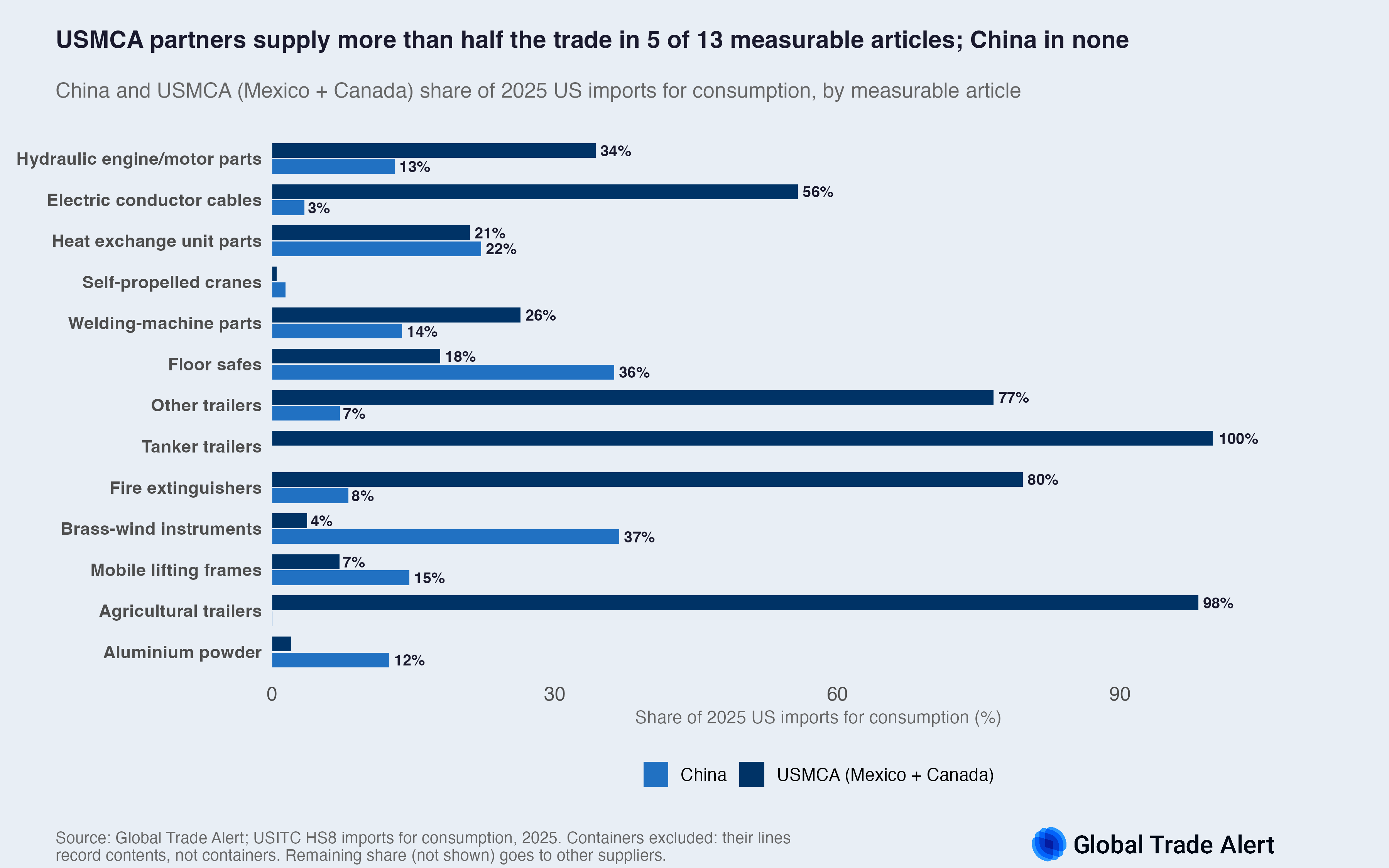
These shares show whose exports and supply chains are directly exposed; the duty itself would be paid by US importers. They carry no verdict on BIS's reasoning. The notice asks commenters about metal intensity, import volumes, domestic supply and economic effects, and the authority in Proclamation 11021 turns on whether letting an article enter duty-free lets steel, aluminium or copper content escape the tariff that would apply to it as metal. That is a question about product form and metal content, which origin data cannot observe: a trailer assembled in Canada from covered foreign steel could undermine the metals tariff in exactly the way the programme's logic describes. What the origin data do show is that North American supply chains face the largest exposure, while China accounts for a substantially smaller share.
Two articles are already covered, and four would be returning
Six of the 14 articles have a Section 232 history. Welding-machine parts have been covered as aluminium derivatives since March 2025, and one of the four cable lines, insulated conductors under 80 volts, since August 2025; together about $0.6bn of the 2025 trade already pays the 25% derivative duty. Fire extinguishers and the three filled-container lines were added as steel derivatives in August 2025 and removed on 6 April 2026, when Proclamation 11021's Annex II took 144 product lines out of scope. The notice proposes to restore them without mentioning that they were covered eight months ago.
The rest of the current duty picture makes the origin split consequential. Chinese-origin imports of every article except mobile lifting frames have carried Section 301 duties since 2018–19, mostly at 25%. The forced-labour Section 301 action in force since 24 July 2026 adds 10 to 12.5 percentage points on most of these lines from most origins; it exempts articles covered by Section 232 and, for Canada and Mexico, goods entered duty-free under USMCA, while Canadian and Mexican goods that do not qualify pay 10%. No general surcharge remains: the emergency-powers reciprocal tariffs stopped applying in February 2026 and the Section 122 surcharge that replaced them expired in July. A separate Section 338 action puts a 50% duty on Canadian floor safes, one cable line and one crane line from 19 August 2026, and it too exempts products covered by Section 232.
Inclusion would move duties in both directions. USMCA-compliant Canadian and Mexican trade, which pays no additional duty today, would move to the full proposed rates. Imports from China and most other origins would swap the forced-labour duty for the higher Section 232 rate, a smaller step than the headline rates suggest. And on the three Canadian lines under Section 338, designation would replace a 50% duty with a lower Section 232 one.
Comments close 27 August; nothing requires BIS to act by then
BIS states that the public-comment period is not legally required: Section 232 actions are treated as a "military function" exempt from the Administrative Procedure Act's usual notice-and-comment rule. It is asking anyway, and wants commenters to address five points: how metal-intensive each product is, whether import volumes threaten national security, whether US producers could meet domestic demand if the article is added, the economic effect of adding it, and any other relevant factor. Commerce and the US Trade Representative then decide jointly, article by article, whether to bring any of the 14 into scope; the notice sets no date for that decision and does not have to reach one by any particular time.
Net assessment
Excluding filled goods that customs data cannot measure, the proposal reaches an observable tariff-line universe of less than $9.6bn, about $9.0bn of it not already covered. Mexico and Canada account for the largest share and hold majorities in five measurable articles; China holds a majority in none. These figures identify the supply chains most exposed; they do not test the national-security rationale for extending the tariff. For USMCA-compliant North American trade, inclusion would generally mean moving from no additional duty to rates of 15–50%, subject to the separate treatment of the two crane articles; for most other origins the step is smaller; on the three Canadian Section 338 lines the applicable duty would fall.
Status and method
All import figures are USITC Imports for Consumption at the 8-digit HS level: full-year 2025 as the baseline, full-year 2024 on the same basis for the growth comparison, and January–May 2026 for the current partial year, which is not annualised anywhere in this piece; the June monthly release is not incorporated. Six of the 20 cited HTSUS codes are 10-digit statistical lines; the totals here use their five parent 8-digit lines, so the affected article totals are ceilings, flagged in the text; 10-digit data are published by the US International Trade Commission but are not used here. The floor-safe line is broader than the free-standing safes the notice names, so that article's total is a ceiling as well. The filled-container lines record the value of the chemicals however shipped, not the containers the proposed duty would tax. Tracked in the Global Trade Alert database as state act 99702.
Downloads