Competitiveness Is Usually One of the Reasons
GTA Monthly Newsletter: October 2026
Authors
Global Trade Alert
Date Published
20 Oct 2026
Related Topics:


GTA Monthly Newsletter: October 2026
Global Trade Alert
20 Oct 2026
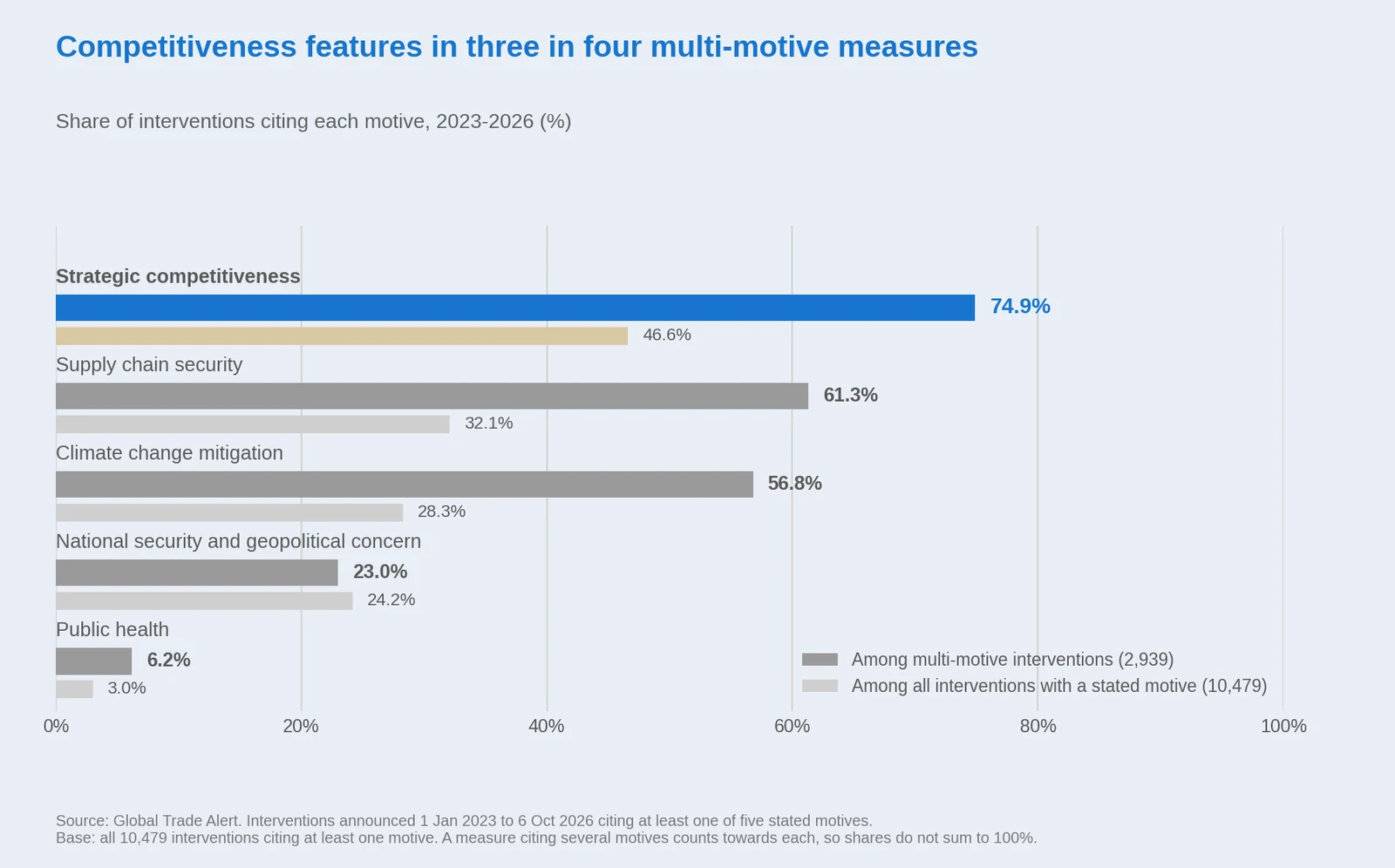
When governments give more than one motive for a trade or industrial policy intervention, strategic competitiveness is usually one of them. Since 2023, it has featured in 74.9% of the policy interventions that cited several motives, against 46.6% of all policy interventions that cite any motive. It is the most frequent partner of both climate mitigation and supply chain security.
Interventions citing climate change mitigation are the most likely to also cite strategic competitiveness. Half of all climate policy interventions (49.2%) cited competitiveness in 2026, up from 29.2% in 2023. The EU drove most of the jump, reaching 54% so far this year from 28.9% in 2023. The shift came in early 2025, coinciding with the launch of the Clean Industrial Deal. Under it, Brussels introduced a new framework to facilitate state aid approvals for projects involving, among others, clean technologies, industrial decarbonisation, and renewable energy.
Worldwide, the pairing is strongest in metals and chemicals. Among climate-justified policy interventions targeting specific sectors, 57.6% of those covering metals and 56.4% of those covering chemicals cite competitiveness. Some examples of recent policy actions include the EU’s higher annual allocation for research projects in sectors related to the coal and steel industry, Australia’s USD 1.8 billion investment in the Tomago Aluminium smelter and the UK’s USD 167 million support for INEOS' Grangemouth chemical plant.
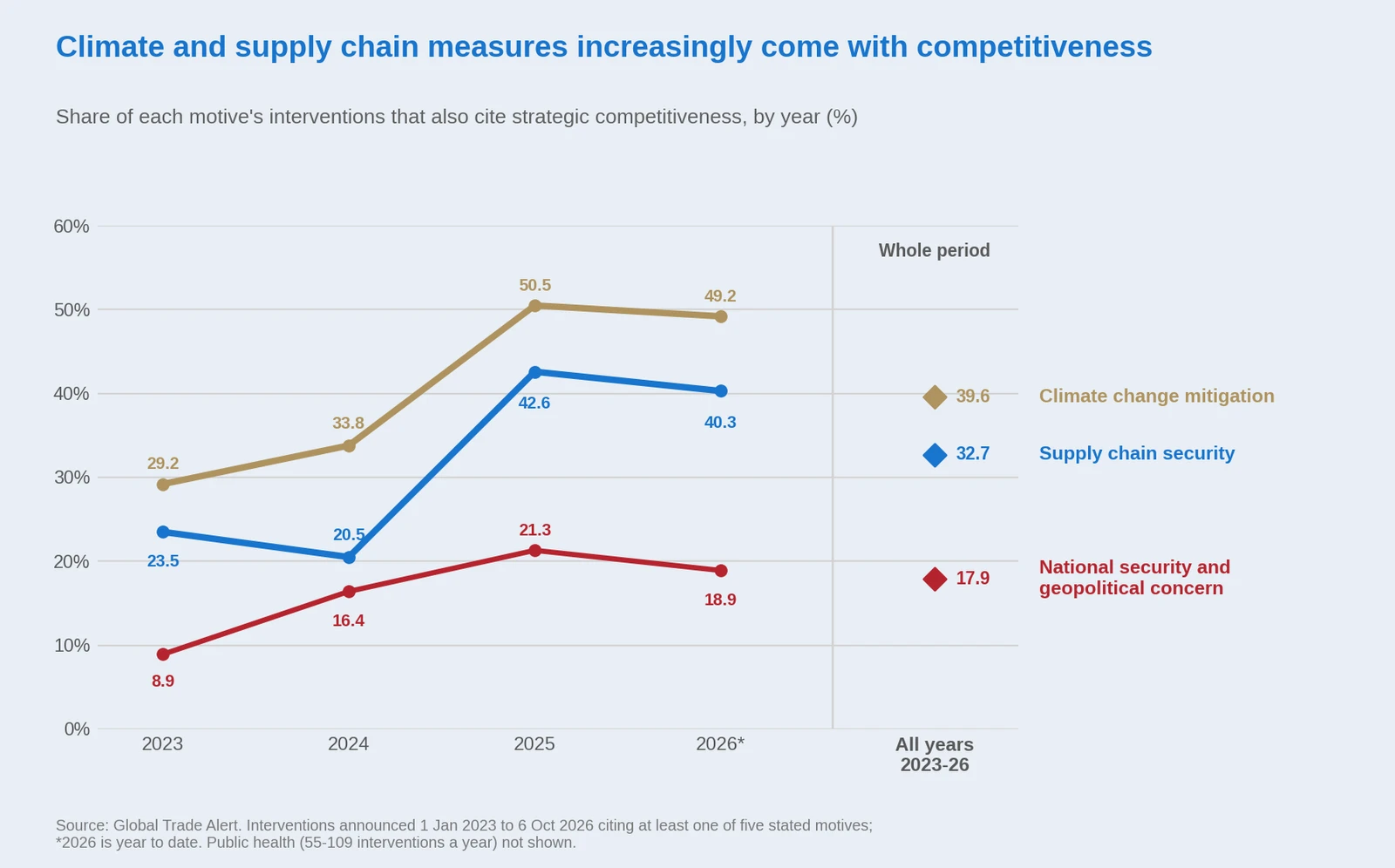
Competitiveness is increasingly the motive supply chain interventions come with. The share of supply chain security interventions that also cite competitiveness doubled, from 20.5% in 2024 to 42.6% in 2025. It now stands at 40.3% so far this year, close to the climate figure (49.2%). As we showed last month, supply chain security is the fastest-growing policy motive this year.
Recent measures show the pairing in practice. China’s 15th Five-Year Plan for petroleum and natural gas targets domestic supply of 440 million tonnes of oil equivalent by 2030. South Korea announced USD 3.5 billion in support for the “15 Grow-Together Projects” in critical minerals, materials, parts and equipment.
Competitiveness now accompanies climate, supply chain and national security measures more often than in 2023. Security remains the lowest: 17.9% of security measures since 2023 also cite competitiveness. The share has still doubled, from 8.9% in 2023 to 18.9% so far in 2026. The rise affecting all pairings shows that governments increasingly justify their policy interventions in connection with strategic competitiveness.