Chips and AI: From Gatekeepers to Financiers
GTA Monthly Newsletter: November 2026
Authors
Global Trade Alert
Date Published
17 Nov 2026
Related Topics:


GTA Monthly Newsletter: November 2026
Global Trade Alert
17 Nov 2026
Governments have changed how they shape the chips and AI sector, moving from controlling who has access to fostering industry growth. The shift also affects how governments are supporting their industrial base. States now act more as investors, taking equity stakes and running funds.
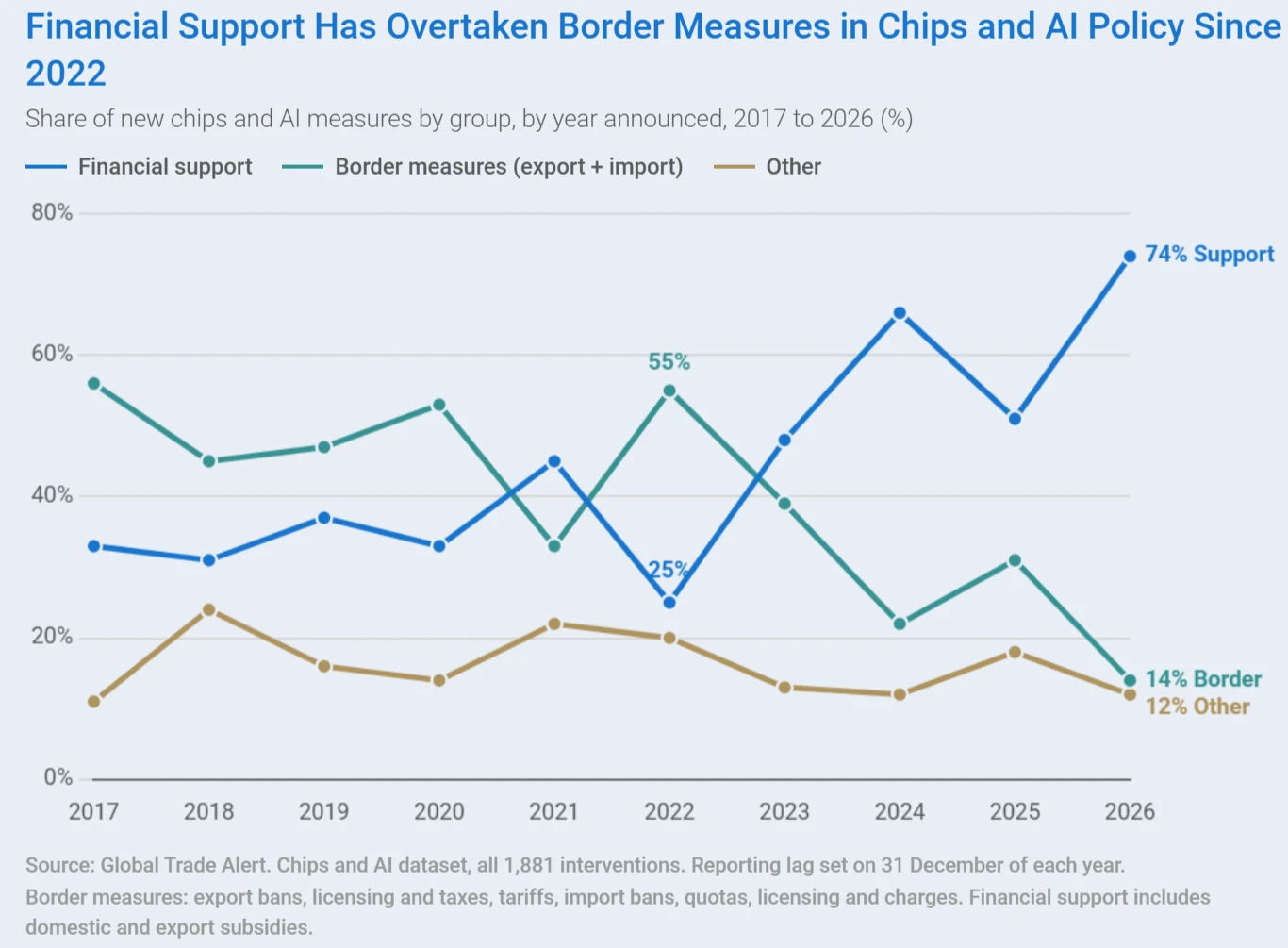
Until 2022, trade and industrial policy affecting chips and AI mainly happened at the border. New import measures and export controls made up about half of all these measures each year, reaching 55% in 2022. Advanced economies focused on export controls mainly connected to US-China rivalry and sanctions on Russia. The peak of these chip-specific controls took place in October 2022, when the US restricted exports of advanced computing and chipmaking items to China. In emerging economies, tariffs and other import measures accounted for 48% of their sectoral measures in 2017–21.
Yet, since 2022, financial support has grown more than sixfold. It now accounts for 74% of the total in 2026, the highest share on record. Border measures have fallen to 15%. This trend is also visible in emerging economies where, by 2024-26, financial support made up 70% of their new measures, and import measures had fallen to 14%.
Governments increasingly act as investors rather than grant-givers. Equity and investment support represented 8% of all new domestic subsidy measures announced in 2022. This year, this has risen to 26%. In contrast, grants fell from 44% to 31% over the same period. Actions like Washington’s 9.9% stake in Intel and Bpifrance's USD 3.5 billion funding round for Mistral AI are clear examples of this equity activity. Korea’s USD 35.7 billion Advanced Strategic Industry Fund, China’s CNY 60 billion AI industry fund, and Saudi Arabia’s new investment company also illustrate the growth of investment funds.
But many governments still take the traditional financing route. To build production capacity, they rely on grants, loans, guarantees and tax cuts. Examples of recent measures include Brazil’s BNDES BRL 2 billion credit line for data centres and Türkiye’s USD 1.6 billion funding call for cloud and AI.
Public money, not border control, now drives chips and AI policy. Financial support makes up three-quarters of the sector's measures. The shift may not last. Calls for tighter export controls followed the Nvidia investigation. If technological rivalry sharpens and those calls become policy, governments may turn to the border again. The GTA will track whether they do.