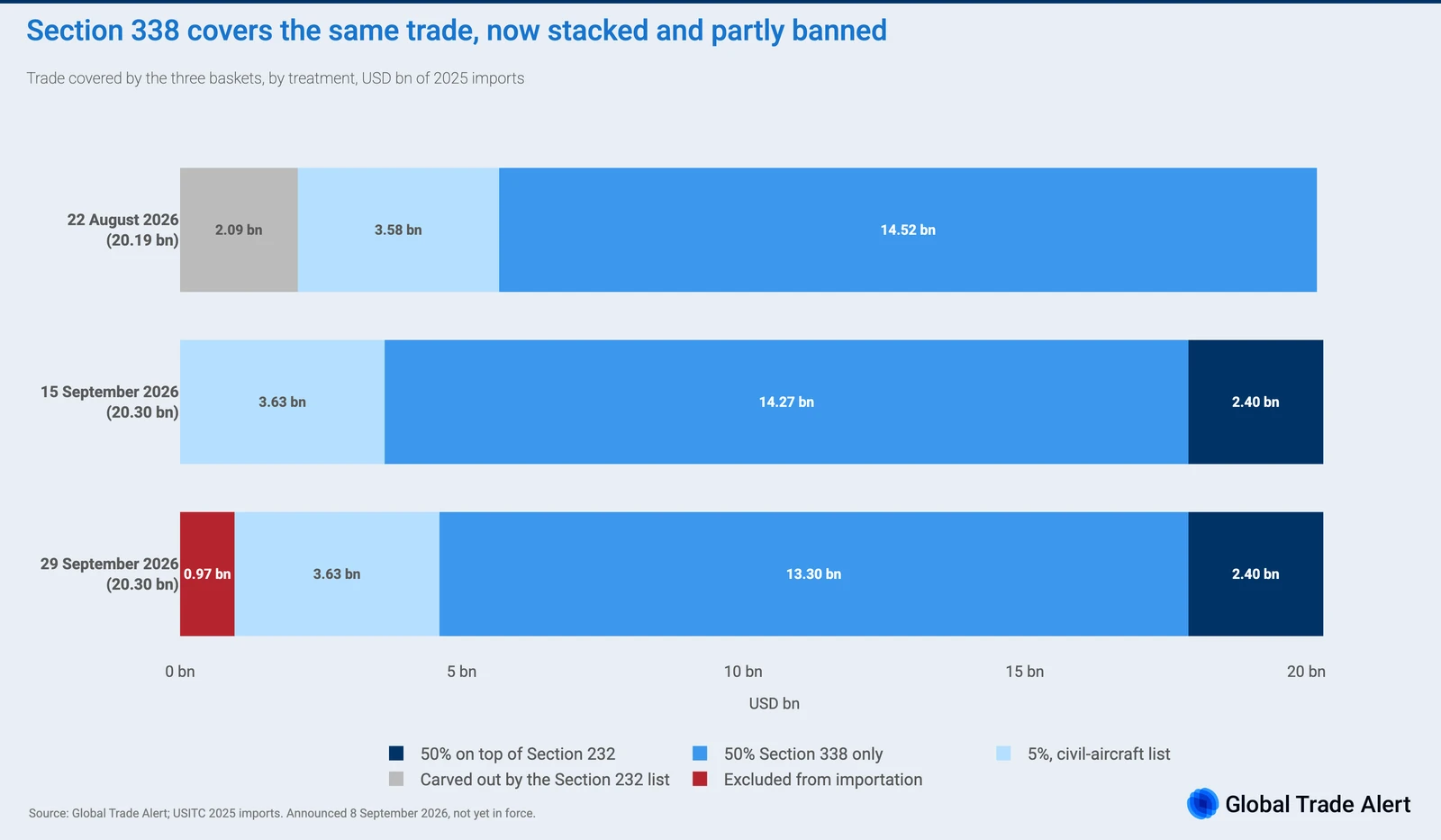
Before the proclamations of 8 September 2026, the three baskets covered $20.19bn of the $383.1bn the United States imported from Canada in 2025, 5.3% of the total, on 554 products lines. From 15 September they cover $20.30bn on 659 lines. Canada's trade-weighted average applied US tariff moves from 7.17% on 14 September to 7.50% on 15 September, on 2024 import weights.
While the overall trade affected is comparable, the treatment and composition of the products affected by Section 338 changed. Trade paying the full 50% rises from $14.52bn to $16.66bn, because the Section 232 carve-out that had sheltered $2.09bn disappears. Of the trade now paying 50%, $2.40bn pays it in addition to Section 232 duties. And from 29 September up to $0.97bn is not tariffed at all, because it may not be imported.
The largest change is that Section 338 now stacks on Section 232
Until 14 September, goods in the eight Section 232 categories of US note 51(c) to Chapter 99 of the tariff schedule were exempt from the Section 338 surcharge. Those categories are steel, aluminium, copper, autos, trucks, lumber, pharmaceuticals and semiconductors. From 15 September that exemption survives only for the dairy basket. Both modification proclamations state that the duties apply in addition to duties imposed under Section 232.
On 2025 values, $2.40bn of the motor-vehicle basket pays 50% on top of Section 232. Newly added structural steel, aluminium and small vehicles account for $1.09bn of it. The rest was carved out in August: the retained part of the electric control panel line at $973m, a Section 232 auto part, and wooden furniture at $328m, Section 232 lumber. Qualifying for the US-Mexico-Canada Agreement still gives no relief.
Changing product composition for alcohol and automotive tariffs
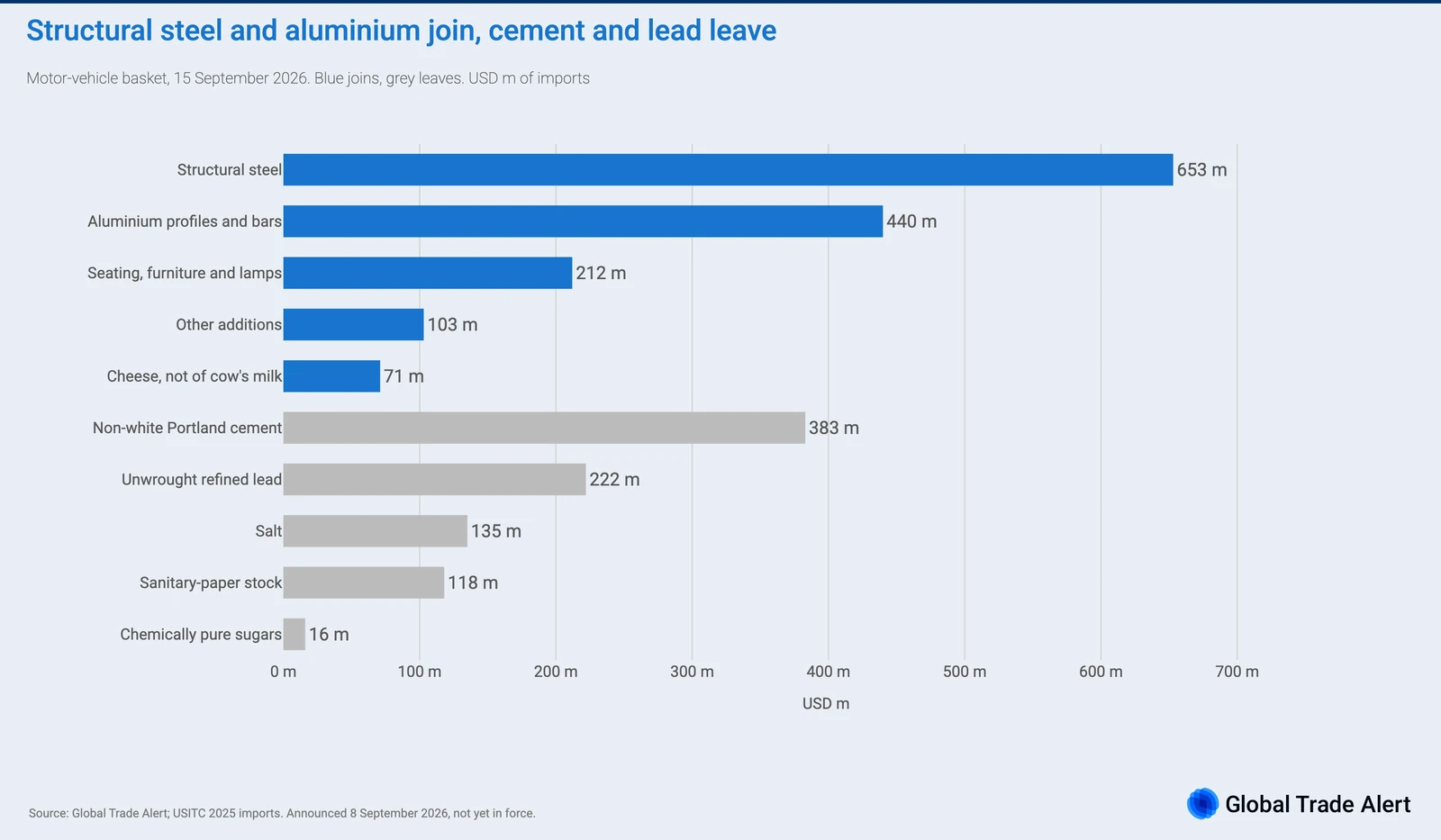
The motor-vehicle basket gains 76 lines worth $1.48bn of 2025 imports and loses five worth $874m. Three further lines are narrowed to a sub-category: paper household and hospital articles keep only face masks, fishing tackle keeps only rods, and electric control panels drop switchgear assemblies and switchboards, 44% of that line in 2025.
The alcohol basket gains 34 entirely different products, 23 of them cheese lines, along with modified fats and oils at $272m, hides and leather at $8m and motorboats at $73m. It loses bulk whisky and bulk liqueurs, which move out of scope above four litres. Bourbon and rye are listed separately and stay in.
The proclamation titles name three Canadian practices: provincial bans on US alcoholic beverages, a dairy quota-eligibility rule and a surtax on US-made cars. The product lists reach well beyond them. Until September, the motor-vehicle basket contained no passenger vehicles. It now contains two lines: golf carts and cars under 1,000cc. Cheese becomes newly liable to 50% through the alcohol and motor-vehicle proclamations rather than the dairy one, 23 lines worth $17m and one worth $71m.
Sixty-eight entries may be banned from importation
The three exclusion proclamations name 68 annex entries: 53 alcohol, 14 dairy and one motorcycle line. Of those 68, 36 have recorded Canadian imports in 2025. Together they value up to $0.97bn of 2025 imports, 0.25% of Canada's exports to the United States. Alcoholic beverages account for $0.85bn of that, whey, molasses and non-alcoholic beer for $0.04bn, and motorcycles over 800cc for $0.08bn.
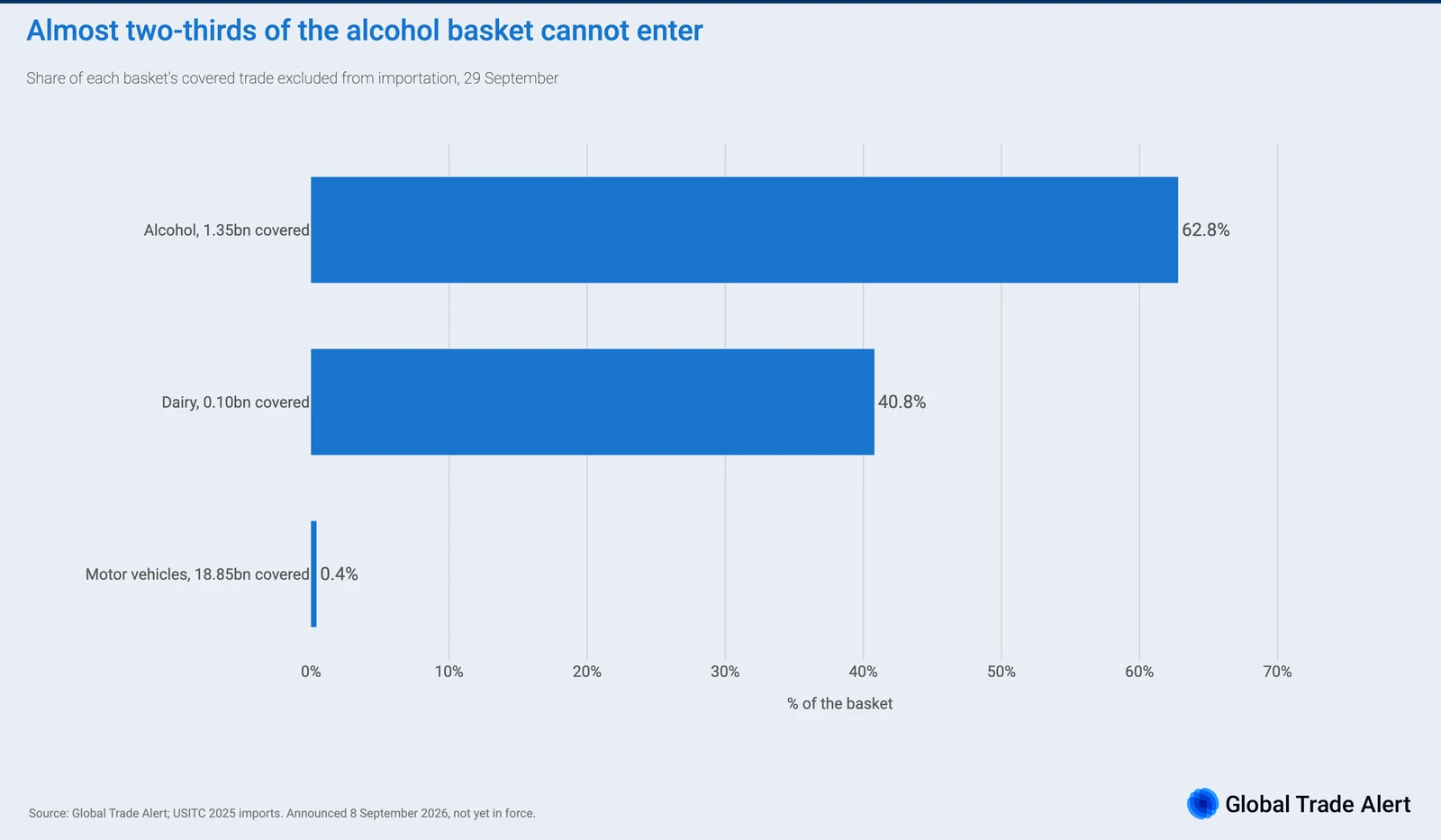
The bans concentrate where the baskets are small. Almost two-thirds of the alcohol basket's covered trade cannot enter. The motor-vehicle basket, twenty times larger, loses 0.4% of its trade.
Of the $0.97bn, $0.84bn is banned on the face of the annexes. The remaining $0.13bn turns on how much of one product group travels in retail packaging: the annex marks 28 entries as covering only product in bottles, cans, boxes, kegs and similar containers, and no trade series records container type. We treat those entries as banned in full, which is an upper bound. Of that $0.13bn, $79m sits on two lines whose own tariff-schedule text points the other way.
Status and method
The changes are announced and not yet in force. The scope changes apply to goods entered for consumption on or after 15 September. The bans apply to goods imported on or after 29 September.
Averages use the model's 2024 trade weights. Coverage and scope values use observed 2025 customs values. Both come from US import data at the eight-digit level. Banned trade carries no rate: it leaves both the numerator and the denominator of every average, and the banned value is reported beside the average rather than converted into one.
Three assumptions carry the figures. The packaged share is an upper bound, bracketed above. The civil-aircraft share of 0.9 is an uncalibrated placeholder that keeps lines on that list at about 5% rather than 50%. Five lines deleted at eight digits and re-listed only for some of their ten-digit children keep a retained share taken from US ten-digit import data. Two provisions are not modelled: goods imported before 29 September but not yet entered keep the 50% duty, and the 50% duty applies to any import for which a ban is invalidated. The dairy exclusion proclamation refers to a dairy scope-modification proclamation of 8 September. No such proclamation exists, and we read the reference as a drafting artefact.