The President's post of 24 August 2026 says that "on January First, 2027, Tariffs on all Cars, Trucks, both large and small, Automotive Parts, and Steel, will be increased to 50%" for Canada, and that there will be "ZERO TARIFFS" for production in the United States. It names products, not tariff lines or a legal instrument.
To assess the tariff implications of this threat, we have to make two assumptions. First, we assume the product scope is the four existing Section 232 actions that cover those products: automobiles, auto parts, medium- and heavy-duty vehicles, and steel, including steel derivatives. Together they reach 932 Canadian tariff lines worth $83.5bn of 2024 exports to the United States, 21% of the total. Second, we assume the increase takes effect inside those actions on 1 January 2027, on top of the tariff regime already scheduled for that date.
We compute two scenarios because the treatment of USMCA-qualifying goods is unclear. Under the current actions, qualifying Canadian cars and trucks pay Section 232 only on their non-US content and qualifying parts are exempt. Our scenario A raises every rate to 50% and keeps that relief, the reading closest to "build in the U.S. and there are zero tariffs". Scenario B raises the rates and cancels the relief, so every good in scope pays 50% on its full value. In both, the USMCA preferential tariff rate itself stays in place.
Canada's average US tariff rises by 2.5 points with USMCA relief kept, by 7.2 without it
| Canada | All US imports |
|---|
| Baseline, 1 January 2027 | 8.5% | 12.5% |
| A: 50%, USMCA relief kept | 11.0% (+2.5 pp, $9.9bn) | 12.9% (+0.3 pp) |
| B: 50%, no USMCA relief in Section 232 | 15.7% (+7.2 pp, $28.1bn) | 13.4% (+0.9 pp) |
Trade-weighted average applied rates on 2024 imports; extra duty applies the change in rate to 2024 volumes. Canada's baseline of 8.5% sits 1.1 points above the 7.5% our model gives for 22 August 2026; the pharmaceutical Section 232 tariff due on 29 September, on $5.5bn of Canadian exports, accounts for 1.0 of those points.
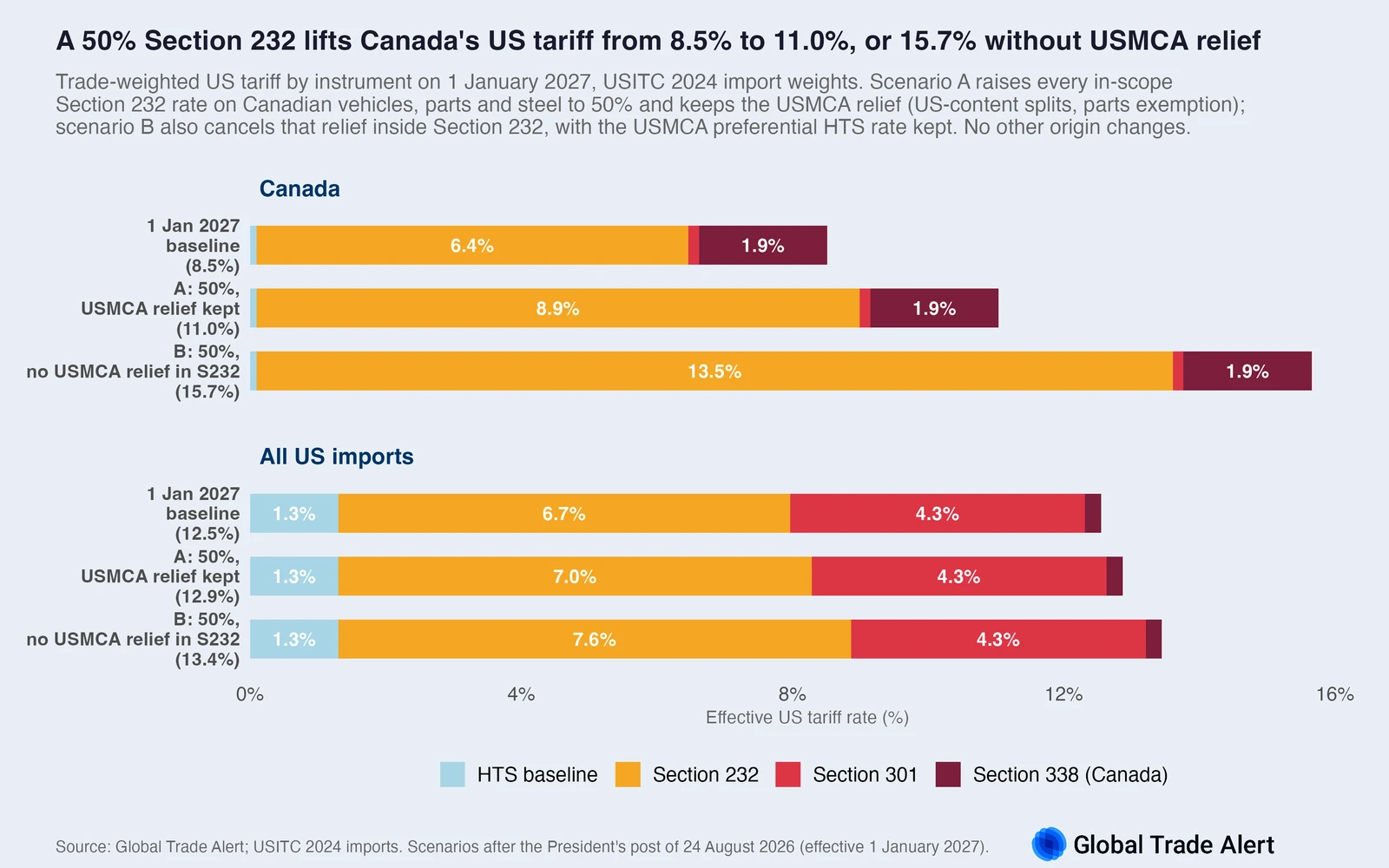
The all-origins effect is small because Canada is one-eighth of US imports and the goods in scope are a fifth of Canada's exports. No other origin's tariff changes in either scenario.
Vehicles carry the smaller scenario; vehicles and parts carry the larger one
Finished vehicles are $32.4bn of the $83.5bn in scope and pay an effective Section 232 rate of 13.1% today, since qualifying cars are charged 25% on their non-US content only. Scenario A doubles that to 26.3% and accounts for $4.3bn of the $9.9bn. Steel derivatives on the reduced-rate lists (Annex I-B and III of the April 2026 metals proclamation, and Annex I-C added in June) add $4.4bn, because their rates go from 25%, or a 15% ceiling, to 50%; steel main products are already at 50% and do not move. Auto parts add only $0.7bn in A, since qualifying parts stay exempt.
Scenario B falls on vehicles and parts. Cars go to 50% on full value, $12.0bn of extra duty; parts go from exempt to 50%, $9.3bn; trucks add $1.7bn. Steel adds only $0.3bn more than in A, because steel has almost no USMCA relief to lose. Buses, at 10% today with no relief, go to 50% in both scenarios.
The scope is assumed, the statute is unknown and the estimates are static
The product scope is our reading of a social-media post. A narrower reading (finished vehicles and primary steel only) or a broader one (every product containing steel) would change the figures, and the post says nothing about aluminium, copper or lumber, which we leave untouched.
The statute to impose this threat is also unknown. A 50% Section 232 rate on Canada alone would need new proclamations under the existing investigations. While we use this for our modelling approach, we do not mean to say that this is the likely course of action.
Downloads
- Scenario dataset (Excel) (rates by state and instrument, the Section 232 buckets, the 932 Canadian tariff lines in scope, the origin panel and the USMCA sensitivity)
- Charts and backing data (ZIP) (the chart in desktop and mobile sizes with its spreadsheet, the source CSVs and the methodology note)