Policy Rationales Tilt Toward Security and Competitiveness
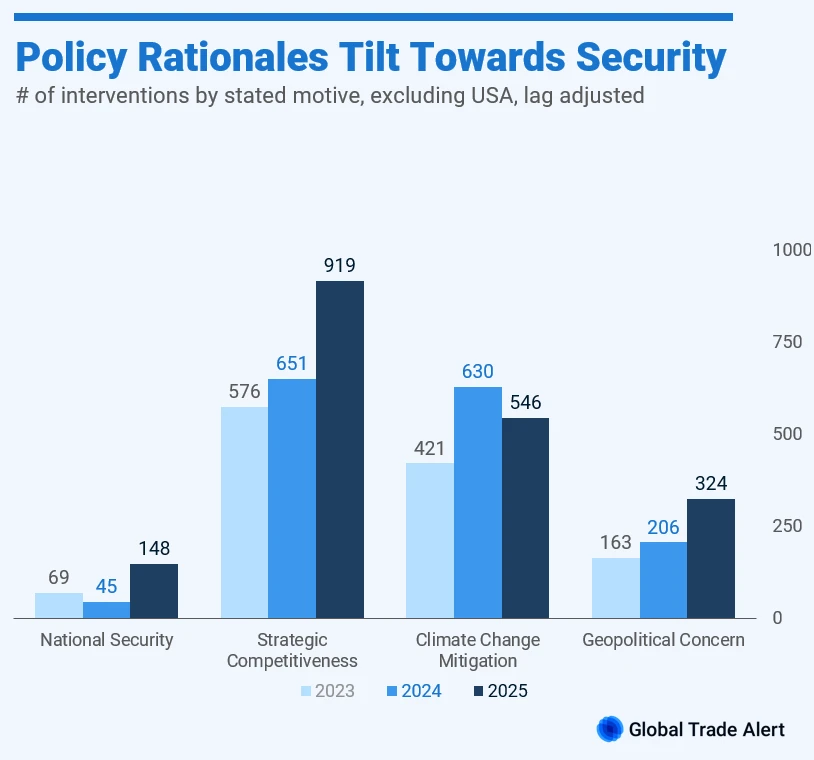
In 2025, governments deployed nearly 1,400 policy measures citing strategic competitiveness, national security, or geopolitical concerns (Figure 1). Citations of national security motive surged by 229%, driven by interventions from 39 jurisdictions. Citations of geopolitical concern increased by 57% over the same period. Together, these trends indicate a growing defensive orientation in trade and industrial policy. Strategic competitiveness nonetheless remained the most frequently cited motive, recording a 41% increase relative to 2024.
Meanwhile, fewer actions cited climate change mitigation concerns. These dropped 13%, from 630 in 2024 to 546 in 2025, reversing the trend from 2023 to 2024. This pattern was visible across major jurisdictions, though some salient climate change mitigation policies were still adopted. Notable examples include the EU's Clean Industrial Deal and Brazil's multibillion-dollar investment scheme for the green economy.
From Subsidies to Border Measures: The Instrument Shift
Policy instruments pivoted too (Figure 2). Domestic subsidy measures declined for the first time after five years of consistent growth. Rather than abandoning financial support, governments are concentrating resources on policies deemed strategically important. According to GTA data, subsidy measures citing strategic competitiveness as a rationale surged by 80% between 2023 and 2025, rising from 362 to 651. The EU announced several sectoral action plans and strategies, including quantum technologies and AI. Brazil followed a similar pattern, fostering the adoption of Industry 4.0 equipment and supporting emerging sectors like data centres.
The five-year plateau in border import measures ended abruptly in 2025. Last year, tariff measures surged to levels 45% above their five-year average. Much of this activity was a direct response to US tariffs. But the surge extended beyond retaliation. Mexico increased import duties on over a thousand products. Vietnam raised import duties on steel sheets and polymers. Similarly, import licensing and quota measures jumped 74% last year. Türkiye implemented 33 import-licensing measures (up from 21 in 2024), while India implemented 17 (up from 5 in 2024).
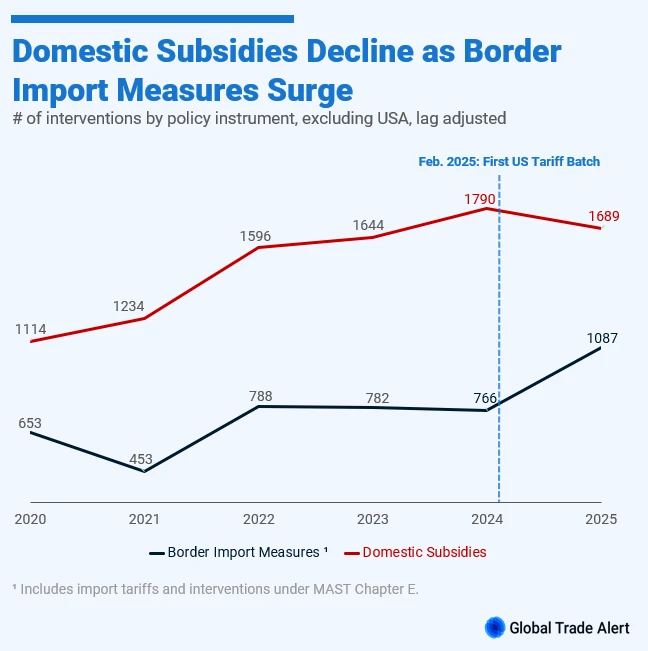
In 2025, security and competitiveness rationales rose as climate priorities receded. Border measures surged after years of stability. The breadth of this shift across regions, rationales, and instruments suggests a structural turn, not a passing cycle.
Sign up here to receive every Monthly Newsletter prepared by the GTA.