
Tariff Watch: Real-Time Information on Trump’s Trade Deals
Latest Update: 19 February 2026, 4:00 pm CET


Latest Update: 19 February 2026, 4:00 pm CET
Ana Elena Sancho, Anttoni Asikainen, Marius Risse, Fiama Angeles
19 Feb 2026

Jurisdictions with closed deals confirmed by both parties (19): Argentina, Bangladesh, Cambodia, Chinese Taipei, Ecuador, El Salvador, the EU, Guatemala, India, Indonesia, Japan, Malaysia, North Macedonia, South Korea, Thailand, Switzerland and Liechtenstein, the United Kingdom, and Vietnam
Jurisdictions with temporary deals confirmed by both parties (1): China
Jurisdictions with deals confirmed by one party (2): the Philippines and Pakistan
On 12 February 2026, the United States and North Macedonia announced a Framework for an Agreement on Reciprocal, Fair, and Balanced Trade. Under the Framework, the United States committed to eliminating reciprocal tariffs on specific products from North Macedonia. Specifically, committed to identifying products from the list set out under the "Potential Tariff Adjustments for Aligned Partners" mechanism that would receive a zero percent reciprocal tariff rate. For other goods originating from North Macedonia, the reciprocal tariff rate will remain at 15%.
North Macedonia, in turn, committed to eliminating customs duties on all industrial and agricultural goods exported from the United States of America to North Macedonia. The agreement also includes North Macedonia's commitment to "commence purchases of U.S. liquefied natural gas (LNG)" upon the completion of a new gas interconnector between North Macedonia and Greece. These commitments are subject to additional domestic formalities before entering into force.
.png)
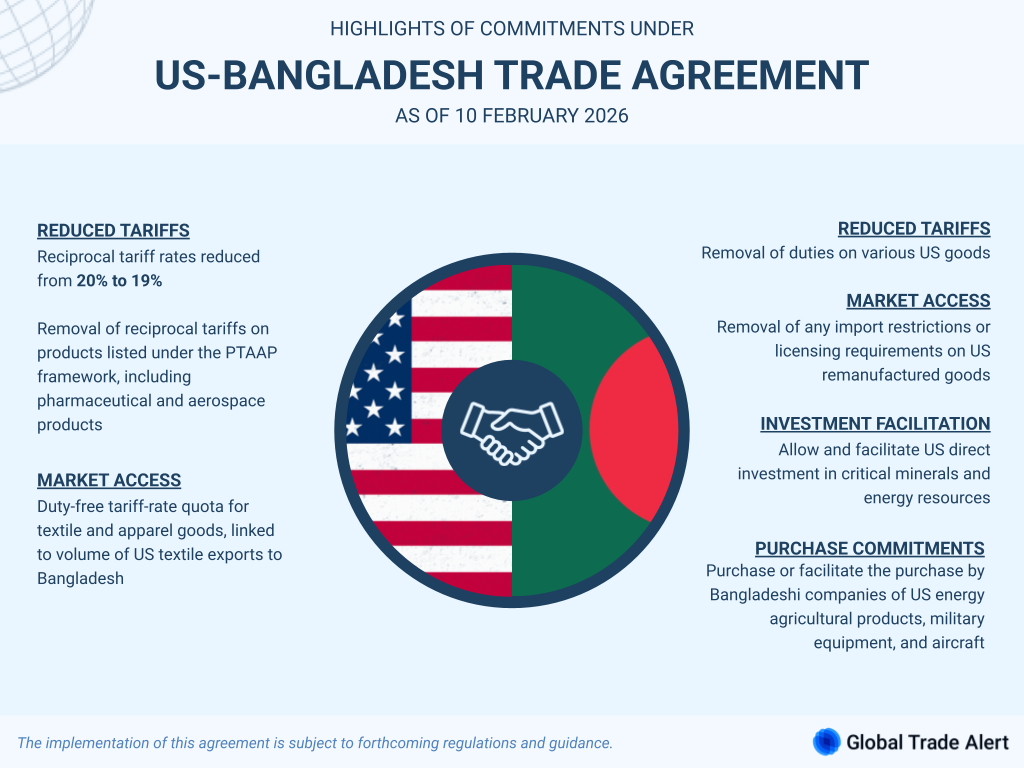
On 9 February 2026, the United States and Bangladesh announced the signing of the United States–Bangladesh Agreement on Reciprocal Trade. Under the agreement, the United States committed to reducing reciprocal tariff rates from 20% to 19% on goods originating from Bangladesh. In addition, the United States committed to applying a zero reciprocal tariff rate to products listed under the Potential Tariff Adjustments for Aligned Partners (PTAAP) framework. The United States also committed to establishing a tariff-rate quota mechanism for certain textile and apparel products from Bangladesh. These commitments are subject to additional regulatory procedures before entering into force.
Bangladesh, in turn, has committed to removing or reducing import tariffs on various US goods and to removing import licensing requirements on US remanufactured goods or their parts. In addition, the Bangladesh government will "allow and facilitate U.S. direct investment in its territory to explore, mine, extract, refine, process, transport, distribute and export critical minerals and energy resources” and will “endeavour to purchase, or to facilitate the purchase by Bangladeshi companies”, of US energy (including LNG), agricultural products (including wheat, soy, soy products, cotton), military equipment, and US civilian aircraft, parts, and services.
The agreement remains subject to completion of domestic legal procedures and will enter into force 60 days "after the date on which the Parties have exchanged written notifications certifying completion of their applicable legal procedures or on such other date as the Parties may decide."
On 7 February 2026, the United States and India announced a framework for an Interim Agreement regarding reciprocal and mutually beneficial trade. Under the framework, the United States committed to specific tariff adjustments for India-originating goods, including reducing reciprocal tariff rates, removing reciprocal tariffs on certain goods and removing certain Section 232 tariff measures. The US also committed to a preferential tariff-rate quota for automotive parts subject to the Section 232 tariffs on automobiles and automobile parts. These commitments are subject to additional regulatory procedures before entering into force. A day earlier, the US Administration issued an executive order eliminating an additional 25% ad valorem duty on imports of articles from India. The decision followed representations that India would stop directly or indirectly importing Russian Federation oil and would increase purchases of United States energy products.
India, in turn, committed to removing or reducing import tariffs on US industrial goods and a variety of US food and agricultural products. The list of food and agricultural products that will be affected includes dried distillers’ grains (DDGs), red sorghum for animal feed, tree nuts, fresh and processed fruit, soybean oil, wine and spirits, and other goods. India also agreed to eliminate import licensing procedures that delay market access or impose quantitative restrictions on Information and Communication Technology (ICT) goods from the US. In addition, the Indian government committed to purchasing USD 500 billion worth of goods from the US over the next five years, including energy products, aircraft and parts of aircraft, precious metals, technology products, and coking coal.
.pptx.png)
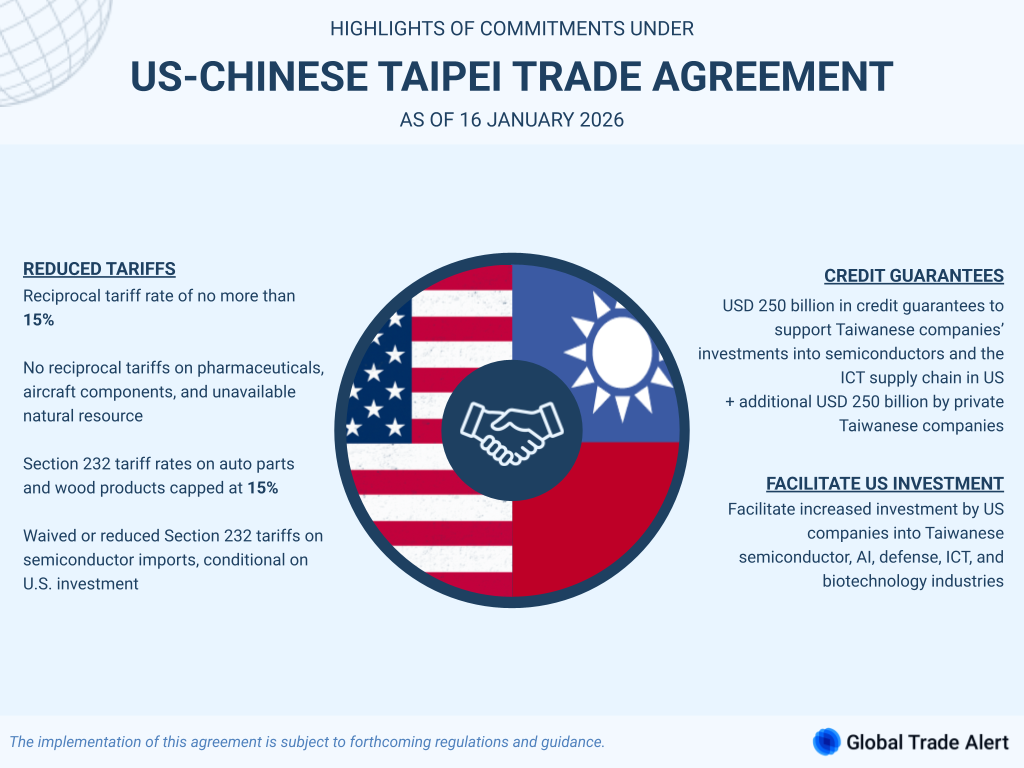
On 15 January 2026, the United States announced that it had signed an Agreement on Trade and Investment with Chinese Taipei. Under this agreement, the US committed to applying a revised tariff structure covering reciprocal tariff policy and certain Section 232 measures. Specifically, the US will apply a reciprocal tariff rate of no more than 15% on goods originating from Taiwan (down from 20% reciprocal tariff rate), with generic pharmaceuticals and their ingredients, aircraft components, and unavailable natural resources excluded from reciprocal tariffs. For semiconductor imports, the US will introduce a duty framework linked to domestic investment. These commitments are subject to additional regulatory procedures before entering into force.
Chinese Taipei, in turn, agreed to provide credit guarantees of up to USD 250 billion "to facilitate additional investment by Taiwanese enterprises" into semiconductors and the ICT supply chain in the US. The government also committed to facilitating increased investment by US companies into Taiwan through the establishment of a two-way investment mechanism. Under this arrangement, the government cowed to encourage greater US private sector investment in its “five trusted industries”, including semiconductors, artificial intelligence, defence technologies, security and surveillance, next-generation communications, and biotechnology.
On 12 February 2026, the United States released the text of the Agreement on Reciprocal Trade. The final text specifies that the United States will apply a reciprocal tariff rate on Taiwan-originating goods equal to the higher of the US MFN rate or 15%. Certain goods listed in the agreement’s annexes (Schedules 2A and 2B) are subject to a zero percent reciprocal rate. The text also specifies that the US will consider supporting investment financing in critical sectors in Taiwan in collaboration with U.S. private sector partners. To this end, the United States will work through institutions such as the Export-Import Bank of the United States (EXIM Bank) and the U.S. International Development Finance Corporation (DFC), where eligible.
The government of Chinese Taipei also published the Agreement on Reciprocal Trade with the United States. Among others, under the text, the Taiwanese government pledged to eliminate or reduce import tariffs for various US industrial and agricultural products and to remove quantitative restrictions on the importation of US motor vehicles. The Taiwanese government also pledged to facilitate the purchases of US goods, including LNG, crude oil, civil aircraft and engines, as well as power equipment, power grids, materials, generators, storage facilities, marine equipment, steel-making equipment, and other equipment from 2025 through 2029.
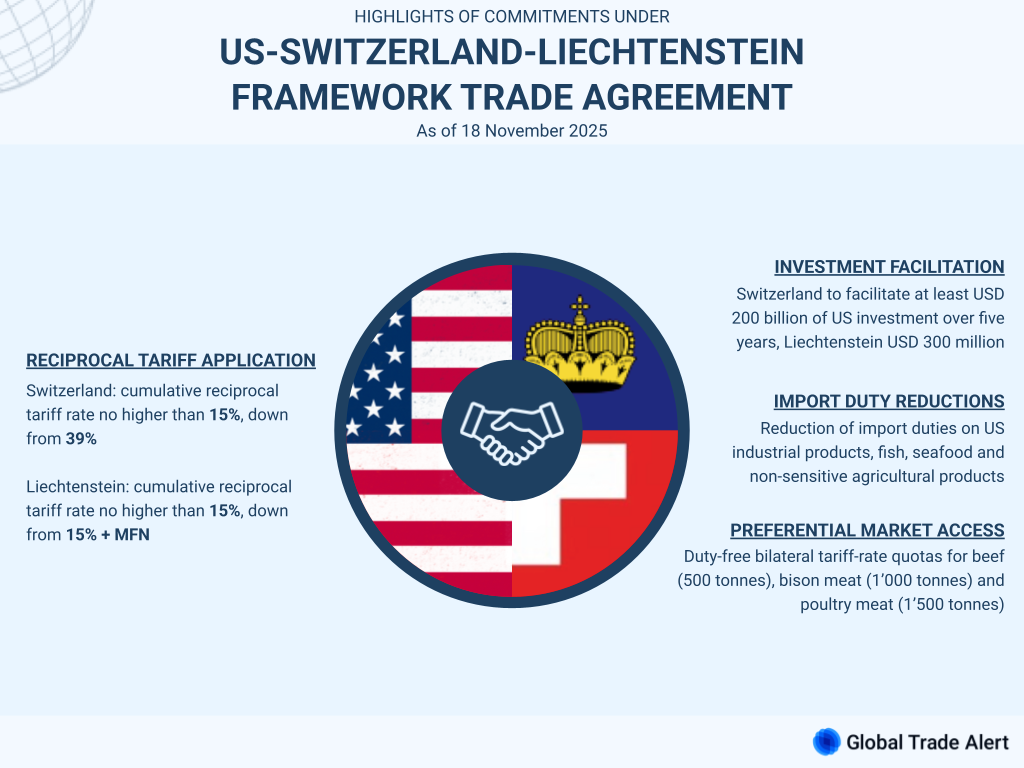
On 14 November 2025, the United States announced a Framework for an Agreement on Reciprocal, Fair, and Balanced Trade with Switzerland and Liechtenstein. Under the framework, the US committed to capping the cumulative reciprocal tariff rate at 15% for both countries, matching the treatment granted to the EU and replacing the previous 39% rate for Switzerland and the 15% surcharge above MFN rates for Liechtenstein. Reciprocal tariffs will continue to apply broadly, with exemptions for goods covered by Section 232 tariffs and certain items listed in the exclusion annex.
Switzerland and Liechtenstein, in turn, referred to the deal as a “non-binding memorandum of understanding” with the US. Accordingly, the countries committed to reducing import duties on a range of US products, including industrial products, fish and seafood, as well as certain “non-sensitive” agricultural products. In addition, Switzerland vowed to grant the US duty-free bilateral tariff quotas for beef, bison meat and poultry meat. In addition, the joint document includes commitments to encourage and facilitate investment into the US, at least USD 200 billion from Swiss companies and at least USD 300 million from Liechtenstein companies. According to the document, a third of these investments will be made by the end of 2026.
On 10 December 2025, Switzerland published two regulations to implement its tariff commitments. The first regulation establishes the duty reductions for 78 goods under 62 tariff subheadings and tariff-rate quotas for US meat, and the second regulation sets out applicable rules of origin. The measures enter into force retroactively on 14 November 2025.
On 17 December 2025, the US issued a joint notice implementing tariff elements of the agreement. The measure caps reciprocal tariffs at a combined rate of 15% for both countries, down from 39% for Switzerland and 15% for Liechtenstein. Certain goods including agricultural products, unavailable natural resources, aircraft parts, and generic pharmaceuticals are exempted from additional reciprocal tariffs. The changes took effect retroactively on 14 November 2025.
On 13 November 2025, the US and Argentine governments published a Joint Statement on a Framework for a United States-Argentina Agreement on Reciprocal Trade and Investment. As part of the agreement, the US committed to removing reciprocal tariffs on certain unavailable natural resources and non-patented articles for pharmaceutical use. The US had not specified the exact scope of products at the time of writing.
The government of Argentina confirmed the signing of the Agreement but did not specify the content of its commitments in a separate document at the time of writing. According to the Joint Statement, Argentina committed to providing preferential market access for US goods exports, including certain medicines, chemicals, machinery, information technology products, medical devices, motor vehicles, and a wide range of agricultural products. Argentina will also phase out the statistical tax for US goods.
The framework also includes a series of joint commitments where the United States will work collaboratively with Argentina. These include finalising improved, reciprocal market access conditions for beef, facilitating trade in critical minerals, and stabilising the global soybean trade.
On 5 February 2026, the governments of El Salvador and the United States announced the signing of the United States–El Salvador Agreement on Reciprocal Trade. The agreement specifies and operationalises various commitments made in November 2025, including Argentina’s commitment to establish import tariff rate quotas. The agreement text also includes further details and commitments, including that Argenita "shall allow and facilitate U.S. investment in its territory”. The agreement remains subject to completion of domestic legal procedures and will enter into force five days after both parties notify each other that these procedures are complete.
.png)
On 13 November 2025, the US and Ecuadorian governments published a Joint Statement on a Framework for a United States-Ecuador Agreement on Reciprocal Trade. As part of the agreement, the US committed to removing reciprocal tariffs on certain qualifying exports from Ecuador that cannot be grown, mined, or naturally produced in the United States in sufficient quantities. The US had not specified the exact scope of products at the time of writing.
The government of Ecuador confirmed the signing of the Agreement but did not specify the content of its commitments in a separate document at the time of writing. According to the Joint Statement, Ecuador committed to reducing or eliminating tariffs in key sectors for the United States, including machinery, health products, ICT goods, chemicals, motor vehicles, and certain agricultural products. Ecuador will also establish tariff-rate quotas on "a number of other agricultural goods. The government also agreed to prohibit the importation of goods produced by forced or compulsory labour and not to introduce new discriminatory barriers to services.
The framework also includes a series of joint commitments where the United States will work collaboratively with Ecuador. These include finalising commitments on international intellectual property treaties and strengthening economic and national security cooperation. This cooperation will focus on enhancing supply chain resilience, addressing non-market policies, combating duty evasion, and aligning approaches on investment security and export controls.
.png)
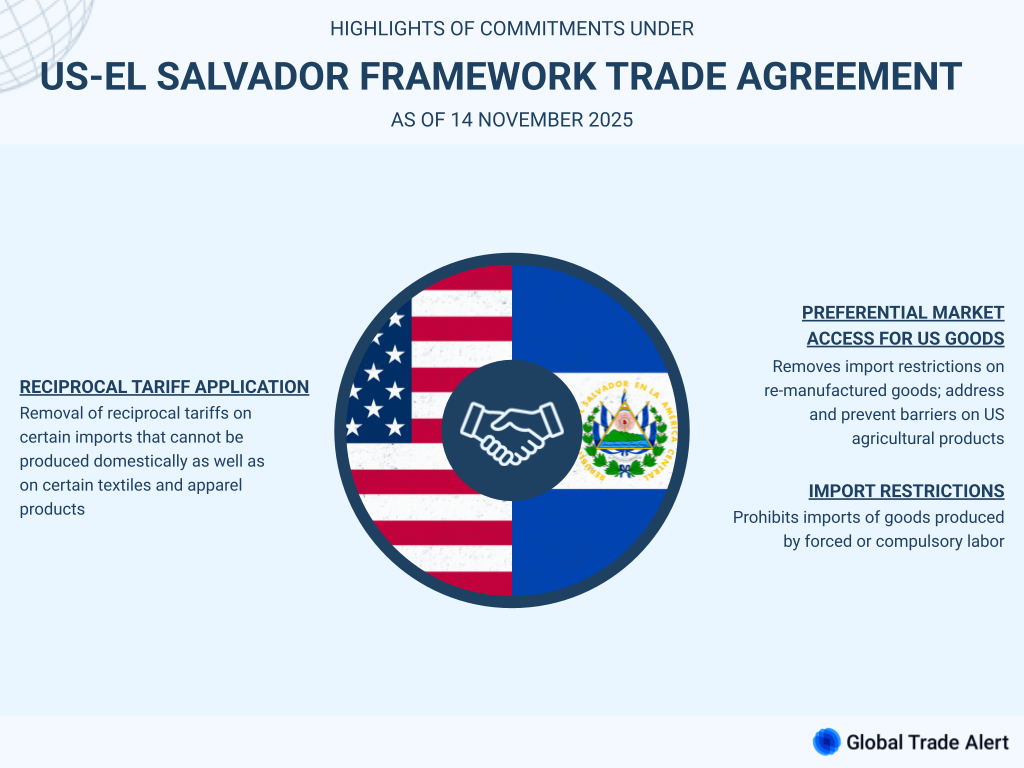
On 13 November 2025, the US and El Salvadoran governments published a Joint Statement on a Framework for a United States-El Salvador Agreement on Reciprocal Trade. As part of the agreement, the US committed to removing reciprocal tariffs on certain qualifying exports that cannot be grown, mined, or naturally produced in the United States in sufficient quantities, as well as certain products, such as textiles and apparel. The US had not specified the exact scope of products at the time of writing.
El Salvador, in turn, committed to removing import restrictions on remanufactured goods from the US and to addressing and preventing barriers to US agricultural products in its market. The scope of affected products has not been specified. El Salvador also vowed to prohibit the importation of goods produced by forced or compulsory labor and to address a range of non-tariff barriers affecting trade in priority areas.
The framework also includes a series of joint commitments where the United States will work collaboratively with El Salvador. These include supporting a permanent multilateral moratorium on customs duties on electronic transmissions and strengthening cooperation to enhance supply chain resilience and innovation. Both nations are further committed to enhancing cooperation on economic security.
On 29 January 2026, the governments of El Salvador and the United States announced the signing of the United States–El Salvador Agreement on Reciprocal Trade. The agreement specifies and operationalises various commitments made in November 2025. The agreement text also includes further details and commitments, including that El Salvador "shall allow and facilitate U.S. investment in its territory”. The agreement remains subject to completion of domestic legal procedures and will enter into force five days after both parties notify each other that these procedures are complete.
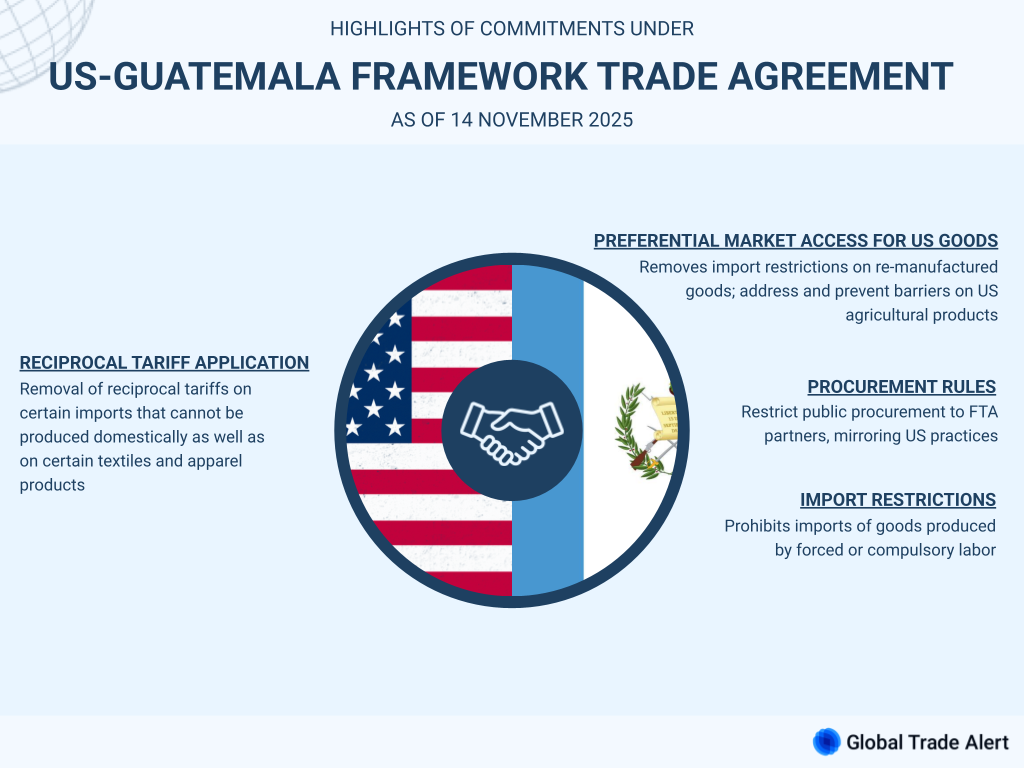
On 13 November 2025, the US and Guatemalan governments published a Joint Statement on a Framework for a United States-Guatemala Agreement on Reciprocal Trade. As part of the agreement, the US committed to removing reciprocal tariffs on certain qualifying exports that cannot be grown, mined, or naturally produced in the United States in sufficient quantities, as well as certain products, such as textiles and apparel. The US had not specified the exact scope of products at the time of writing.
The government of Guatemala confirmed the signing of the Agreement but did not specify the content of its commitments in a separate document at the time of writing. According to the Joint Statement, Guatemala committed to removing import restrictions on remanufactured goods from the US and to addressing and preventing barriers to US agricultural products. Guatemala also vowed to prohibit the importation of goods produced by forced or compulsory labor and to "take steps to restrict access to central level procurement covered by its free trade agreement commitments for suppliers from non-free trade agreement partners".
The framework also includes a series of joint commitments where the United States will work collaboratively with Guatemala. These include supporting a permanent multilateral moratorium on customs duties on electronic transmissions and strengthening cooperation to enhance supply chain resilience and innovation to address the non-market policies of other countries. Both nations are further committed to enhancing cooperation on economic security.
On 30 January 2026, the governments of Guatemala and the United States announced the signing of the United States–Guatemala Agreement on Reciprocal Trade. The agreement specifies and operationalises various commitments made in November 2025. The agreement text also includes further details and commitments, including that Guatemala "shall endeavor to purchase at least 50 million gallons of ethanol from the United States annually". The agreement remains subject to completion of domestic legal procedures and will enter into force 30 days after both parties notify each other that these procedures are complete.
On 4 July 2025, Cambodia’s Council of Ministers confirmed that the US and Cambodia had "reviewed and agreed on the draft Joint Statement on Framework for United States-Cambodia Agreement on Reciprocal Trade". Four days later, Deputy Prime Minister, Sun Chanthol, declared that "while Cambodia has temporarily avoided the steep tariff increase, the exact new tariff rate has not yet been finalised and is awaiting approval from US President Donald Trump".
Although the document was expected to be released shortly thereafter, no further official statement was issued by either Cambodia or the United States. However, on 7 July 2025, President Trump notified Cambodia that it would be subject to a 36% reciprocal tariff effective 1 August 2025. This rate represents a reduction from the April 2025 rate of 49%.
On 31 July 2025, the US Administration issued an executive order modifying previously imposed reciprocal tariff rates, effective 7 August. While not explicitly referencing signed agreements, the order includes a reduction in "reciprocal tariffs" to 19% for imports from Cambodia. A day earlier, the US Secretary of Commerce had confirmed in a TV interview that the US “made trade deals with Cambodia and Thailand”.
On 26 October 2025, the US government issued an “Agreement Between the United States and the Kingdom of Cambodia on Reciprocal Trade”. As part of the agreement, the US committed to removing the additional duty rate of 19% imposed in July 2025 on a selection of products from a pre-existing list, including certain agricultural, pharmaceutical, textile, and aircraft-related goods. In addition, the US government vowed to "consider supporting investment financing in critical sectors in Cambodia" through U.S. institutions such as the Export-Import Bank of the US or the US International Development Finance Corporation (DFC).
The Cambodian government has confirmed the issuance of the Agreement but did not specify the content of its commitments in a separate document at the time of writing. According to the US document, the Cambodian government agreed to eliminate all tariffs on US industrial and agricultural goods, refrain from imposing import quotas or discriminatory taxes on US companies, and align with US export controls and trade restrictions on third countries. Cambodia also agreed to allow US investment in critical minerals, energy resources, and related infrastructure sectors on terms no less favourable than those given to domestic investors, among other commitments. In addition, Cambodia's state-owned Air Cambodia committed to purchasing ten Boeing aircraft.
.png)
On 1 August 2025, the Malaysian government announced that bilateral tariff negotiations “were officially concluded on 31 July 2025”. The US reportedly agreed to set a 19% reciprocal tariff rate as opposed to the initial 25% reciprocal rate. This was implicitly confirmed by the US, which on 31 July 2025 disclosed a reduction in "reciprocal tariffs" for Malaysia from 25% to 19%. Notably, the US did not explicitly reference signed agreements.
On 4 August 2025, the Malaysian government presented more details on several commitments made as part of the deal. These include reducing or eliminating import duties on 98.4% of US imports, agreeing not to impose any export restrictions on the supply of rare earth elements or critical minerals to the US, easing various non-tariff barriers for US imports, and removing requirements for US social media companies and cloud service providers to contribute to a state fund. In addition, Malaysian companies will purchase US goods such as semiconductors, data centres and aircraft worth USD 150 billion over the next five years, while other Malaysian firms will purchase Boeing aircraft, LNG, and telecommunications products. According to the government, the deal also includes cross-border Malaysian investments in the US with USD 70 billion during the next 10 years.
On 26 October 2025, the US government announced the “Agreement Between the United States of America and Malaysia on Reciprocal Trade”. As part of the agreement, the US administration committed to applying a revised reciprocal tariff structure on Thai-origin goods. Specifically, for certain Malaysian products, the United States agreed to remove the additional duty rate of 19% imposed in July 2025. The document does not specify which products will be subject to the duty-free rate. In addition, the US government vowed to "consider supporting investment financing in critical sectors in Cambodia" through U.S. institutions such as the Export-Import Bank of the US or the US International Development Finance Corporation (DFC).
The Malaysian government has confirmed the issuance of the Agreement but did not specify the content of its commitments in a separate document at the time of writing. In addition to commitments already announced in August 2025, the Malaysian government committed to eliminating quotas on imports of goods originating from the US and to removing import restrictions and licensing requirements on US remanufactured goods. According to the US document, Malaysia also committed to refraining from imposing value-added taxes, digital services taxes, or customs duties on electronic transmissions that discriminate against US companies.
.png)
On 1 August 2025, the government of Thailand announced that it had “successfully negotiated and reached an agreement on reciprocal import tariffs”. According to the press release, imports from Thailand to the US will be subject to a 19% reciprocal tariff rate as opposed to the initial 36% reciprocal rate. In a further statement, the government referred to the agreement as preliminary, not yet legally binding, and requiring further negotiations.
This was implicitly confirmed by the US, which on 31 July 2025 disclosed a reduction in "reciprocal tariffs" for Thailand to 19%. A day earlier, the US Secretary of Commerce had confirmed in a TV interview that the US “made trade deals with Cambodia and Thailand” but did not offer further details.
On 26 October 2025, the US government announced a “Framework for a United States-Thailand Agreement on Reciprocal Trade”. As part of the agreement, the US administration committed to applying a revised reciprocal tariff structure on Thai-origin goods. Specifically, for certain Thai products, the US agreed to remove the additional duty rate of 19% imposed in July 2025. The document does not specify which products will be subject to the duty-free rate.
The Thai government has confirmed the issuance of the Agreement but did not specify the content of its commitments in a separate document at the time of writing. According to the US document, in return, the Thai government committed to eliminating tariff barriers on approximately 99% of US industrial, food, and agricultural products, though the specific affected products have not yet been specified. In addition, the document states that Thai companies agreed to purchase USD 2.6 billion annually in US agricultural products, USD 5.4 billion annually in US energy products, and 80 US aircraft totalling USD 18.8 billion. The government also committed to issuing import permits for US fuel ethanol and to easing foreign ownership restrictions for US investment in Thailand's telecommunications sector, among other commitments.
.png)
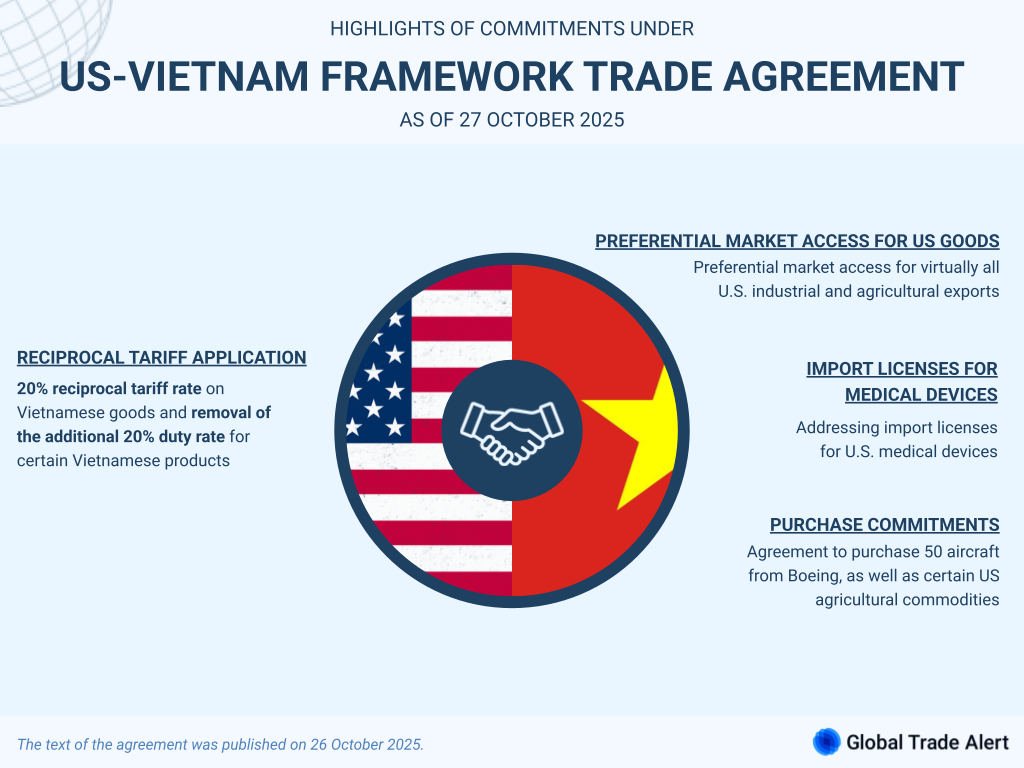
On 2 July 2025, President Trump announced on social media a trade deal with Vietnam, setting a 20% reciprocal tariff on most Vietnamese imports while securing full market access for US goods. The announcement also included a 40% tariff on "illegally transshipped" goods, with details of the transhipment provision remaining unclear. Previously, Vietnamese imports faced the threat of a 46% additional tariff. Vietnamese officials have not confirmed the terms of this deal, raising questions about the agreement's finalisation and implementation timeline.
On 31 July 2025, the US Administration issued an executive order modifying previously imposed reciprocal tariff rates, effective 7 August. While not explicitly referencing signed agreements, the order confirmed a reduction in "reciprocal tariffs" from 46% to 20% for Vietnam.
On 26 October 2025, the US government issued a statement on “United States-Vietnam Framework for an Agreement on Reciprocal, Fair, and Balanced Trade”. As part of the agreement, the US administration committed to applying a revised reciprocal tariff structure on Vietnam-origin goods. Specifically, for certain Vietnamese products, the United States agreed to remove the additional duty rate of 20% imposed in July 2025. The document does not specify which products will be subject to the duty-free rate.
The commitments confirmed by the Vietnamese government as part of the agreement include the provision of preferential market access for substantially all US industrial and agricultural exports. Vietnam also committed to addressing import licensing requirements for US medical devices. The document also highlights Vietnamese companies’ agreement to purchase 50 Boeing aircraft worth over USD 8 billion, as well as various signed memorandums of understanding to buy USD 2.9 billion in US agricultural commodities.
On 31 July 2025, the US President and the South Korean government confirmed the conclusion of an agreement. As a result, the US will apply a 15% reciprocal tariff rate and will also lower tariffs for automobile and auto part imports to 15%. The US also agreed not to treat South Korea any worse than any other country with regard to potential tariffs on semiconductors and pharmaceuticals. According to the US Secretary of Commerce, tariffs on steel, aluminium, and copper are not included in the deal.
In return, the South Korean government confirmed commitments to provide up to USD 350 billion in investment into the US, focusing on shipbuilding, semiconductors, nuclear power, secondary batteries, and biotech. In addition, South Korea vowed to purchase USD 100 billion in energy products from the United States.
On 31 July 2025, the US Administration issued an executive order reducing "reciprocal tariffs" for imports from South Korea to 15%, effective 7 August. The order did not include reductions for goods beyond those subject to reciprocal tariffs.
On 29 October 2025, the South Korean government announced an agreement on the details of tariff negotiations with the US. The government noted that the two sides had agreed on a phased USD 350 billion investment structure, additional tariff reductions for Korean exports to the US (including for semiconductors, wood products, and pharmaceuticals), and safeguards to limit foreign-exchange impacts. The White House did not release additional documentation on the deal.
On 13 November 2025, the White House released a factsheet specifying certain commitments made as part of July’s ”U.S.-Korea Strategic Trade and Investment agreement”. The US will maintain a 15% reciprocal tariff rate and reduce Section 232 tariffs on Korean autos, auto parts, timber, lumber, and wood products to 15%, while ensuring that future Section 232 measures on semiconductors and pharmaceuticals will not treat Korea less favourably than other partners. The United States will also remove supplemental tariffs on selected Korean aircraft, natural resources, and generic pharmaceutical inputs.
Korea, in turn, confirmed additional commitments, including purchasing USD 36 billion in Boeing aircraft and USD 25 billion in US military equipment. Korea will also remove the 50’000-unit cap on US vehicles meeting FMVSS standards and allow them to enter without further modifications. In addition, Korea will host an annual exhibition with US state governments to promote US exports and deepen commercial ties.
On the same day, the US and South Korean governments published a Memorandum of Understanding (MoU) establishing a bilateral framework for the committed Korean investment into strategic US industries. The MoU establishes a funding and oversight mechanism with joint committees and US-led governance to guide investment selection and management. As stipulated in the MoU, Korea commits up to USD 20 billion per year in funding, with all investment commitments to be made before 19 January 2029.
On 3 December 2025, the US government adopted a notice implementing the tariff-related elements of the deal. It changed the reciprocal tariff rate to a combined rate of 15% (including MFN). Previously, the additional reciprocal tariff applicable, excluding MFN, to South Korea alone was 15%. The notice also specifies reduced duties for automobiles and automobile parts and certain wood products.
.png)
On 27 July 2025, the European Union announced a "deal on tariffs and trade" with the United States following the imposition of higher reciprocal tariffs. Two days later, it published a Q&A document providing more details about the “political agreement”. Meanwhile, on 28 July 2025, the US Administration published a factsheet regarding the "US-EU Cooperation Agreement on Reciprocal, Fair and Balanced Trade".
The EU’s confirmed commitments include “zero-for-zero tariffs” on strategic products, the elimination of tariffs on industrial goods, USD 750 billion in purchases of US energy products and EUR 40 billion in purchases of US AI chips. Moreover, it promised enhanced market access to limited and non-sensitive US agricultural and fisheries products via the current TRQ systems. In turn, the US agreed to apply a 15% import tariff for most EU exports, including autos and automobiles, instead of the 30% announced earlier. This duty would also cover as well as pharmaceuticals and semiconductors. Implementation details and timelines remain pending further regulatory finalisation.
On 31 July 2025, the US Administration issued an executive order modifying previously imposed "reciprocal tariffs" for imports from the EU. The order sets a 15% minimum tariff floor for “any good of the European Union” by adding duties only when the existing Column 1 rate falls below 15%, while goods already at or above 15% receive no additional tariffs.
On 21 August 2025, the US and EU published the “Joint Statement on a United States-European Union framework on an agreement on reciprocal, fair and balanced trade”. Compared to previously published documents, the statement includes several new commitments. Among others, the EU vowed to "eliminate tariffs on all U.S. industrial goods and to provide preferential market access for a wide range of U.S. seafood and agricultural goods”, to “substantially” increase the procurement of US military and defense equipment, and to “provide additional flexibilities in the CBAM implementation”.
In return, the US would lift reciprocal tariffs on selected strategic products from the EU, reduce tariffs on automobiles and automobile parts to a combined rate of 15%, and ensure that imports of pharmaceuticals, semiconductors, and lumber would face a combined tariff rate of a maximum of 15%. Both sides also mentioned the possible introduction of tariff rate quotas for steel and aluminium imports. In addition, the statement refers to cooperation on addressing non-tariff barriers as well as cooperation on “the imposition of export restrictions on critical mineral and other similar resources by third countries."
On 28 August 2025, the EU adopted a proposal for reducing or eliminating customs duties and opening tariff quotas on certain agricultural and industrial products. On the same day, the EU also proposed the retroactive non-application of customs duties on imports of lobster. The proposals are pending discussion and approval by the Parliament and Council before they are published in the official gazette and enter into force.
On 24 September 2025, the US authorities adopted a Notice to implement part of the US-EU agreement, reducing the Section 232 tariffs on automobiles and automobile parts as well as establishing tariff exemptions for a broad range of products from the EU. The changes take effect retroactively on 1 August and 1 September 2025, respectively.
.png)
On 23 July 2025, the White House and the Japanese Prime Minister confirmed the conclusion of an agreement. As a result, the US will apply "a baseline 15% tariff rate" to "imports from Japan", down from the previously announced 25% reciprocal tariffs that would become effective on 1 August 2025. According to Japan, the duty reduction also applies to Japanese automobiles and auto parts. This, however, was not explicitly confirmed by the US. In return, Japan committed to providing USD 550 billion in investment and loans for Japanese investments in the US. The support will primarily target such sectors as semiconductors, pharmaceuticals, steel, shipbuilding, critical minerals, aviation, energy, automobiles, AI, and quantum technology. Japan will also increase the volume of staple rice imported from the US within the annual 100'000 tonnes duty-free tariff rate quota (TRQ).
The US government also stated that Japan will purchase US goods worth several billion USD, including corn, soybeans, fertiliser, bioethanol, sustainable aviation fuel, commercial aircraft, and defence equipment.
On 31 July 2025, the US Administration issued an executive order reducing "reciprocal tariffs" for imports from Japan to 15%, effective 7 August. The order did not include reductions for goods beyond those subject to reciprocal tariffs.
In early September, the US government issued executive orders and guidelines outlining further implementation details as well as modifying the scope of reciprocal tariffs.
To implement part of the Japan–US agreement on a USD 550 billion investment framework, the Japanese government established the Japan Strategic Investment Facility under the Japan Bank for International Cooperation (JBIC). The facility was launched on 26 September 2025.
.pptx.png)
On 22 July 2025, the US and Indonesian governments announced an agreement that reduces the reciprocal tariff rate on Indonesian imports from the previously announced 32% to 19%, avoiding the August 1 implementation deadline. According to the US, in exchange, Indonesia committed to eliminating 99% of tariff barriers on US industrial and agricultural products, exempting US companies from local content requirements, accepting US vehicle and medical product standards, and removing export restrictions on critical minerals to the US. However, the Southeast Asian nation so far only confirmed its commitment to reduce import tariffs on various goods and to "direct purchases of key US commodities, such as energy and agricultural products".
The US government also informed that the deal includes Indonesian commitments on digital trade barriers, labour protections including forced labour bans, environmental measures against illegal fishing and logging, and participation in the Global Forum on Steel Excess Capacity. Implementation details await forthcoming regulations and guidance from both governments.
On 31 July 2025, the US Administration issued an executive order reducing "reciprocal tariffs" for imports from Indonesia to 19%, effective 7 August. The order did not include reductions for goods beyond those subject to reciprocal tariffs.
.png)
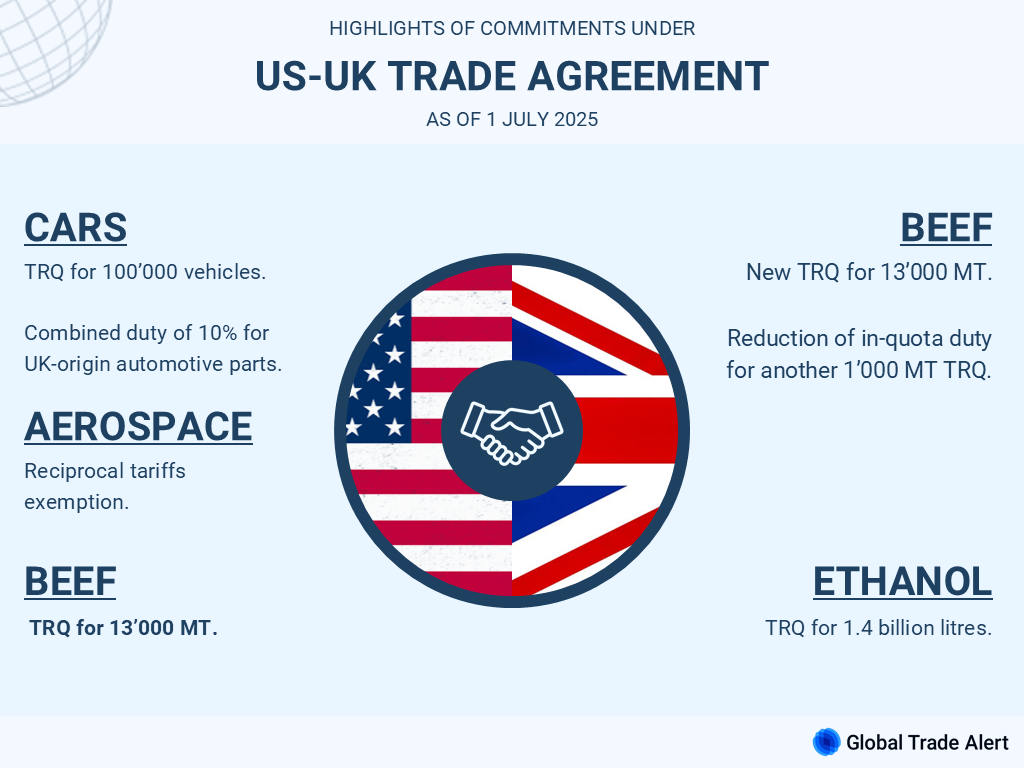
On 8 May 2025, the United Kingdom and the United States announced the "Economic Prosperity Deal", establishing reciprocal trade preferences between the two nations. The US granted UK exporters duty-free access for aerospace products (reduced from 10%), a 100,000 vehicle quota with 10% tariffs for automotive parts, and committed to implementing steel quotas and reallocating 13,000 metric tonnes of beef quota access. The UK reciprocated with duty-free quotas of 13,000 metric tonnes for US beef, eliminated tariffs on the existing 1,000 metric tonne beef quota, and established a 1.4 billion litre quota for US ethanol. Implementation began in July 2025, with several measures still pending regulatory finalisation.
On 12 May 2025, the US and China released their "Joint Statement on U.S.-China Economic and Trade Meeting in Geneva". The statement outlined a temporary suspension, until 12 August 2025, of the additional tariffs imposed on each other from April 2025. Specifically, the US agreed to reduce from 125% to 10% the reciprocal tariffs on China, as well as reduce the duties on low-value imports. In turn, China agreed to match this reduction with regard to its retaliatory tariffs. The joint statement also called on China to "adopt all necessary administrative measures to suspend or remove the non-tariff countermeasures taken against the United States since April 2, 2025". No further details were provided.
Subsequently, on 9 and 10 June 2025, authorities representing both countries met in London and agreed on implementation details. No public document was released from that meeting. Throughout May and June, however, China temporarily suspended the blacklisting of several US companies, granted export licenses for rare earth products, and reportedly allowed national airlines to resume Boeing deliveries.
On 12 August 2025, the US and China each announced an additional 90-day suspension, until 10 November 2025, of the additional tariffs imposed on each other. In addition, the Chinese government removed some US companies from its Export Control and Unreliable Entity Lists in order to “implement the consensus reached during the high-level China-U.S. economic and trade meeting”. Beijing also prolonged the temporary suspension of the export control blacklisting and the Unreliable Entity List blacklisting of other US companies for another 90 days.
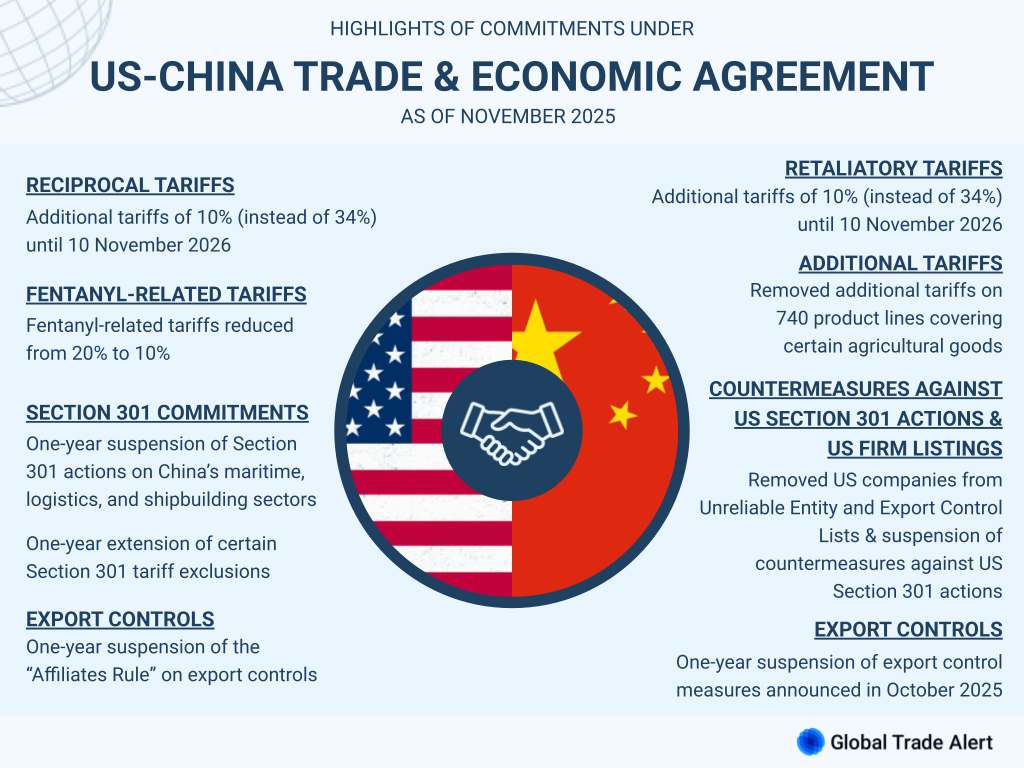
On 30 October 2025, the US and China reached a trade and economic agreement. In the following days, both sides began implementing the commitments made under the deal. The US government, on 4 November, suspended additional reciprocal tariffs on Chinese goods for one year whilst maintaining the existing 10% tariff and reduced the fentanyl-related tariffs from 20% to 10%. On 9 November, the US suspended actions in the Section 301 investigation targeting China's maritime, logistics, and shipbuilding sectors for one year. The US government also suspended for one year the expansion of the Entity List and Military End-User List restrictions to any company that is 50% or more owned by listed entities.
China, in turn, on 5 November suspended higher tariffs on US goods for one year, keeping the existing 10% tariff in place. On the same day, it also removed additional tariffs on 740 product lines, covering agricultural goods, including chicken, wheat, corn, cotton, soybeans, pork, beef, and dairy products. China also removed 10 US companies from its Unreliable Entity List and lifted an import ban on genetic sequencers produced by Illumina and removed 15 US companies from the Dual-Use Export Control List. On 7 November, the Chinese government suspended the implementation of export control measures announced on 9 October 2025 until 10 November 2026. Some days later, China suspended the general prohibition on exports of dual-use items to the US and introduced new licensing requirements for exports of 13 precursor chemicals used in fentanyl production to the United States, Canada, and Mexico. Lastly, the Chinese government suspended for one year the implementation of its countermeasures against US measures under the US' Section 301 investigation, including suspending special port fees on vessels associated with the United States for one year and suspending countermeasures against five US subsidiaries of Hanwha Ocean, a South Korean shipbuilding enterprise.
On 30 July 2025, the government of Pakistan announced the conclusion of a “Landmark Trade Deal” with the United States. The deal would reduce the reciprocal tariffs for imports from Pakistan into the US to 19%, down from the initial 29% rate announced by the US in April. President Trump also announced on social media a “Deal with the Country of Pakistan, whereby Pakistan and the United States will work together on developing their massive Oil Reserves”. No further information on the content of the agreement was specified by either side.
The reduction in "reciprocal tariffs" for goods from Pakistan to 19% was confirmed by the US via Executive Order on 31 July 2025. Notably, the Executive Order did not explicitly reference signed agreements.
On 22 July 2025, President Trump announced on social media a trade deal with the Philippines. According to the announcement, the Southeast Asian country granted "ZERO Tariffs" and an "OPEN MARKET" to the US. In exchange, the Philippines got a 19% reciprocal tariff rate instead of the 20% announced earlier this month.
On the following day, the President of the Philippines stated certain commitments agreed upon within trade negotiations with the US. Among others, the Philippines would eliminate import duties on certain US goods, including automobiles, and "increase imports from the United States for soya products, wheat, and pharmaceuticals". However, negotiations would continue to finalise the agreement.
On 31 July 2025, the US Administration issued an executive order modifying previously imposed reciprocal tariff rates, effective 7 August. While not explicitly referencing signed agreements, the order confirmed a reduction in "reciprocal tariffs" from 20% to 19% for the Philippines.