The intervention type "state aid, unspecified" has settled into the landscape of state capitalism. When looking at state capitalism, nearly one in five implemented subsidy programmes do not specify the delivery instrument. Only financial grants and state loans are more common.
This piece is the fifth analysis of our state capitalism series. It focuses on implemented program-level policies adopted from 2020 onwards.
What Unspecified Looks Like and When It Appears
State aid, unspecified, signals subsidy programmes where the delivery mechanism is not known or identifiable from available documentation. India’s semiconductor facility development scheme illustrates the problem. It commits support of up to 50% of capital expenditure without specifying whether the support takes the form of a grant, a loan, a guarantee, or something else.
Within the category, three patterns recur: no specificity on the instrument; no disclosure of the instrument and the targeted sector; and instrument ambiguity. The most prominent group refers to cases that identify the sector and policy objective but not the form of support. However, in roughly 10% of cases, neither the instrument nor the target sector is disclosed. Early COVID-era programmes from Cambodia to Qatar follow this model. A third group resists classification due to instrument ambiguity. The US Project NextGen initiative to develop COVID-19 vaccines is one example. The program can take the form of R&D contracts, procurement agreements, grant-like arrangements, and technical assistance. However, for final beneficiaries, confirmation on the delivery form of the support is not publicly disclosed.
The category is not a COVID artefact. In 2020, the GTA recorded 40 national-level programmes as state aid, unspecified. That number tripled by 2023 and has not returned to 2020 levels. A lack of specificity has become a feature of how governments conduct industrial policy. What has changed is the targeting. In 2020, over a quarter of programmes applied horizontally across all sectors, a feature of broad emergency governance. From 2021, that share fell below 10% and has stayed there since. Lack of specificity mainly relates to the delivery form, not the targets of support.
Where Unspecified Programmes Concentrate
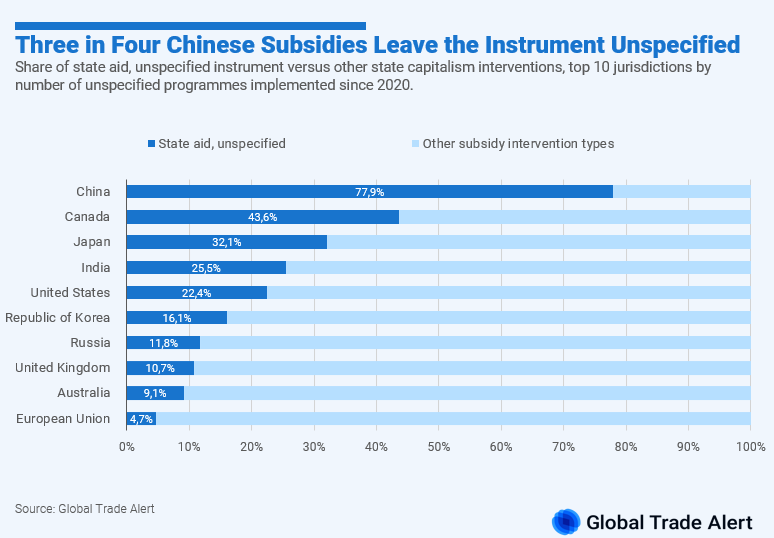
State aid, unspecified is not confined to any single governance model or region. Among jurisdictions with at least 20 implemented state capitalism programmes since 2020, China, Canada, Japan, India, and the United States each derive more than one in five of those programmes from state aid, unspecified. South Korea, Russia, the United Kingdom, and Australia range between 9% and 18%.
National and subnational governments account for over 90% of state aid, unspecified, with national and international financial institutions playing a marginal role. Subnational governments are the defining institutional feature of the instrument, but the pattern is driven almost entirely by China. More than three-quarters of Chinese subsidy schemes since 2020 do not specify the instrument, and 93.6% of those are subnational. This pushes the global subnational share to 58.5%, against 14.7% at the national level. Strip out China, and the subnational share falls to 13.3%, broadly in line with the national level.
This reflects how China structures industrial policy. China's 2024 Action Plan to promote large-scale equipment renewal illustrates the pattern. Central guidelines commit financial support. Subnational governments operationalise the guidelines with discretion over implementation, including the choice of subsidy instrument. That discretion extends, in practice, to whether the instrument is specified at all. Lower-level implementation documents occasionally specify the instrument at later stages.
Where Specificity is Higher
High subsidy activity and high specificity are compatible. The EU records just 4.7% of its state capitalism programmes as state aid, unspecified, despite being the most active user of subsidy programmes in the state capitalism database. Argentina, Thailand, and Brazil record shares of 4.4%, 2.1%, and 0.5%, respectively.
The EU shows that transparency can be structural rather than incidental. EU state aid law is part of the explanation. Take the 2025 Clean Industrial Deal State Aid Framework. It pre-specifies permissible instruments for each policy objective. For industrial decarbonisation, five are permitted: direct grants, repayable advances, loans, guarantees, and tax advantages. Member states notify their scheme design to the European Commission before implementation. The approval decision confirms the instrument.
The Cost of Not Knowing
The causes behind state aid, unspecified vary. It may reflect sequencing, where the instrument is determined after the announcement and specified only at later stages or by different implementing bodies. It may reflect crisis governance, where speed and flexibility take priority over disclosure. Or it may be deliberate, because state aid, unspecified reduces political visibility and complicates legal challenges.
Whatever the reason, the consequences are the same. Unspecified support is harder to value, harder to classify, and harder to compare. The contrast is stark: where compulsory disclosure is built into the subsidy approval process, the instrument is nearly always specified. Where it is not, opacity becomes far more prevalent. A trading partner cannot challenge what it cannot characterise.