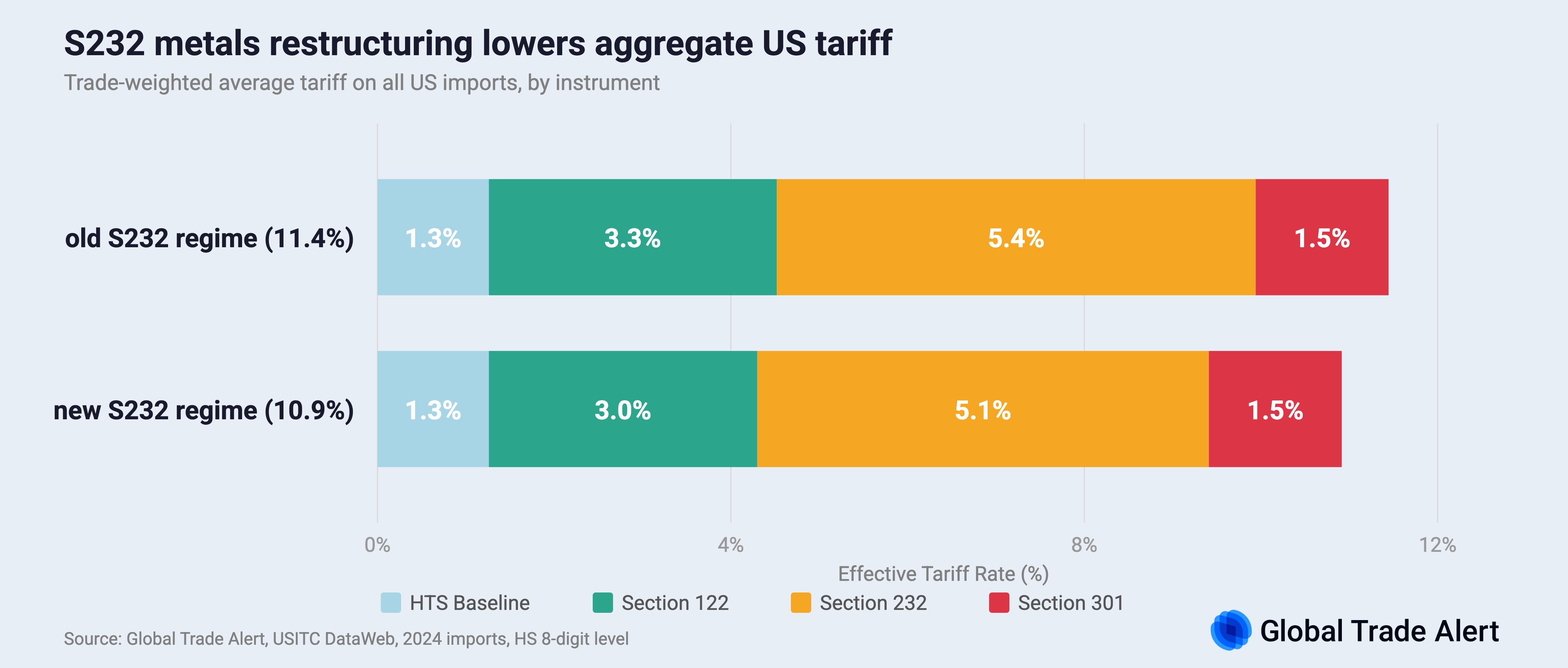
With the proclamation of 2 April 2026, President Trump overhauled the structure of the Section 232 tariffs on metals and their derivative products. The trade-weighted average US tariff falls by 0.53 percentage points, from 11.44% to 10.91%.
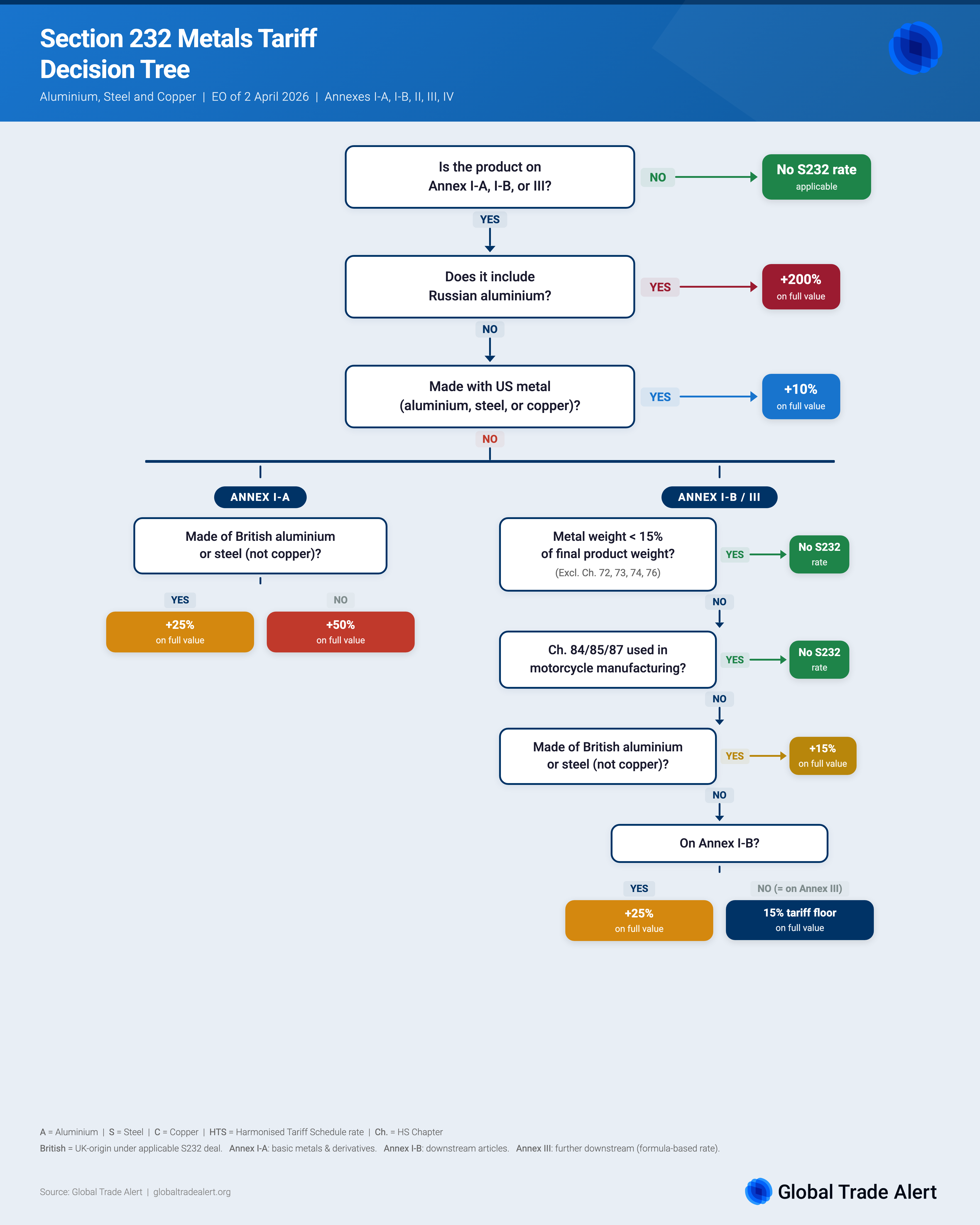
This post explains the new regime, shows how products were reallocated across annexes, and provides a decision tree for determining the applicable rate. Find the full data including product-origin-level tariff estimates for download at the bottom of this post.
From one rate to four annexes
Until 5 April 2026, the Section 232 tariff on metals was straightforward: every steel, aluminium, and copper product in scope attracted a single 50% duty, assessed on the metal content value of the imported product. That regime covered roughly 1,055 product codes and $538 billion in 2024 US import value.
On 6 April 2026, a presidential proclamation replaced this single-rate system with a tiered structure organised around four product annexes. Each annex carries a different tariff rate, and the duty is now assessed on the full product value, not just the metal content.
The table below summarises the new regime:
| Annex |
Coverage |
Rate |
| I-A |
Core metals and close derivatives |
50% |
| I-B |
Downstream manufactured articles |
25% |
| III |
Further downstream articles (temporary, until end 2027) |
15% tariff floor |
| II |
Products removed from S232 scope |
0% (removed) |
How the products were reallocated
The diagram below shows how the 1,055 products under the old regime were distributed across the four new categories, sized by their 2024 US import value. Seven additional products entered S232 scope for the first time.
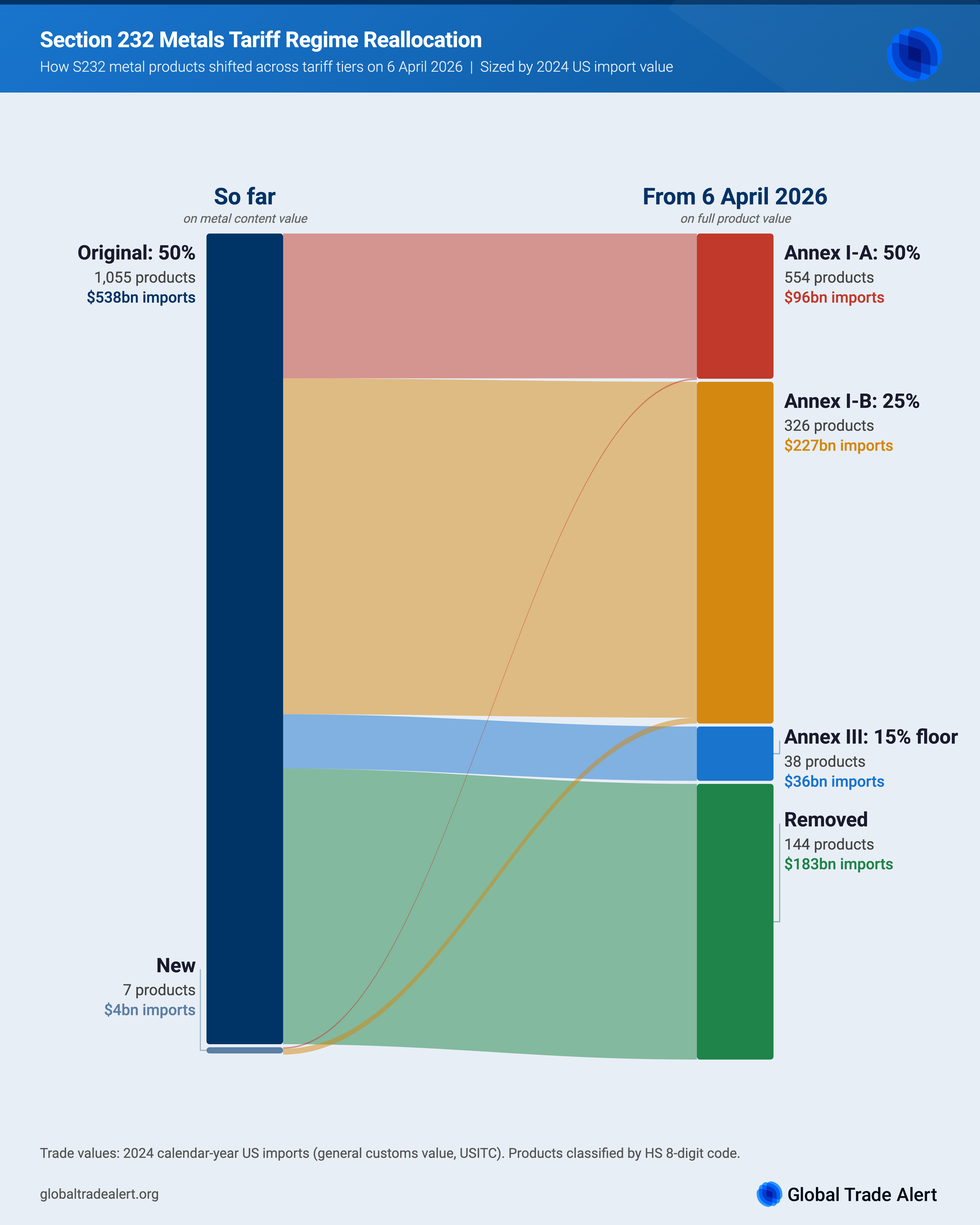
The largest flow by trade value runs to Annex I-B ($227 billion across 326 products). These are the downstream manufactured articles, from machinery to electrical equipment to construction materials, that previously attracted the 50% metals tariff. On the other end, 144 products worth $183 billion were removed from S232 scope entirely via Annex II.
The core metals in Annex I-A (554 products, $96 billion) keep the 50% rate, while 38 products worth $36 billion fall under the Annex III formula that ensures a minimum 15% total tariff.
The base shifts from metal content to full product value
Beyond the headline rate changes, the restructuring introduces a fundamental change in how the tariff is calculated. Under the old regime, the 50% rate applied only to the metal content value of the imported product. Under the new regime, all rates apply to the full customs value.
This means a nominal rate cut does not necessarily translate into a lower effective tariff. Consider a product where metal content accounts for 20% of the product value:
- Old regime: 50% on 20% metal content = 10% effective tariff on product value
- New regime (Annex I-B): 25% on full product value = 25% effective tariff
For products with low metal content, the shift from 50% on metal content to 25% on full value can actually increase the effective tariff burden. The breakeven point is around 50% metal content for Annex I-B and 30% for Annex III.
For core metals in Annex I-A, which are close to 100% metal, the base shift has little practical effect since the full product value is essentially the metal value.
Exemptions and preferential rates
The proclamation introduces five exemptions that can reduce the effective S232 burden:
- US-origin metal: Products made with US metal attract a reduced 10% rate (all annexes).
- De minimis weight: Products where metal content weighs less than 15% of the product are exempt from S232 (Annex I-B and III only, excluding chapters 72, 73, 74, 76).
- UK preferential rates: Imports with at least 95% British-origin steel or aluminium receive 25% (instead of 50%) on Annex I-A, and 15% (instead of 25%) on Annex I-B.
- Motorcycle manufacturing: Parts for US motorcycle production are exempt (Annex I-B, chapters 84, 85, 87).
- Russian aluminium surcharge: Products containing Russian aluminium attract a 200% duty.
How to determine the applicable rate
We have published a high-level decision tree flowchart that walks through the rate determination logic for any imported product under the new regime. Find it also among the downloads to this post.