The US tariff regime in force since 20 January 2025 is the most complex in living memory. Stacked statutory bases (Section 232, Section 301, IEEPA, Section 122, emergency authorities), bilateral floor deals with the EU, UK, Japan and Korea, designated-firm carve-outs for pharmaceuticals, and rolling regime changes since the SCOTUS ruling on IEEPA mean that any single applied rate is the output of a non-trivial model, not a lookup.
SGEPT has spent the past months building that model. Today we are exposing it through the GTA MCP server. If you have already connected the server to Claude, the new capability is available with no extra setup. If you have not, the install takes under five minutes.
What is now in your AI assistant
Fourteen new tools query the SGEPT US Tariff Barrier Estimates: applied rates on roughly 234,846 product-country flows covering $3.24 trillion of 2024 US imports, every working day since 20 January 2025. The tools cover single-rate calculation, cross-country comparison, time series, sensitivity analysis, country and chapter aggregation, and scenario building.
The novel part is not the rate. It is what comes with the rate. Every calculation returns the formula that produced it (for example HTS + IEEPA + S122 + Emergency + S301), the bilateral deals in force with their counterfactual rates if those deals were revoked, the tunable parameters that drive the result, and a hint to Claude about which interactive widget would help the user explore the model. Two examples make this concrete.
Example 1: where does my country sit in the US tariff stack?
An exporter, an investor, or a negotiator looking at one tariff rate in isolation learns very little. The interesting question is comparative: relative to competitors, is this country advantaged, disadvantaged, or at parity?
The prompt:
"President Trump has just threatened to raise tariffs on European automobiles to 25%. Using the Global Trade Alert's US Tariff Estimates: for me, the implication for EU automakers, if the threat were to materialise, is that I am particularly interested in the amount of trade affected and the relative competitive position of EU automakers with respect to US market access. Provide a bottom-line-upfront summary and at least one insightful graphic."
Claude pulled the applied rate for HS 8703.23 across major exporters, ranked them, computed the EU's trade-weighted exposure on the line of fire, and produced this directly in the chat:
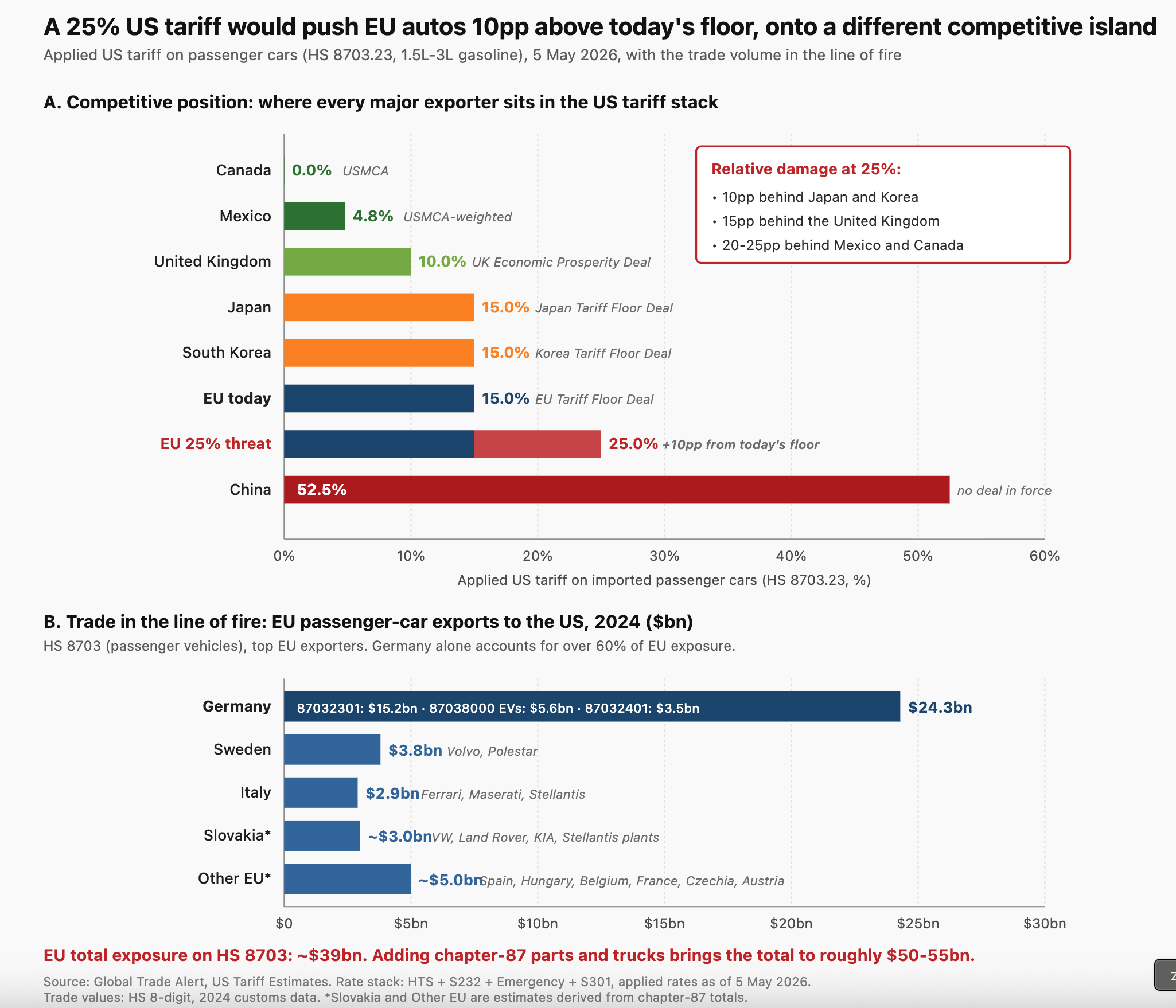
The answer is structural rather than topical. A 25% rate would push EU autos ten percentage points above the floors negotiated by Japan and Korea, fifteen above the UK, and twenty to twenty-five above the USMCA partners. Germany alone accounts for roughly $24bn of EU exposure on chapter 87. The same workflow runs for any HS line and any set of competitors.
Example 2: a model you can interrogate
The Section 232 pharmaceutical tariffs, due to take effect at the end of July, are another complex case. The applied rate on a given import depends on at least four parameters: the patented vs generic share, the orphan-drug share, the share covered by designated-firm onshore-investment commitments, and any country-specific floor deal that caps the headline rate.
SGEPT has a default parameterisation. But your default is probably different. The MCP returns its parameters explicitly so Claude can render them as an interactive widget. You then move the sliders to your case:
The prompt:
"Explain the structure of the upcoming U.S. tariffs on pharmaceutical products according to the Global Trade Alert U.S. tariff estimates. Construct a simple interactive dashboard that helps me understand the mechanics behind the effective Section 232 pharma tariffs."
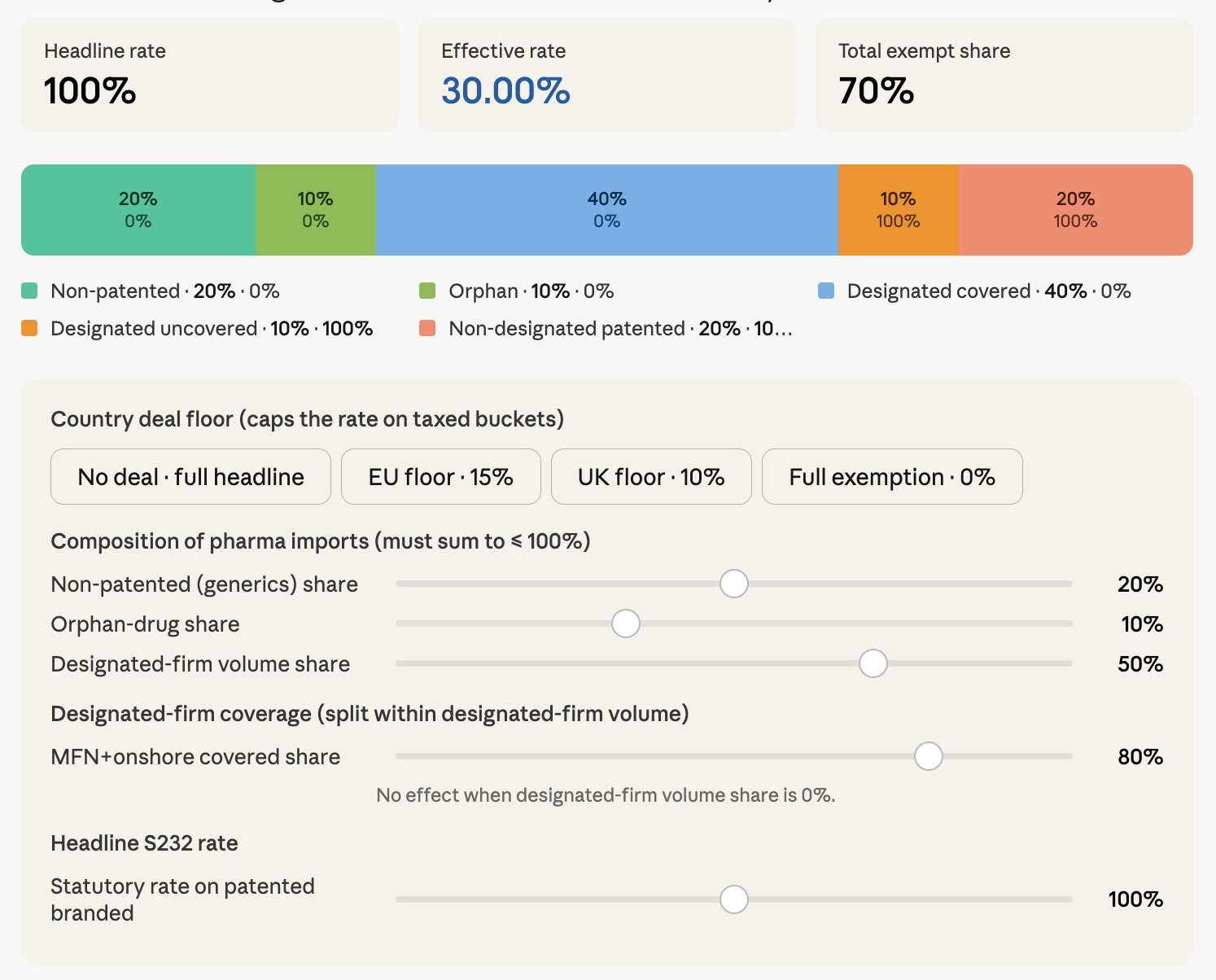
The widget is not pre-built. Claude builds it on the fly, from the parameter list and algebraic structure shipped by the MCP. Change a slider and the effective rate recalculates against SGEPT's model. Toggle the EU floor deal off and the counterfactual rate updates. The point is not that we picked the right defaults. The point is that we ship the model, not just the number, and the assumptions that matter most for your use case become visible and adjustable.
What you can ask
A short, non-exhaustive list:
- Single rate: "What is the US tariff on Japanese steel derivatives today?"
- Cross-country comparison: "Compare US tariffs on autos across the EU, Japan, Korea, and Switzerland on 2026-04-15."
- Time series: "How has the US tariff on Canadian aluminium changed over 2025-2026? Show me the rate jumps from each regime activation."
- Drivers: "Which policy components matter most for the US tariff on German autos? What is the biggest deal saving for Japan on auto imports?"
- Aggregation: "What is the trade-weighted US tariff on chapter 72 today? On total Canadian imports?"
- Scenarios: "What if the EU tariff floor deal were revoked? Build a scenario and rerun the calculation."
Every answer carries the rate decomposition, the deals in force with counterfactuals, the parameters that drive the result, and links to the methodology, formula reference, and known gotchas.
A note on model choice
Tariff calculations reward careful reasoning. Our internal evaluation found Claude Opus at 100% exact match on complex tariff prompts. Sonnet is fine for exploration. Opus is the right choice when the answer feeds a decision.
How to get started
If you already use the GTA MCP, the tariff tools are live in the same connection. If you do not, setup is the same five-minute flow as before: point your client at https://mcp.globaltradealert.org/mcp, authenticate via OAuth, and you are ready.
The full step-by-step guide and a short video walkthrough are at globaltradealert.org/mcp.
Access and pricing
The MCP integration, including the new tariff toolset, is free during the beta period. Professional subscriptions and enterprise licences go live shortly, with reasonable pricing to support the ongoing monitoring work of the St Gallen Endowment. Scenario-mutation tools (creating bespoke scenarios, toggling deals, tuning parameters) will sit in the subscriber tier.
For now, connect the server and try it. We want to hear what works and what is missing. Write to mcp@sgept.org with your feedback.