Governments’ use of financial grants is structural. Of the more than 30’000 interventions in the State Capitalism release, 44% are financial grants, followed by loans at 32%. Grants also absorb a wide range of policy ambitions. They can carry a pandemic paycheque, a battery plant subsidy, or an SME loss compensation payment. The same instrument accommodates distinct policy cycles and cross-jurisdictional variation. Aggregate comparisons of "how much grant activity" a jurisdiction undertakes can therefore be misleading without this contextual lens.
For the last piece of GTA’s State Capitalism series, we examined 13’253 financial grant interventions covering the period 2009 to 2024.
From Emergency Relief Back to Industrial Policy
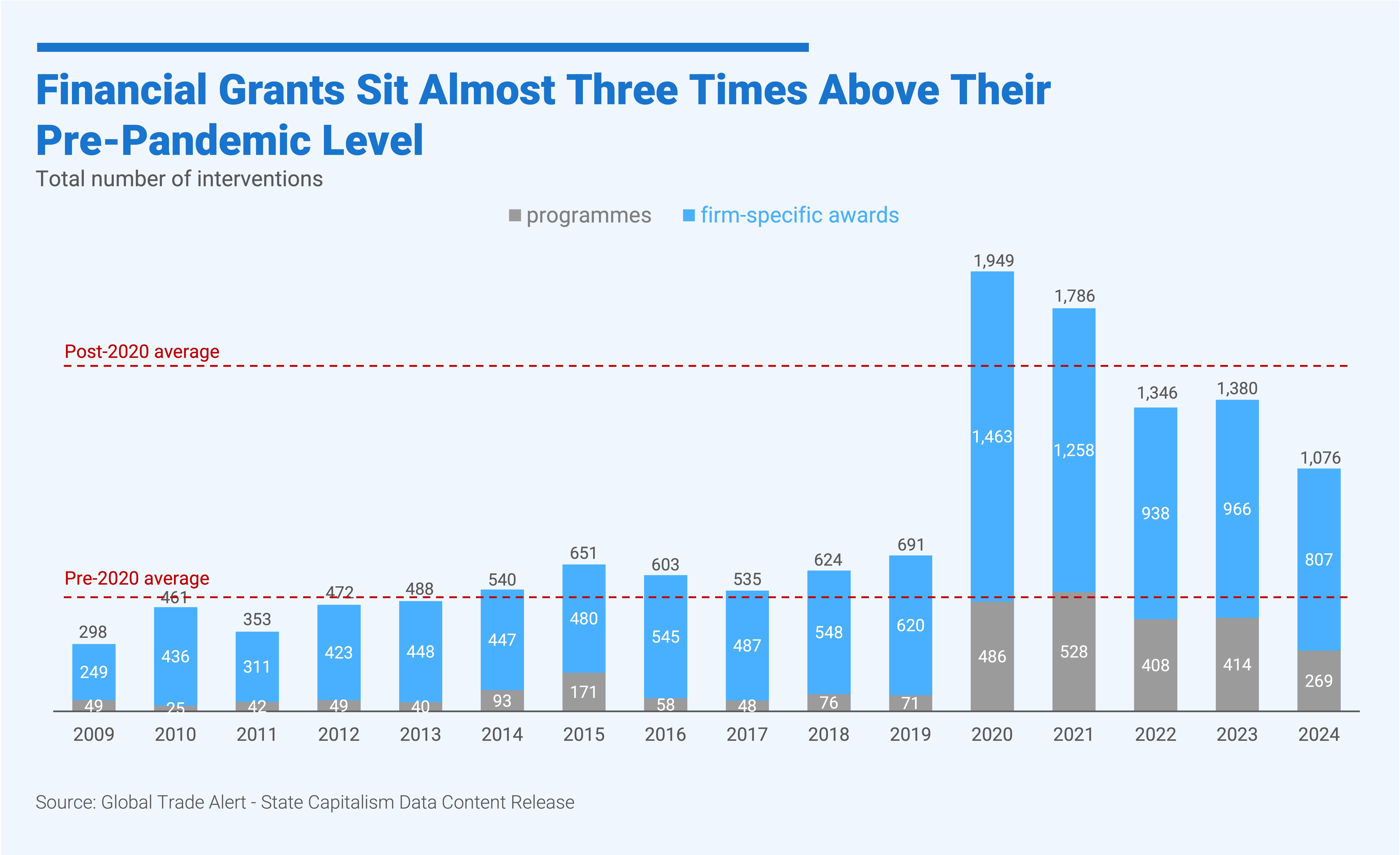
The COVID-19 pandemic catapulted the use of grants and permanently raised its baseline. The surge appears in both programmes and firm-specific awards. Grant interventions rose from 691 (including 71 programmes) in 2019 to 1’949 (including 486 programmes) in 2020. Adoption has since moderated, but it has never returned to pre-pandemic levels. The 2020-2024 annual average sits almost three times higher than the 2009-2019 (1’507 vs 519).
The pandemic produced two temporary changes in how grant programmes were used. First, the non-sectoral-selective share climbs sharply during the pandemic. Across the whole period, only 11% relate to support favouring all economic sectors. This share reached 27% in 2020 and 25% in 2021, when economy-wide emergency relief was increased. However, by 2024, it had fallen to 7%. Second, programme adoption explodes worldwide. Measured against a 2017 to 2019 average baseline, programmes in 2020 and 2021 more than doubled in the EU, Australia, the United Kingdom, Japan and South Korea.
Contextualisation Matters for Cross-Jurisdictional Analysis
The same instrument carries different meanings across jurisdictions. China and the United States dominate firm-level counts. The EU dominates programme counts. But these headline figures obscure important variation.
In the United States, large-budget programmes generate a high volume of firm-level recorded actions in the GTA database. 93.6% of all recorded US financial grants are firm-specific actions, all exceeding USD 10 million. Policies such as the USD 2 trillion CARES Act launched during the pandemic, the CHIPS and Science Act, or the Inflation Reduction Act all exemplify this pattern. At least 220firm-specific interventions in the GTA trace back to these three programmes alone.
Programme-level activity predominates in the EU27. Only 18.8% of the bloc's recorded financial grants are firm-specific. This reflects the EU state aid notification regime, which refers mainly to schemes rather than individual awards. Italy, France, and Germany each adopted more grant programmes than the US. Even so, some large schemes, notably the EUR 95.5 billion Horizon Europe and the EUR 10 billion Innovation Fund, generate streams of firm-level awards mirroring the pattern seen in the United States.
Firm-level awards dominate Chinese financial grants, accounting for 98.4% of all cases recorded in the GTA. Firm-level figures for China are mainly drawn from stock exchange filings, in which listed companies must disclose non-reimbursable public support received. This does not mean, however, that China operates without grant schemes. Chinese programmes seldom disclose the total budget allocated, leaving programme-level data largely absent from the record. Exceptions exist, like the “one-off” support for grain farmers with a budget of USD 1.45 billion, but they are rare.
The Default Setting
The financial grant is the most common instrument in the database. It is structurally embedded in state capitalism activity and is no longer reserved for emergencies. The pandemic wave broadened both the scale and scope of its use. The industrial policy wave then narrowed its application. Yet the same instrument absorbed both and emerged stronger as deployment surged from 2020. Other policy instruments may be gaining ground, but grants remain the simplest and most widely used form of direct, unconditional public support.