
Substitution or Reinforcement? The Role of Import Barriers
ZEITGEIST SERIES BRIEFING #73


ZEITGEIST SERIES BRIEFING #73
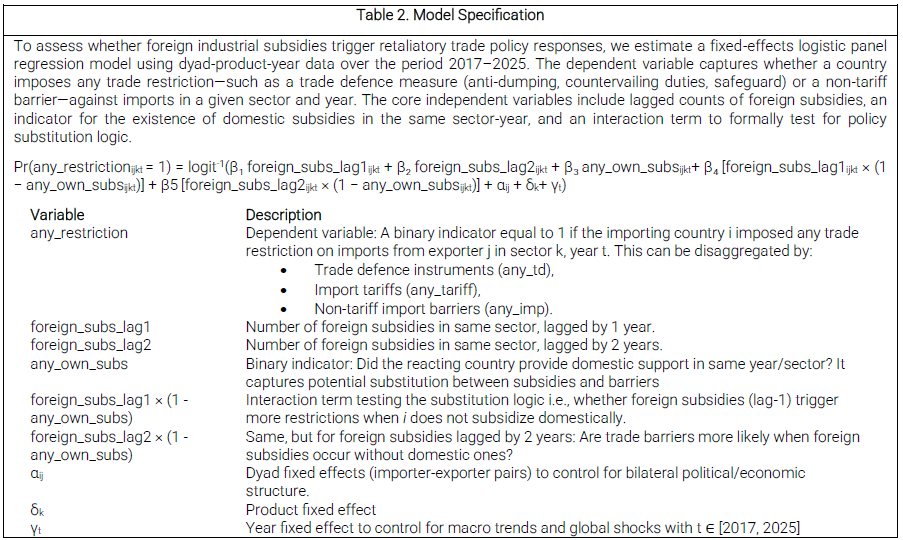
A key question in understanding industrial policy spillovers is whether defensive trade instruments deployed by G20 members act as substitutes for, or reinforcements to, domestic subsidies. This section examines that question, focusing on whether domestic support influences the likelihood of imposing trade defence measures after a partner’s subsidy. Annex 1 details the model specification, while Table 1 summarises the regression results.
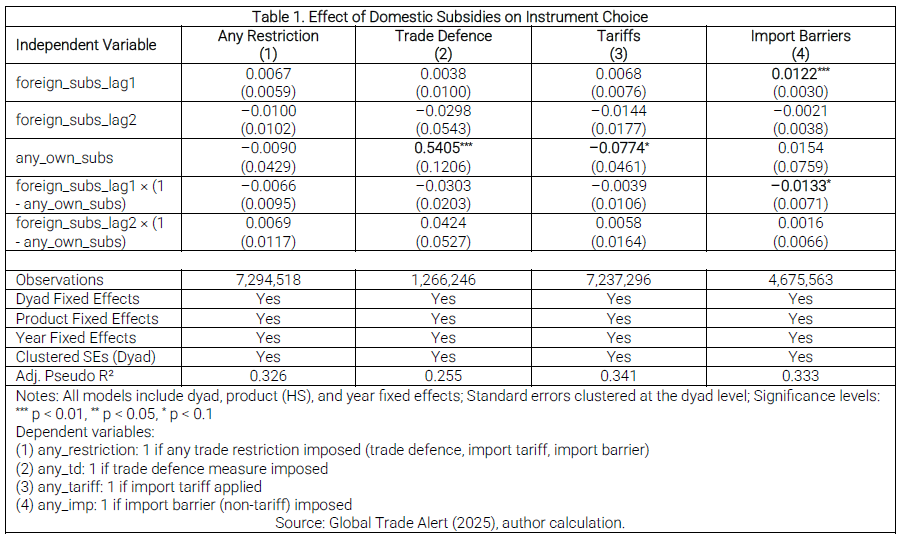
Import barriers are the only policy instrument that exhibit a positive and statistically significant retaliatory response, and this response typically occurs within the first year after a subsidy. In our estimates, the coefficient on foreign_subs_lag1 is positive and significant only for import barriers (Column 4), implying that a one-unit increase in lagged foreign subsidies increases the likelihood of imposing these measures. Governments tend to reach for administrative or opaque restrictions rather than formal trade defence actions or tariffs when reacting promptly to subsidised foreign competition. By contrast, foreign_subs_lag2 is negative and insignificant, indicating little evidence of delayed retaliation beyond the first year.
Domestic subsidies significantly increase the likelihood of trade defence filings (Column 2) but reduce the probability of tariffs. This asymmetry suggests that governments already supporting a sector are more inclined to initiate trade defence investigations — reinforcing protection — while being less likely to impose tariffs. Trade defence is closely tied to domestic subsidies rather than foreign ones, operating more as a complementary tool than as a direct retaliatory measure.
The interaction term foreign_subs_lag1 × (1 − any_own_subs) is negative and weakly significant for import barriers, implying that countries without domestic subsidies are more likely to impose them — consistent with substitution logic. No similar interaction effects appear for trade defence or tariffs. Overall, import barriers are the only instrument showing both retaliation and substitution tendencies, especially when governments are not subsidising the same sector. Tariffs show a weak substitution signal, but the evidence is limited.
Retaliation is selective, and instrument choice depends on whether the government is subsidising the sector at home. When there are no domestic subsidies, governments are more likely to use import barriers, which can be imposed quickly and with limited transparency.
For businesses, these patterns raise compliance uncertainty: sudden, opaque barriers can appear with little recourse — putting unsubsidised sectors at greater risk while shielding subsidised ones. The speed and selectivity of responses drive up market-access costs and complexity, making proactive policy monitoring and adaptable supply chains essential.
Fernando Martín is an Associate Director at the Global Trade Alert leading the Analytics team.