
PM Takaichi has revived explicit state-led industrial strategy in Japan. Her Cabinet designated new priority sectors in November 2025 which will receive enhanced government support. Since then, nuclear energy, semiconductors and AI have been subject to the largest concrete efforts. This shift comes at the expense of green transformation programmes and broad-based support for SMEs. The rulebook for channelling resources to the remaining sectors is already being written.
Authors
Fiama Angeles
Date Published
28 Apr 2026
Japan’s five most recent PMs share a party but not an economic philosophy. Shinzo Abe, in office from 2012 to 2020, launched Abenomics, a monetary easing and fiscal stimulus programme. His industrial policy centred on horizontal tax cuts, innovation incentives, and trade liberalisation. Sectors were targeted, but through removing regulatory barriers rather than directing state investment. Yoshihide Suga, PM from September 2020 to October 2021, explicitly continued Abe’s policies. In contrast, Fumio Kishida, in office from October 2021 to October 2024, coined the New Capitalism. His agenda centred on redistribution, wage growth, and green and digital investment. Shigeru Ishiba succeeded him in October 2024 and largely continued that framework, adding emphasis on regional revitalisation and SMEs. Sanae Takaichi, who took office in November 2025, reclaimed Abenomics but has recast its approach. Unlike Abe, she revived an explicit state-led industrial strategy through her Growth Strategy Headquarters, established in late 2025. This body designated 17 strategic sectors for concentrated government investment, including AI, semiconductors, quantum computing, shipbuilding, nuclear fusion, and defence.
To gauge the recent direction and nature of change, we compare the financial support measures implemented under Ishiba and Takaichi. Coincidentally, each leader oversaw two sets of annual budget programmes or amendments so far. Two fall under Ishiba: the FY2024 supplementary budget and the FY2025 main budget. Two fall under Takaichi: the FY2025 supplementary budget and the FY2026 main budget.
A Narrower Toolkit, Bigger Bets
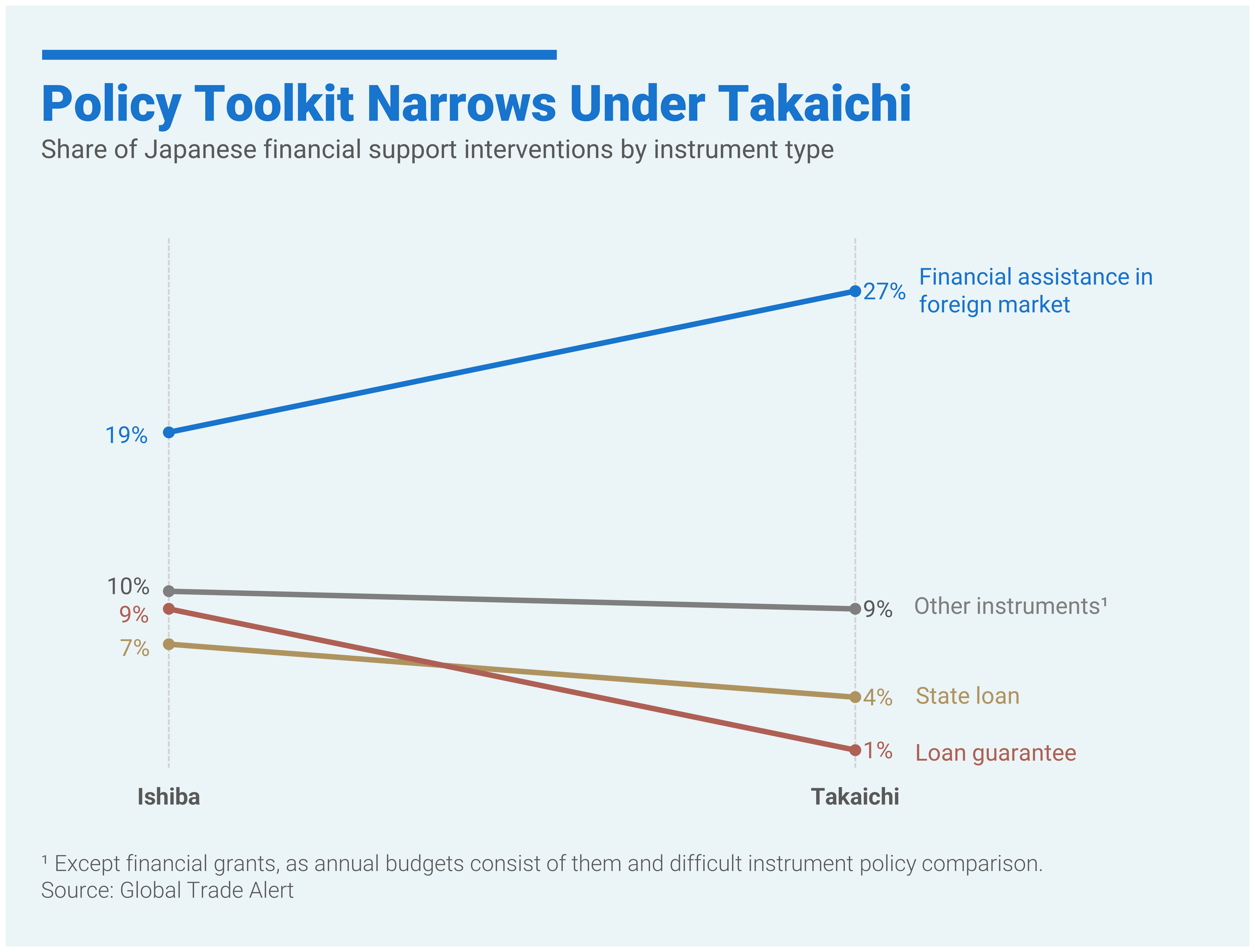
The policy toolkit has become more concentrated and hands-on. Comparing the policy mix of Q1 2025 against Q1 2026 illustrates this shift. Q1 is a useful benchmark since it sidesteps the fiscal budgets announced every year in December. In Q1 2025, GTA data shows that Ishiba announced five guarantees and seven loans. These instruments are much less prominent in Q1 under Takaichi, who provided only two guarantees and one loan. Conversely, Takaichi implemented 12 overseas financial support measures, compared to 9 under Ishiba. Whether this concentration reflects a deliberate choice or simply an early-stage pattern remains to be seen.
Takaichi's approach favours large-scale support for selected companies. The share of measures targeting SMEs fell from 26% in Q1 2025 to 9% in Q1 2026. Firm-specific support jumped from 62% to 86% in the same period. The scale of individual transactions reinforces this pattern. Deal sizes at the Japan Bank for International Cooperation (JBIC), for example, have grown dramatically in recent months. Recent examples include the USD 3.7 billion to Nippon Steel Corporation and USD 2.4 billion to Mitsubishi Corporation, both for acquiring large US companies. By comparison, the largest JBIC deal under Ishiba was USD 1.8 billion to Abu Dhabi National Oil Company for securing oil imports.
Nuclear, Semiconductors and AI Take Centre Stage While Green Transformation Loses Ground
Nuclear energy is back at the centre of Japan’s economic strategy. What began as a subsidiary component of the green transformation (GX) agenda under Ishiba has become a priority under Takaichi, with nuclear fusion now designated one of the 17 strategic sectors. Funding exemplifies best this trajectory: Nuclear funding rose from USD 37 million in 2024 to USD 64 million in FY2025, spread across supply chain and reactor programmes. FY2026 increased it to USD 791 million under the consolidated “Next-Generation Innovative Reactor Technology Development and Industrial Infrastructure Strengthening Support” programme.
AI and semiconductors follow a similar path. Under Ishiba, these sectors already received considerable support. However, the USD 2.5 billion “Multimodal Foundation Model Development for AI Robotics and Physical AI” is the single largest programme in the FY2026 budget. An equity support programme for mass production of next-generation semiconductors also saw its budget increased by 50% in FY 2026, up to USD 945 million.
The increased financial support for these strategic sectors is coming at the expense of green transformation. Japan's GX initiative, launched under Kishida in 2023, persists as an institutional structure. Yet Takaichi has reoriented its emphasis and importance. Beyond nuclear fusion, no specific energy source is designated as a priority sector. Renewables, hydrogen, and other clean energy technologies are subsumed under the broader “Resources, Energy Security, and GX” category. GX programmes still appear across the FY2026 budget, but with diminished standing. The GX Promotion Organisation loan guarantee facility, for instance, saw its budget cut by 71%, in 2026. Other GX programmes for supply chains and startups were cut substantially or discontinued altogether.
Back to the Future
Takaichi’s industrial strategy marks a deliberate return to state-led sector selection. The 17 priority sectors, the scale of individual support packages, and the narrowing of the toolkit all confirm a government willing to pick winners. Nuclear energy, semiconductors and AI have emerged as the first beneficiaries, absorbing the bulk of new funding. Green transformation has been subordinated to competitiveness objectives. The rulebook for channelling support to the remaining priority sectors is already being written. Whether concentrated bets on frontier technologies deliver the growth that broad-based support could not remains the defining question of Sanaenomics.
Fiama Angeles is a Senior Trade Policy Analyst at the Global Trade Alert.