
New Converts: The Return of Discriminatory Public Procurement
ZEITGEIST SERIES BRIEFING #87


ZEITGEIST SERIES BRIEFING #87
Fiama Angeles
19 Mar 2026

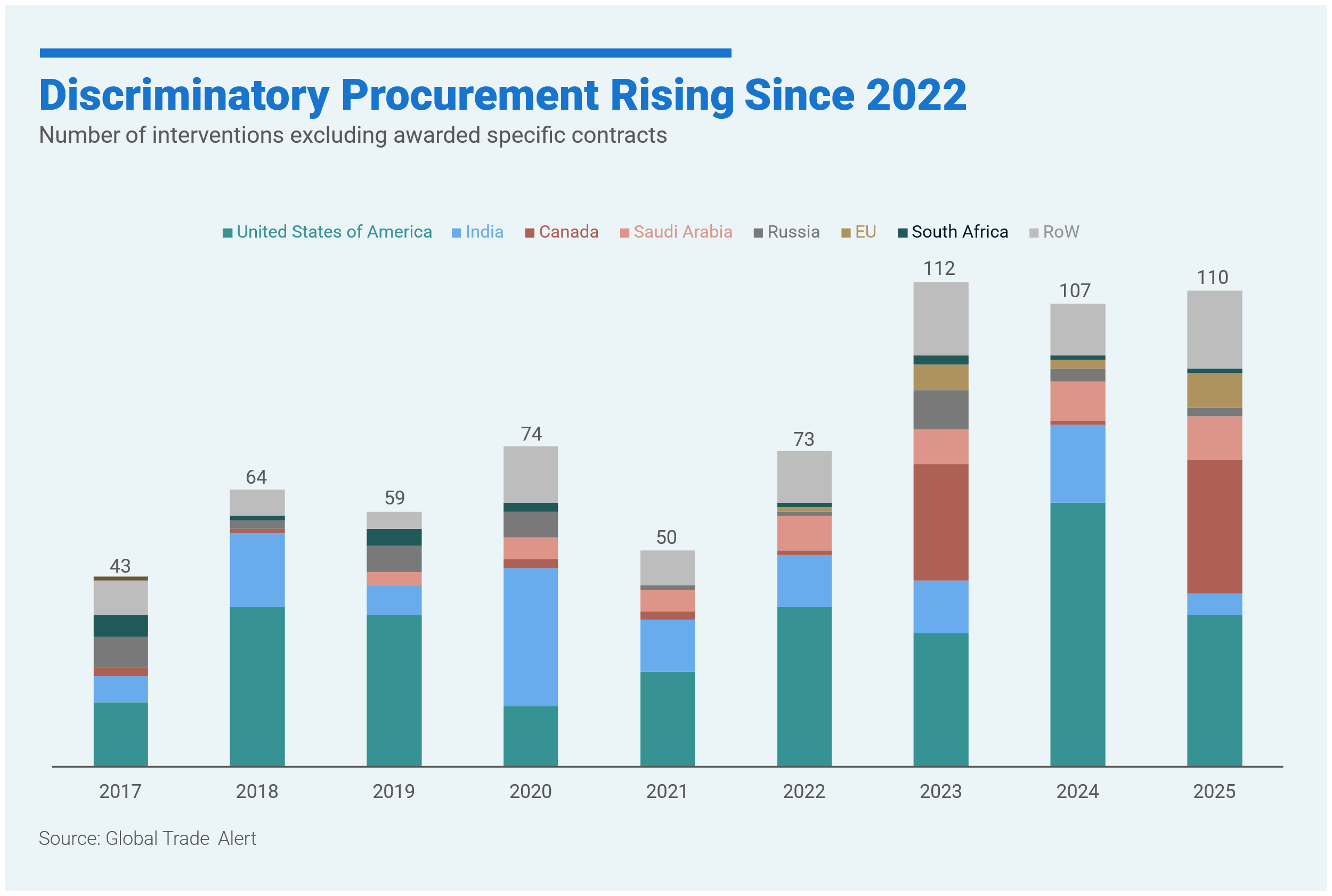
Since 2022, governments have been reviving an old tool: discriminatory public procurement. The Global Trade Alert (GTA) has recorded 633 such interventions between 2017 and 2025[1], with 58% recorded in the last four years alone. Figure 1 shows this acceleration. From 2017 to 2021, annual interventions averaged 60, apart from a spike in 2020 driven by vaccine procurement during the COVID-19 pandemic. Then the numbers climbed sharply, peaking at 112 in 2023.
The US and India have historically led the use of discriminatory public procurement tools. Their approaches differ in design but share the same goal: favouring domestic suppliers. The United States' Build America, Buy America (BABA) of 2021 partly explains the ramp-up seen in Figure 1. The Act required that all iron, steel, manufactured products, and construction materials be produced domestically. India operates through its Public Procurement Order of 2017. The policy establishes two classes of suppliers, each with a minimum local content threshold. It grants a 20% margin preference to the class with higher local content. New Delhi issued this framework to promote manufacturing under the "Make in India" initiative.
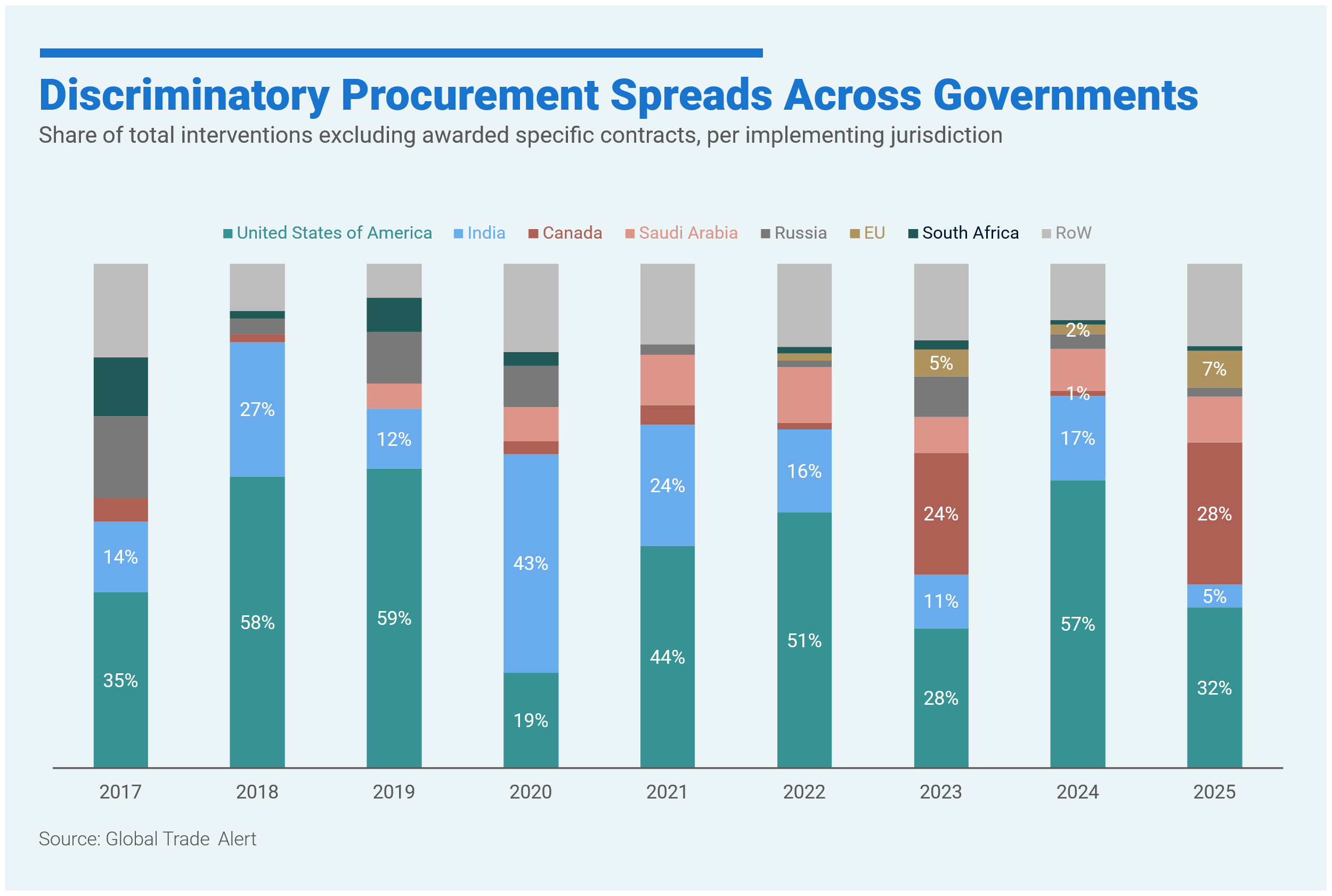
But 2023 and 2025 marked a shift. As Figure 2 shows, the US share of all discriminatory public procurement measures dropped to 32% in 2025. India’s contribution also fell to 5%. And new actors appeared: Canada jumped to 28% and the EU to 7%. Their emergence as major users is among the most consequential developments in this shift. Both were founding parties to the WTO Government Procurement Agreement, which, since 1996, has required signatories to extend national treatment to foreign suppliers[2]. For decades, they promoted the Agreement’s principles in trade negotiations.
Canada's moves last year marked a meaningful departure. Ottawa's Interim Policy on Reciprocal Procurement was framed as direct retaliation against US tariffs. Minister Lightbound did not dress it up: the measure would "leverage our purchasing power" against "unjustified American tariffs." By December 2025, Canada had formalised a permanent Buy Canadian Policy, giving domestic suppliers a 10% price advantage, up to 25% of evaluation points for Canadian content, and mandatory domestic-content rules for steel, wood, and aluminium.
Brussels' shift was slower but no less significant. The International Procurement Instrument had existed since 2022. This is the EU's tool for restricting procurement access to non-reciprocal trading partners. Yet it sat unused for three years. Its June 2025 deployment for excluding Chinese medical device companies from contracts above EUR 5 million marked a clean break with years of hesitation. The permanent shift is best exemplified by the EU's embrace of "Buy European," a centrepiece of the Industrial Accelerator Act and upcoming Public Procurement Act.
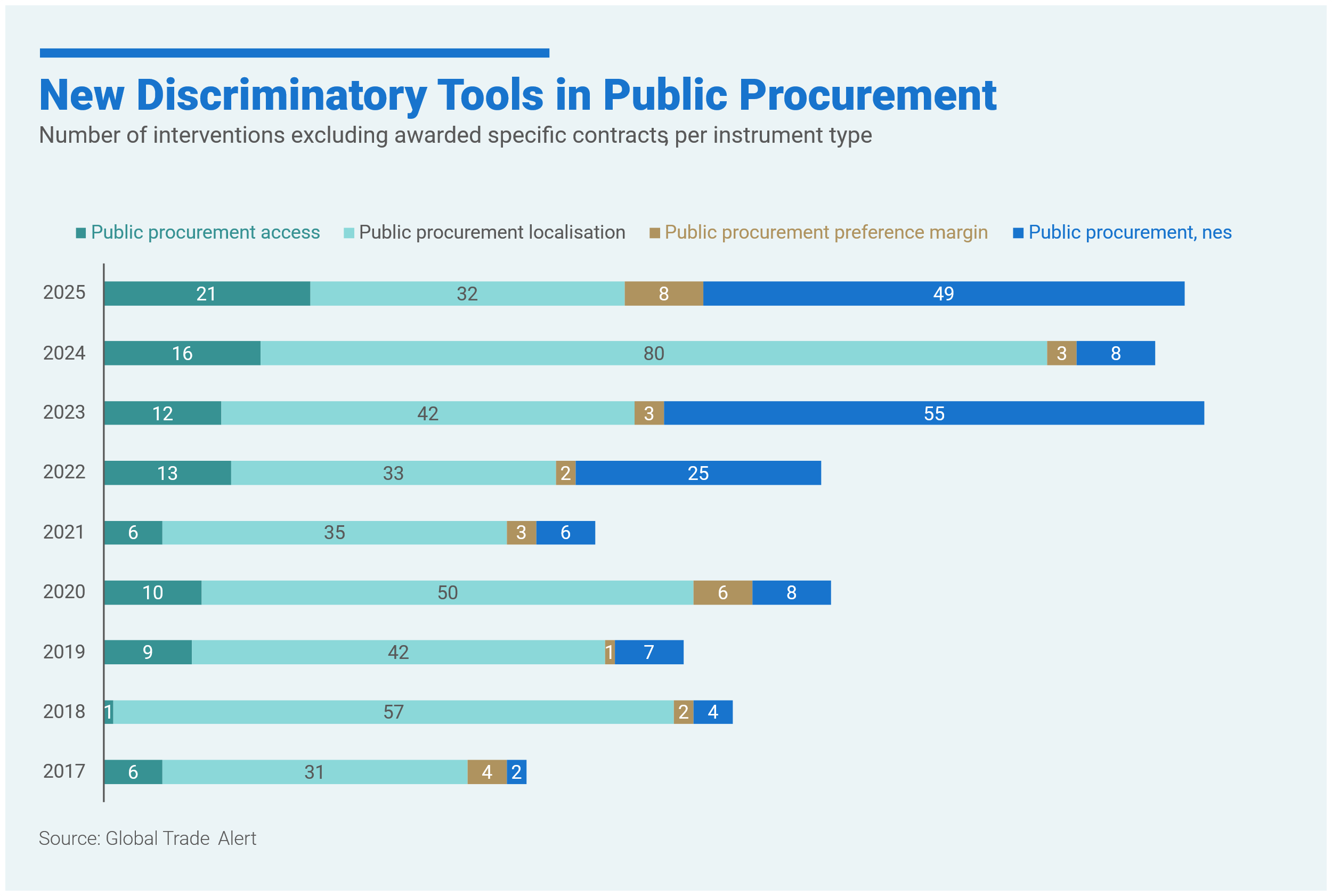
Traditional localisation requirements are losing ground to other forms of discrimination in public procurement. Figure 3 shows that procurement access restrictions, which limit foreign firms' entry to procurement bids, have surged since 2023. Measures under the "nes (not elsewhere specified)" category are also on the rise.
The "nes" category captures increasingly diverse forms of protectionism in public procurement. It includes procurement contracts structured as financial support for domestic industrial capacity, and outright bans on foreign products or services in government systems. Such measures now appear across far more sectors than traditional tools ever covered. Governments have used procurement as industrial support before. During the COVID-19 pandemic, they acted as anchor consumers for vaccine development (visible in Figure 1's 2020 spike). Most recently, the United States deployed these contracts in the critical minerals sector. On the bans side, multiple jurisdictions prohibited DeepSeek from government devices in 2025, echoing similar TikTok bans from 2023.
These instruments share a common logic: procurement as leverage. Governments are no longer just buying goods and services; they are using purchasing power to reshape supply chains and react to trading partners. The explicit justifications vary by jurisdiction, but reciprocity and economic security overshadow the rest. The EU, for instance, framed its exclusion of Chinese medical device suppliers as a response to discriminatory practices. Canada was even blunter, stating the policy would counter "unjustified American tariffs". They both cast procurement restrictions as retaliation for asymmetric market access. The United States, meanwhile, justifies its use of procurement contracts in the critical minerals sector through national security, citing the imperative to reduce dependence on foreign suppliers.
Each justification is framed as defensive, i.e. a response to others' protectionism. History shows such framing creates self-reinforcing spirals of retaliation[3]. Expect more countries to adopt these tools, along with their variants, as each new restriction invites the next.
Fiama Angeles is a Senior Trade Policy Analyst at the Global Trade Alert.
The number of interventions excludes contracts awarded to specific companies or for specific public procurement projects.
The agreement, however, permitted carve-outs for specific entities, sectors, and below-threshold contracts.
The archetype being the Smoot-Hawley Tariff Act of 1930, which triggered retaliatory tariffs from major US trading partners. More recent examples include the municipal Buy Canadian policies enacted in response to the 2009 Buy American provisions, and the early 2025 reciprocal tariff escalation between China and the United States.